
Free book for boys and reluctant readers
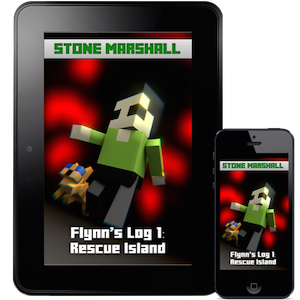
Flynn’s Log is free on the following devices
Choose your device
KindleiPad/iPod/iPhoneGoogle Play (Android Tablets)nookkoboRead Online
US$8.99 Paperback
Get Reluctant Reader Book News from Stone Marshall
Reading is important
Any book that helps a child to form a habit of reading, to make reading one of his deep and continuing needs, is good for him. –Maya Angelou
Most adults would agree that reading is important, but many kids detest reading. Video games, devices, and TV are preferred entertainment and escape. They provide instant gratification. Reading takes time. For some kids, reading isn’t engaging.
I had this same problem with my son, so I solved the problem.
The classic stories I remember enjoying as a kid don’t interest my son and his immediate attention span. If he doesn’t enjoy the story from page one, he will not read further.
So how did I get my son to read?
I showed him how much fun it is to get sucked into a story.
Your book is amazing I can’t stop reading it – Joseph Young via twitter
Contemporary and Classic titles alike don’t interest many kids. Don’t worry, the love of reading is learned. We need a starting point. We need that one book that is just as engaging on the first read as the fifth, just like a really great movie that kids want to see again and again. A positive association with reading will make kids want to read more.
A love of reading is cited as the number one indicator of future success. My son didn’t have the desire to read. He didn’t care about the books I chose to read to him, and was overwhelmed with the selection at the library. I want my son to succeed, so I had to do something. Since we struggled to find books he cared to read, I wrote one. An epic saga about the things he loves. I put it in a world he loves and addressed the issues he faces in his life.
I just love your books I’ve been reading them over and over again. -Carson via twitter
But it’s a video game book
Don’t worry; it’s not a book about video games, nor is it a game strategy book. Flynn’s Log is a hero’s journey that takes place inside the Minecraft world that today’s kids know and love. The protagonist, Flynn, naturally flows through Maslow’s hierarchy of needs (builds shelter and tools, learns what to eat and discovers a digital friend) and faces questions about his destiny. He learns important life lessons about friendship, integrity, and trust. Flynn’s Log is good for kids without being boring.
Thank you so so much for the free ebook. My son loves Minecraft now with this book I can get him to read to me. – Jennifer Wilkins
Start your son or daughter on journey today, reading Flynn’s Log 1: Rescue Island. Free on available these devices and apps.
Flynn’s Log is free on the following devices
Choose your device
KindleiPad/iPod/iPhoneGoogle Play (Android Tablets)nookkoboRead Online
US$8.99 Paperback
Why is Flynn’s Log 1 Free?
My son loves reading — finally. If you have experience with a reluctant reader then I know your pain and I want to help. I’ve seen thousands of kids transform with this book. My readers, who don’t usually read books during the summer, couldn’t put Flynn’s Log 1 down.
Good book I thought I would never read a book on my summer but I feel I’m gonna finish it soon – Multigamer 47 via twitter
Let this book change your kid’s life too. You have nothing to lose and an avid reader to gain.
Once you learn to read, you will be forever free.
–Frederick Douglas
I am giving away Flynn’s Log 1 free because I want to give you a risk-free way to hook your reluctant reader.
Please and I mean PLEASE, WRITE MORE! I absolutely love it! They’re outstanding books.
-Devon123321 via twitter
What are Books for Boys?
I spend lots of time with teachers and parents. I hear parents ask, “How do I get my son to read? Do you have books for boys?”
I wrote the Flynn’s Log series for my son, and this book is interesting for boys. However, the series is a non-stop read for both boys and girls, especially those who are interested in Minecraft.
The more that you read, the more things you will know. The more that you learn, the more places you’ll go.
—Dr. Seuss
What are you waiting for?
You have nothing to lose!
Flynn’s Log is free on the following devices
Choose your device
KindleiPad/iPod/iPhoneGoogle Play (Android Tablets)nookkoboRead Online
US$8.99 Paperback
News for Parents of Reluctant Readers
Get Reluctant Reader Book News from Stone Marshall
Help children grow a love of reading with these tips
 Let’s face it, reading affects every area of our lives. If kids struggle with reading, it is highly likely they will struggle in other areas of their academic life too. Parents can influence kids to form better reading habits and help them become better readers. Check out these five tips to inspire your kids to love reading:
READ WITH YOUR KIDS: Parent involvement is the No. 1 predictor of early childhood reading success and future academic achievement. Kids learn from parental modeling. Starting a daily reading ritual for pre-kindergarten kids is vital for developing a child’s love for reading. Kids who own 100 or more books tend to be more ready to tackle academic challenges. Using books with popouts help stimulate imagination and make reading fun.
Before getting started, read the title and ask your child to make a prediction of what the story is about. Point to words and pictures as you read to helps kids make the correlation between the story and the illustrations. Read with enthusiasm and energy by changing pitch and intonation to punctuate the story and character’s voice.
Follow up each story by asking questions to ensure they understood the story and can relate it to another story or personal experience. The love of reading is partially developed by relating stories to real life.
SET TECHNOLOGY LIMITS: Set a predetermined amount of time for kids to plug in to technology (including TV) each day. Replace TV and gaming time with daily reading rituals by scheduling reading time for your kids each day. Reading on an e-reader is good, but be sure kids have an appreciation for traditional books too. Shared reading time with the family as well as individual reading time reinforces good reading habits. Reading with good comprehension sets kids up for success in all of their other subjects like social studies, math and science.
HELP KIDS CREATE A READING LIST: It’s important to keep your child’s reading level in mind when helping him choose a good book to read. Use your intuition when asking him questions about what he wants to learn about, who he’d like to meet or what he wants to be when he grows up. All of these things make a good list of things to read about.
For infants and toddlers, choose books with bright colorful pictures and familiar objects. Cardboard or washable fabrics prevent little hands from getting too excited and ripping pages. Books that appeal to their senses and explore different textures will be fast favorites. Poems and rhymes are fun for parents to recite over and over again.
Preschoolers love illustrations that are colorful and engaging. Short stories that have simple plots and actions to follow will hold their short attention spans. Stories that are about everyday life can help them explore their world and stories about how things work will help them learn new concepts. Characters that are about the same as age as your child will help him relate to the character and take an interest in the storyline.
Choosing books for young readers, up to age 11, take on a new dimension. They enjoy stories that take several days to read.
They also like to read more in-depth versions of their childhood favorites. They still enjoy illustrations and photos, especially in how-to books. By this time, your child may have developed favorite authors, so reading other books in a series by the same author is a good strategy.
Adolescents like to read books with characters that are facing similar teen related challenges in their lives. Novels that take them to faraway places and times can foster their love for science fiction or history. Biographies, folk tales and mythology can be good options too.
SET CONTENT GUIDELINES: It is totally fitting for parents to monitor what their kids read. Just like television and movies, it is reasonable to consider that parents wouldn’t want their kids to engage in books with vulgar language, sex, violence or drugs. It is also important to only allow kids to read material that is age appropriate.
SCREEN FOR LEARNING DISABILITIES LIKE DYSLEXIA: Kids who don’t like to read typically don’t have good reading skills. This could be because reading wasn’t part of their early childhood experience, therefore, they don’t appreciate the value reading could have in their lives. It is important for parents to delve deeper into the reasons their kids don’t like to read. If kids find reading boring, it could be that they only read school assignments that don’t tap into their interests. Finding books that are more in alignment with their hobbies or interest might help them enjoy reading more.
Some kids find reading difficult or tedious. That could be related to how they learned to read. Check in with his teacher and see if there are learning disabilities like dyslexia involved or if a tutor could help get them up to speed. Poor reading skills can lead to kids falling behind in school and not liking school. Kids like to know that things are relevant to their lives and some kids haven’t made the correlation between books and real life.
Finding books that tie into their hobbies, interests or aspirations can help improve their interest in reading.
Reading opens up new worlds for kids. Stories can take their imaginations to foreign lands and spark an interest in travel, culture and adventure. Reading biographies can provide positive role models and inspire kids to excel in sports, academics and service. Give your kids the gift of reading by making it fun and exciting.
Guys Read program reminds boys it’s cool to read
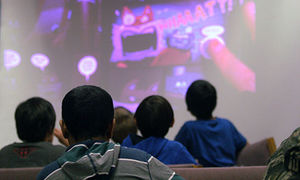 FAIRBANKS — Cool guys read. If anyone claims differently, ask for a footnote.
Longtime Fairbanks resident Greg Hill is one of the coolest guys, and he’s on a mission to invite every boy attending school in Fairbanks North Star Borough to join the club. Hill, who before retirement was the executive director of Noel Wien Public Library, is the creator and coordinator of Guys Read — a program that aims to get fourth-grade boys interested in reading.
Hill works with men from all around the borough, each of whom has his own set of interests and talents, to come serve as reading role models to fourth-grade students.
From radio hosts to engineers, from firefighters to social media curators and from current high school star athletes to police chiefs, Guys Read connects these volunteers with schools to show students that adults with some of the best and most interesting jobs available think reading still is in vogue.
Adult readers volunteer their lunch hour for several days over a three week period, during which time they visit one of the borough’s public elementary schools and read an engaging age-appropriate book to the fourth-grade students. The books usually take the form of comic books or heavily illustrated novels — something that can engage students both through the narration of their reading travel guide and the pictures projected on a nearby wall.
Students gather in a library or common room, where they get the dinner-and-a-show treatment, eating their lunches while taking in the story read by their volunteers.
Explaining the purpose of using comic books and illustrated books for the program, Hill references British author Neil Gaiman, who once referred, as others have, to comic books and fiction in general as a gateway drug to literacy.
Students, economically boys disadvantaged in particular, often lose interest and fall behind the reading curve in fourth grade. It’s a phenomenon so well researched it even has its own monicker: “the fourth-grade slump.” So Hill’s program focuses its efforts there, at that integral point of reading interest.
Guys Read runs for one three-week period each school year. This year’s iteration, the program’s ninth, wrapped up on Friday.
Steve Dutra, the chief at North Pole Police Department, volunteered with Guys Read for the first time this year. He says he hasn’t specifically asked the boys what they think about the reading, but their enjoyment is obvious from they way they get engaged.
At home, Dutra reads to his daughter, in fourth grade, and his son, in fifth grade.
“I wasn’t much of a reader as a kid, and I have absolute passion about my children reading,” he said. “We read every night. That’s kind of our time together.”
Dutra’s son just barely missed the chance to experience the Guys Read program with his father as one of the readers, but that’s OK, Dutra said, because his son gets to read with him every night already.
Since Guys Read Alaska first began nine years ago, it has expanded to other Alaska regions outside the Interior, spawning programs in Barrow, Nome and elsewhere.
A good read for parents raising boys
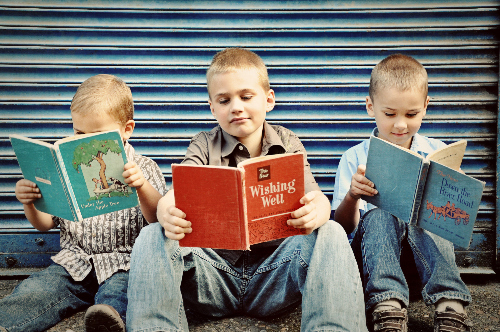
Sometime in the mid-1960s, I began to take an interest in boys. However, the boys in my class did not reciprocate that interest.
I complained to my mother about this deficit in the male of the species. She assured me things would pick up eventually. “Boys,” Mom said, “take longer to mature than girls.” I expect I rolled my eyes.
Last month, my local children’s librarian (a mature boy) introduced me to the book “Raising Boy Readers,” with more than 300 recommended boy-friendly books, by Michael Sullivan.
I have to give Mom points. Somehow, without ever having read a single scientific study, she understood the truth about the differences in the maturity rates between boys and girls.
But the science behind the facts, as revealed by Sullivan, is both compelling and enlightening.
Did you know that, on average, girls’ brains reach their full adult size by age 11? But boys’ brains achieve this growth around age 14. (page 2).
Sullivan calls this phenomenon “brain-lag.” This brain-lag is responsible for the gaps in verbal and written language skills often seen between girls and boys.
Boys catch up to girls eventually, but not until they are 15 years old. Sullivan writes “It isn’t that boys don’t read as well as girls; they simply read at a different time ”
The chances are then that, whatever standardized tests may indicate, most fourth-grade boys aren’t behind in their truly appropriate reading levels, just in that pseudo-appropriate reading level set by the powers that be.
What a relief! Still, the pseudo-level (and resulting bogus grade) may leave boys discouraged and turned off to reading.
This is an outcome adults can change, according to Sullivan, by giving boys reading-for-pleasure time.
In “Raising Boy Readers,” Sullivan lists 300 books from which to choose.
Get Sullivan’s book. Or ask your own children’s librarians for suggestions. They would love to help you. Sometimes they’re even boys.
‘JUST MINE AND CRAFT’: Newark Library’s new Minecraft Club draws enthusiasts
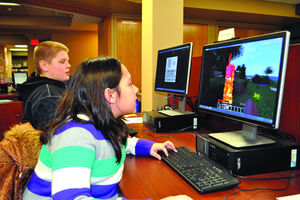
NEWARK — If you have a child (especially a boy), you likely know what Minecraft is.
This computer game is all the rage among the younger set. Played on multiple platforms (computers, Xbox, Kindle, iPad, PlayStation, etc.), the game allows players to build three-dimensional buildings and worlds from textured cubes. Players can explore, craft, fight and gather resources in the game. Think of it as advanced Legos in the computer age.
And now local Minecraft fans can meet once a month at the Newark Library to share their passion.
Youth Services Director Krystina Hardter launched the club last Tuesday evening. She did so because she’s seen firsthand in the library how popular the game is. Young patrons ask for Minecraft books, but the shelf where the series is kept is often empty.
“They just fly off the shelves,” she said. “We just know how kids are obsessed with it. They love it — the creating, the survival, the building.”
Hardter had set aside a table with Minecraft coloring sheets and instructions on how to make three-dimensional paper Minecraft figures, but the four young patrons who braved the snow last week were more intent on getting on the computers and playing the game itself.
Since some of them had played on different platforms, there was a learning curve as they started building on the computer. Questions flew as the young library patrons started clicking away with their computer mice.
“How do you eat?” “How do you build a ladder?” “How do you make a door?” were among the queries being traded.
Anthony Merced, 7, was in the water and afraid he would drown. He asked his classmate Ryan Hinks, also 7, what to do.
“Press the space button to float,” Ryan answered.
The Newark youngster has been playing Minecraft since he was 6, usually on his Kindle tablet. He was a little distracted to explain the game in depth, especially to an obviously clueless questioner.
“It’s very, very complicated to explain. You just mine and then you craft,” said Ryan, noting everyone in his family plays except his parents. His mother, he added, has said she might have to learn just to be able to interact with her children.
Ryan said he’s hooked because “you can craft and be creative about it. It’s a real world that you are building.”
As the children pressed their faces close to the screens and talked to both the computers and each other, Hardter and Youth Services Librarian Caitlin Simonse mingled about. They helped as they could and asked plenty of questions.
Hardter said one of the reasons she started the club was because “I wanted to learn from them what the big deal is.”
“I’m impressed with how quickly they are building houses and things,” she said, noting when she tried the game all she was able to accomplish was chasing some bunnies and cutting grass. “I’m kind of understanding the concept … kind of.”
Blake Aldrich, 11, said he has been playing Minecraft “a long time now” and called it his favorite game.
As Hardter complimented his work, she wondered why his house was built underground.
“It’s most common for houses to be built underground because it’s safest,” Aldrich said.
“Who do you need to be safe from?” Hardter asked.
“Zombies, creepers, and skeletons,” the kids answered.
Despite asking the others, Blake still had trouble constructing a ladder. Hardter pulled out her phone, loaded up a YouTube video and showed him how.
Meeting kids where they are at — in the library — is certainly a goal of hers.
“My hope is to start them younger and build their love for the library so by the time they get to the high school it’s still cool,” Hardter said.
Toy Fair 2015: Funko Movies – Harry Potter, The Matrix, Frozen, More
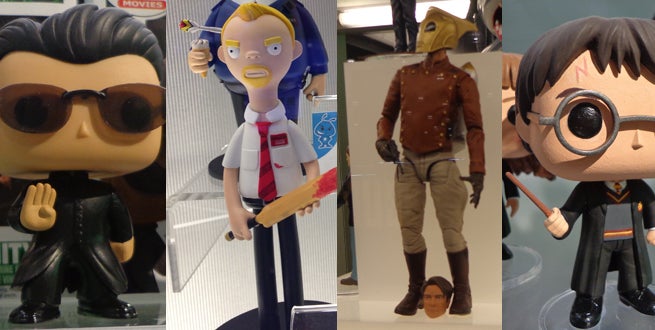
We’ve looked at Funko’s Marvel lineup, and the TV series they’re covering in 2015. Now, it’s time to go to the big screen with a day at the movies.
We won’t repeat the Age of Ultron figures already featured in the Marvel gallery – click the link above to see those – because there are more than enough other images to show you without them.
Frozen is still a juggernaut for Disney, and a Funko rep told me at the show that it “has surprised even us, with how strong all these continue to sell.” Of course, that means there’s a second wave of Frozen POP Vinyls coming, plus the just-debuted mini blind-box vinyls. Funko also told us there are “other waves in development,” and that likely, though they couldn’t confirm, includes figures specifically based off the looks in the new short, Frozen Fever, premiering in front of the new live-action Cinderella (which also gets its first two POP figures, Cinderella and Gus Gus in the glass slipper.

If that cuteness isn’t enough for you, we’ll stop burying the lede here: Harry Potter Vinyls are coming. The ones on display were hand-painted prototypes, something Funko doesn’t usually show the public, let alone allow people to take pictures of, but the company was so excited to announce the new line that they went for it at the show. The first series features the obvious characters: Harry, Ron, Hermione, an over-sized Hagrid, and Professors Dumbledore and Snape. Funko also promised that yes, they have “many” waves of these figures on the way. “Now that we have the license, we’re going to make a lot of these, if I had to guess,” a rep told me.
Pixar’s Inside Out and Cars get their own lines this year. Disney’s Tomorrowland gets not just POP Vinyls, but also the “Reaction” figure line. Those figures are designed, built, and packaged similarly to the classic Kenner action figures, and this property is one of the first new lines in that brand.
The Matrix and the Universal Monsters, plus Domo-style Ghostbuster round out the POP! Vinyl lineup for movies for 2015. There will be new Minions based on their summer film, but no pictures were allowed of those just yet.
Other Reaction figures include Star Trek and Fifth Element. The new Vinyl Idolz line is almost entirely film-focused, with Ghostbusters, Back to the Future, and two thirds of the “Coronetto Trilogy,” Hot Fuzz and Shaun of the Dead all in action.
Finally, the amazing Rocketeer legacy figure shows off Funko’s high-end current action figure chops.
Check out the gallery of film-focused Funko fun here, and start your Funko Fund now!
Kids take off on break with books in their heads
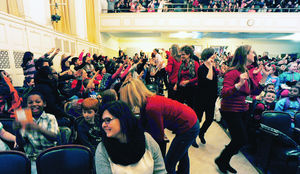
HUDSON — Children in the Hudson Intermediate School were facing a daunting prospect: a whole week without teacher’s dirty looks. How to prepare them for this deprivation?
The school has nothing if not a collective, wildly creative imagination, and to ease their children into nine days of domestic isolation, the powers-that-be devised the M.C. Smith Read-A-Thon.
The event was organized by literacy teacher Lisa Dolan and fifth-grade teacher Lynn Clark, organizing genii of the first order: Not only did the Read-A-Thon get kids off on the right foot for vacation, it also raised $6,000 for the book festival.
“We always have a Read-A-Thon the last day before vacation,” said Principal Mark Brenneman. “It’s the 100th day of the school year.” After an inspiring assembly, the kids read books all day long.
Focusing on literacy the day before the break, Brenneman believes, “increases the chances they’ll read over the coming week.”
Of course, there are kids who stare out the window or twiddle their thumbs? Not a chance, according to Brenneman.
“The kids love it,” he said. “If you put high-interest texts in front of kids, they’re going to read it and enjoy it. I incessantly read sports books.” Now the kids read “Stella Bats” books, or “Happily Ever After” books, he said.
“The kids love them. The authors come here, and they treat them like rock stars. It’s a testament to the hard work of our staff to get the kids to raise their literacy,” Brenneman said.
The Read-A-Thon also has a more concrete, quickly achievable goal.
“It’s our fundraiser for the book festival,” he said. “The kids have pledge sheets, and people pledge for them to read all day. The money raised supports the book festival.”
The Hudson Children’s Book Festival, created and developed by Dolan and other HCSD staff, is the largest such festival in New York state. It gets no tax support, so it depends on donations and fundraising.
So where did all the books the kids read Friday come from?
One student, Malachi, brought in the biggest book in his class, a book of Grimm’s fairy tales, and he said he’d be reading that all day. His favorite is “Hansel and Gretel.”
But for those who didn’t bring in a book or two, “we have the books,” Brenneman said. There are lots in the classrooms, and Dolan’s classroom has books as far as the eye can see.
“Fifty kids a day come down to Lisa’s room (for books),” he said. “We’re constantly getting new books, new authors.”
The Read-A-Thon began with the kickoff assembly in the auditorium.
After a welcome by Brenneman, fifth-grade teacher Edgar Acevedo sang “America the Beautiful” accompanied by Americorps’ Alec Butterfield on vocal percussion.
Next, music teacher Gerard Cordato played a jazzy number on the keyboard, followed by the jazz band itself — trombones, trumpets, saxes, clarinets, flutes, snare and bass drums and a djembe.
The band was followed by Americorps’ Laura Engelman, who executed faster-than-the-eye-can-see jump-roping feats; Brenneman was heard to confide in some front-row students that he could have done as well, had he not worn the wrong shoes.
The athletic wonders continued as physical education teacher Karrie Cox’ gymnastics club did astounding feats, walking on their hands, flips, splits, cartwheels, backflips and on beyond the poor vocabulary of the unitiated.
Cox stayed on for the next event, a hip-hop dance with fellow teachers Tani Quinion, Stephanie Curry and Lena Alessi. Each wore one of the letters of the word “READ” on her T-shirt. The number also included inventive solos by students pulled in from the audience.
The finale was a wide-ranging beat-box number by Butterfield that ended with the words, “I want you all to read many books / This is going to be a wonderful Friday / Read books all day.”
A Card Game Designed To Get Kids Off Their Butts

Childhood obesity rates have more than doubled in the past 30 years, no small thanks to increasing numbers of sedentary hours spent watching television or playing video games. Ujinga, a new card game designed by researchers at a top London hospital in collaboration with the Royal College of Art, aims to get kids moving. Whimsically illustrated by artist Tom Jennings, the 56 cards are printed with actions, like “zombie walk,” “robot dance,” “frog jumps,” and “Gangnam style,” which kids have to perform in order to score points in the “Survival of the Silliest.”
While the illustrations on the cards are cute, it’s hard to believe they can rival MarioKart. What will make kids want to jump around while playing an analog card game instead of, say, an Xbox or a Playstation 4, the very games that keep kids on their butts in the first place?
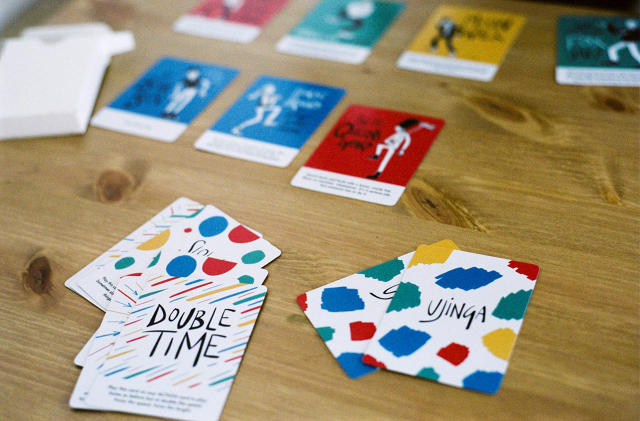
“Our research when designing this game led to two main insights: kids love to be silly, and they love to tell other people what to do,” Ifung Lu, a designer at the HELIX Centre, says. HELIX is an innovation team based within London’s St. Mary’s Hospital, and it was jointly founded by the Royal College of Art and Imperial College. Ujinga gives kids an opportunity to be as bossy and as ridiculous as possible, behaviors often discouraged in classroom settings. “One little girl we tested the game on told us, ‘I love making my friends do stupid things,’” Lu says. For a 5-year-old, the opportunity to boss around 8-year-olds for an hour might be more appealing than watching TV.
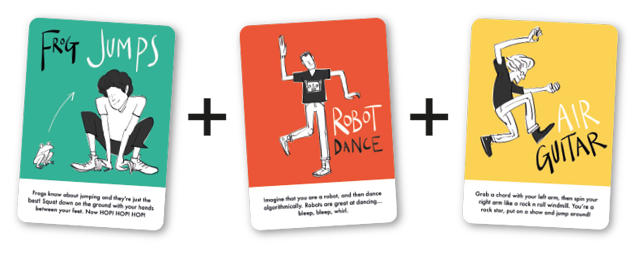
The gameplay is simple: each kid, starting with the youngest, takes a turn being the ringmaster. They draw five action cards and three descriptor cards (i.e., slow motion, double time), and combine them into ridiculous physical comedy routines. The ringmaster tells the other kids what to do based on the cards—for example, frog jumps plus air guitar plus robot dance, all in double time. (Wild cards let players come up with their own activity.) The ring master then rates her friends’ performances, choosing the funniest, the silliest, the fastest, and gives each one cards as rewards. Kids try to one-up another. Then, they move on to the next ringmaster. When the deck runs out, the player with the most reward cards wins. The cards are illustrated in primary colors, with pen-and-ink sketches of characters dancing/hopping/spinning. The style is reminiscent of a children’s picture book.
“Moving is no longer exercise, it’s play,” Lu says. “Kids love the social element of the game.” The team didn’t conduct research on whether playing the game directly affects weight loss. “We don’t want the game to be branded a game for ‘fat kids’—rather, it’s about getting all kids more active,” Lu says.
Ujinga is currently raising funds on Kickstarter, but since the designers’ goal is to get as many kids active as possible, they’re also making the cards free to download and print on their website. “You don’t have to be rich to play this game,” Lu says. “It’s introducing kids to the idea of open-sourcing: they’re co-creating the game, improvising movements.”
Ujinga is currently available for purchase on Kickstarter for $15.
Kids will love the 21st century View-Master (but it made me dizzy)

I may not be the best candidate for a virtual reality demo. My glasses always get in the way, and even straight 3D tends to make me dizzy. None-the-less, I had to try the new View-Master. Well, the new View-Master app, at least. Sadly, the plastic viewer itself is still very early in the production cycle, so there wasn’t a version ready to accept a phone and do a proper demo. But I was able to slot a Nexus into a Google Cardboard set up (stamped with a red View-Master logo) and get an idea of the experience Mattel is planning for October.
Mattel and Google’s View-Master hands-on


My first stop was San Francisco and I wouldn’t be shocked to learn if Mattel simply used Google’s Street View imagery. I was dropped on a corner not far from Fisherman’s Wharf; A green street car was frozen in the intersection. As I looked around, the scenery whizzing by in a 360-degree blur, I noticed an icon floating in the air that looked quite a bit like a View-Master reel. I looked at, pulled down on the shutter, and up popped a text box giving me some historical details on the bay area landmark. If I turned a little bit further, there was a second icon with some compass like markings. When I selected that I was transported a few blocks to the Wharf proper where there were other contextual icons that told me about the delicious Dungeness crab I could be enjoying if I was actually there, as opposed to New York City where the temperature is a balmy seven degrees (that’s Fahrenheit, not Celsius, by the way).
My second destination, the moon, was a little less impressive. The 3D rendering was simplistic, the textures flat and low-res. But it was interesting to be able to look at a spot and pull up an image of Neil Armstrong as he first set foot on the moon.
Since you’re holding the viewer to your face your hands and the imagery are stationary, it’s not nearly as immersive as an Oculus Rift, but it’s certainly fun. It gets pretty close to recreating the experience of looking through a View-Master, and I’m sure kids will be impressed by their ability to simply look at a landmark and learn about it. I, on the other hand, suffered the same fate I always do when I have to remove my glasses to strap on a VR headset — two minutes in and I was too dizzy to stand still. At least I have until October to get some new contacts.
Dauphin County man leaves his mark by helping kids learn to read
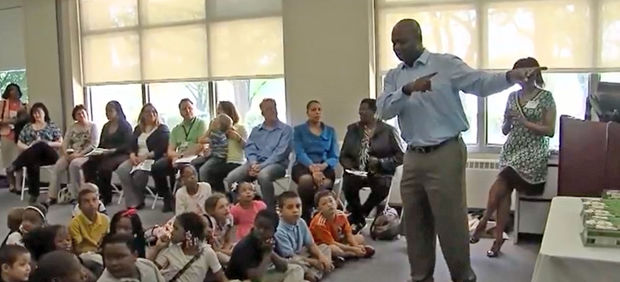
HARRISBURG — Floyd Stokes grew up in rural Mississippi and found out early on that learning to read was going to be an important part of his life as he got older.
“I was surrounded by a lot of people who couldn’t read,” Stokes said. “I saw the struggles.”
He says reading is the foundation of a quality education. He has read to more that 150,000 kids in the past 10 years, and his message is always the same.
“You can’t function in society if you can’t read. Some people are able to hide it, but the truth is you are better off with an education than without,” he said.
Stokes brought the 500 Men Reading effort to the region. He says it started out with 100 volunteers, but continued to grow.
He said as more men signed up over the years, it forced him to approach more school districts because he was running out of space. He approached the non-profit American Literacy Corporation to continue his work helping kids learn to read. He visited students in 25 states in 2014.
Stokes said nearly three out of 10 children of color in fourth grade in Pennsylvania are reading below level. He says getting an early start can help turn the tide.
“We focus on the younger kids to give them the love of reading, so that when they are learning to read, they are enjoying the process of reading and they are enjoying books,” he said.
OUR VIEW: Getting boys to read
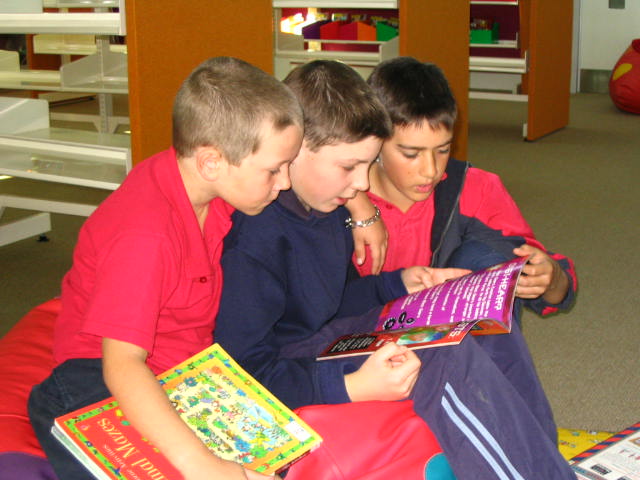
Do a little research and you’ll find reams (paper and electronic) of commentary seeking the answer to a serious question: “Why don’t boys like to read?”
The opinions are varied. A few of them:
• Girls are verbal; boys aren’t. Girls read for enjoyment; boys want information they can use immediately.
• Too many English teachers are female and push reading material that is more attractive to girls. Too many publishing executives are female and push books for children and young adults that are skewed toward girls.
• Boys prefer their action stories with a dash of violence and their funny stories with a sprinkle of grossness, and such things are frowned upon and discouraged in a culture fearful of school shootings and offending people’s sensibilities.
There’s probably no one reason or answer, but the problem is clear and it isn’t new.
For more than 40 years, the National Assessment of Education Progress has shown a “gender gap” between boys and girls in reading at the elementary, middle and high school ages.
A report four years ago by the Center on Education Policy showed that boys were behind girls in reading in every state and every grade.
It’s hard not to see a link between those numbers and a Pew Research Center survey that shows more women than men, in every ethnic group, are enrolling in college these days.
The situation led Jon Scieszka, a former elementary school teacher turned children’s book author, to launch Guys Read, a program to help boys become “self-motivated, lifelong readers” by exposing them to “guy-favorites” — books that will appeal to them.
The Gadsden Public Library has joined the initiative, and throughout February will have volunteers in every Gadsden City elementary school, telling boys about the joy and value of reading.
The strategy isn’t to read to the kids. That’s just going to produce glazed eyes and tuned-out brains.
The volunteers are pointing out the exciting things that can be found in books — titles discussed this week ranged from pirates to how to bathe a cat (very carefully) — in hopes of enticing boys to seek them out on their own.
We support this program and hope it can be expanded to other local schools.
It’s like one volunteer told boys at Floyd Elementary School, “opening up that book and beginning to read” can be the path to adventures around the planet.
The key is the “opening” part.