by Stone Marshall | Nov 12, 2014 | parent-news |
A third of British children now have their own tablet, according to the latest figures from communications regulator Ofcom. It’s a fair bet that those devices will be getting plenty of usage during half-term, which is this week in many parts of England.
Not as a replacement for physical activities – from painting and reading to climbing trees or riding bikes – but to complement them, with digital creativity, storytelling and education for children’s downtime.
Wondering what to download if your children are using Android devices? Here are some recommendations of recent releases that are well worth a look. And please chip in with your own recommendations in the comments section.
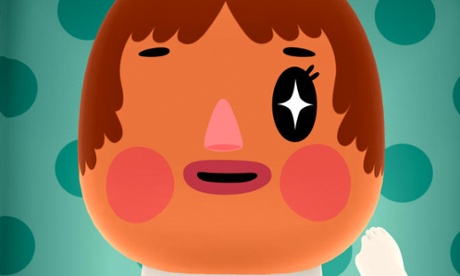
Developer Toca Boca is a reliable source of inventive, playful children’s apps, and Toca Mini is the current favourite of my own kids. It involves creating mini dolls using colour, stamps and facial parts, with huge scope for creativity whether they’re making new characters or modelling their favourites from TV or books. It also proved a spur for my children to try making figures in the real world too, once the tablet had been put away.
Eric Carle’s book about a caterpillar who chomps its way through… well, just about every foodstuff in sight remains a classic. Its latest incarnation is an app from developer StoryToys. Rather than mirror the original story, it tries to add something new with a series of mini-games involving counting, sorting and memory. The graphics do a great job of bringing Carle’s iconic illustrations to life.
This is brand new from MakieLab, the British startup that mixes 3D-printed dolls with mobile games. It’s a fashion-oriented game for children, encouraging them to create clothes for their virtual characters and then send them down a catwalk – complete with a photography feature. It’s just as well-crafted as the real dolls that the company sells.
Moonbot Studios work across apps and animation, and had one of the first big children’s hits on iOS with their The Fantastic Flying Books of Mr Morris Lessmore app back in the day. Fireflies is part of their new series of apps though, with Android support from the start. It’s a playful mission to catch fireflies in a forest, collecting them in a jar and mixing up their colours. A relaxing treat for young children.
Available in the UK, this is the second official app from the BBC’s pre-school TV channel CBeebies, focusing on stories rather than the games in its CBeebies Playtime app. This time, the emphasis is on six stories based on popular shows: Something Special, Charlie and Lola, The Octonauts, Old Jack’s Boat, Show Me Show Me and Grandpa in My Pocket. It’s easy enough for young children to use, but includes reading development information for parents.
I grew up with the Beano in printed form, but my children have discovered Dennis and friends through Me Comics, which is a sign of the times. It’s part digital-comics store and part reader app, with individual comics sold for 69p and up as in-app purchases (the “IAP” above). The selection includes an array of Disney characters as well as Transformers and My Little Pony, with a fun feature enabling kids and parents to record their own voices for the narration.
US developer Originator made its name with the marvellous Endless Alphabet app, and this is the follow-up. It teaches “sight words” through a mixture of interactivity and animation: children drag letters in to place to spell the words, before seeing a troop of colourful monsters act them out. Its humour bears many repeated viewings, while its in-app purchases for new word packs are under parents’ control.
Developer TribePlay has a growing collection of Dr Panda apps, which are well worth exploring. This is one of the most recent: a sequel that sees children cooking up a storm in their own restaurant. There are more than 20 digital ingredients to experiment with, and various cooking methods from boiling to frying. Again, it’s an app that may – if my children are any guide – encourage your kids to help out in your real kitchen. For better or worse…
There’s real craft and charm to this app, just like its predecessors Fiete, Fiete Match and Fiete Christmas. It’s set on a farm, with children helping the three characters go about their daily tasks: feeding animals, shearing sheep, milking cows and so on. It’s relaxed, lovely to look at, and the perfect follow-up to visiting a farm in the real world.
The founder of developer Mighty Yeti Studios used to make shows for Nickelodeon and Disney, and you can see that pedigree in his company’s first Android app. This is a storybook with a pleasingly-sideways sense of humour, as Mr Cupcake sets off to a friend’s birthday party while puzzling over a strange crunching noise. There’s plenty of things to tap on, and plenty to laugh at too.
Tynker is one of the growing number of apps aiming to get children interested in computer programming. Here, that involves completing more than 200 “puzzle adventures” that introduce logic, loops and subroutines in an accessible way. A separate creation mode then gets children to start making their own games, using the skills that they’ve learned. This isn’t about shoving kids into coding to turn them into the next rich startup founder – it’s about having fun in a creative way.
This isn’t an app that you download from the Google Play store: it’s a website designed to work within tablets’ web browsers. It’s a fab idea though: a creative community based around a zoo full of magical animals that children draw themselves, with digital story-books that unlock featuring them, and a light gaming element where they defend the zoo from invaders. It’s free to use, but as parents you can choose to pay £5 a month or £27 for permanent access for all your children – which gets them a physical Fan Club pack sent through the post.
That’s a dozen to get you started, with some recommendations from previous roundups in the links below. But if your children have been enjoying other Android apps, please do tell other parents about them by posting a comment.
Read Original Article Here:
by Stone Marshall | Nov 11, 2014 | parent-news |
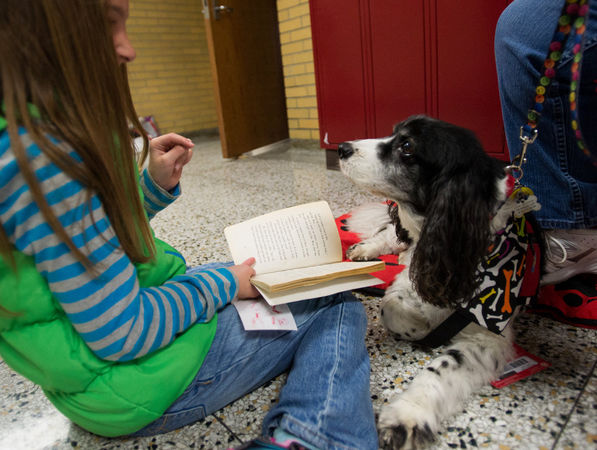
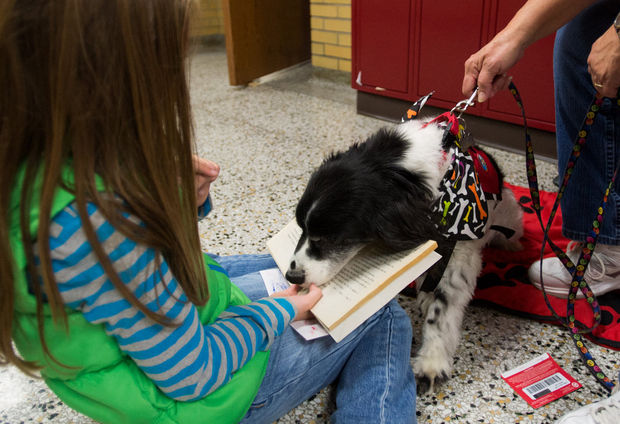
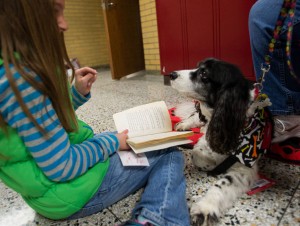
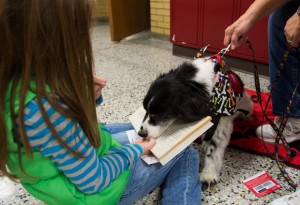
MONITOR, TOWNSHIP, MI — Third-grader Madison Marsh sat in the hallway of Mackensen Elementary last week, reading to Andi, a spaniel mix. Andi poked her nose over the book — “Julie B. Jones and the Stupid Smelly Bus” — to take a peek, and Madison couldn’t stop giggling.
 “It was so cute,” she said. “I honestly love dogs, and I’ve never read to a dog before.”
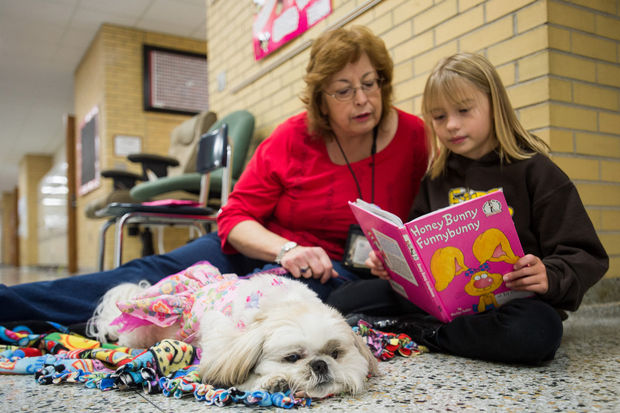
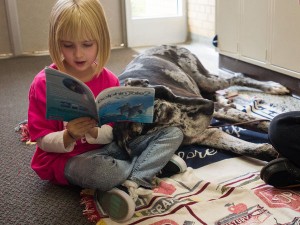
Andi was at Mackensen for the new “Paws for a Book: Readers Rock” program that gives students in second and third grades a chance to read to therapy dogs, boosting their reading confidence and fluency in the process. Karrie Marciniak, a program organizer and an intervention teacher at Mackensen, explained that the program gives kids a chance to work on their reading without worrying about being perfect.
“The dogs don’t care if they make mistakes, and they’re not going to correct them,” Marciniak explained. She said that the reading on Friday, Oct. 24, was the second installment in a weekly program she hopes will last at least until January.
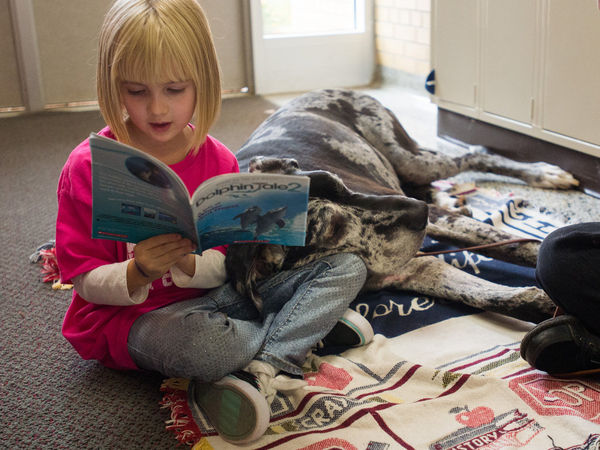
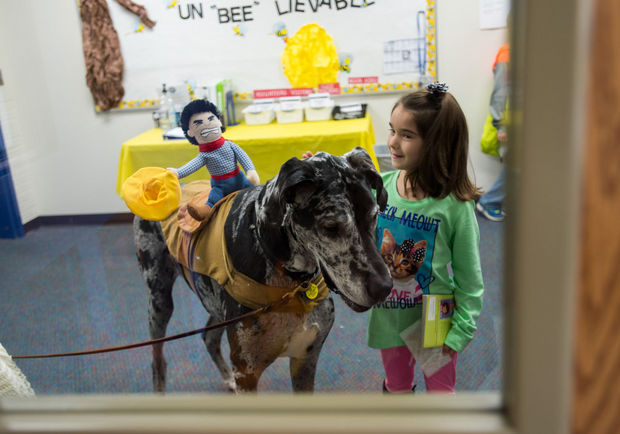
Handlers for the dogs are volunteers from Tail Waggin’ Tutors, part of Therapy Dogs International, and they brought a range of canines, from Andi — a lolling, foot-and-a-half-tall spaniel — to Tucker, a giant of a dog with a costume saddle and a stuffed cowboy on his back.
“I’ve had anywhere from kindergarten up to middle school kids,” said Teresa Gill, Tucker’s handler. “They love it. Half the time we won’t get halfway through the book. The dog will love on them, and the kids will love on them right back.”
Part of what the program helps with, Gill explained, is self-esteem. Kids can often feel nervous when they’re singled out to read in front of a class; reading to dogs can help them build the confidence they need while staying in a safe space.
Besides just reading, it’s a chance to hang out with dogs, too.
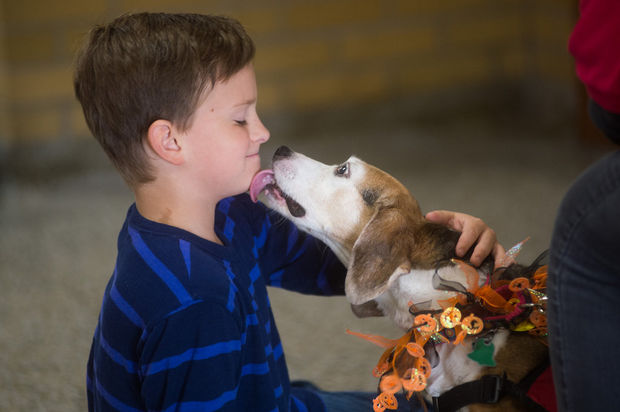
“He kept licking my ear,” said Colin Brady, a second-grader, smiling as he remembered his turn to read. “Dogs like to do that to me.”
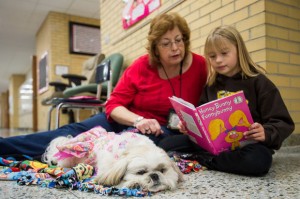
The Paws for a Book Service Team, which has more than 20 students signed up, plans to meet once a week for an hour for the rest of the year. Another goal of the program is to give kids the chance to start coordinating service projects in the community, using the dogs to make a difference for local residents.
Kids on the service team compile literary care packages for children in the hospital, Marciniak said, and deliver them alongside the dogs. They also visit and read to residents of a local assisted living home with the canines and lead a drive for pet food and supplies.
“If we can start them young … when they’re young adults, they’re more likely to serve their community,” Marciniak said.
Marciniak explained that the program is funded by two grants totaling $6,000 — money that is used to help provide small thank-you items for dog handlers at the school and pay for items included in care packages through the service program. The money won’t last forever, though, Marciniak said, and she hopes the program can continue in years ahead.
Marciniak said anyone who would like to donate to the program can do so by writing a check out to “Mackensen Elementary School Paws Program” and mailing it to the school at 5535 Dennis Drive, Bay City, MI 48706. She added that residents can also drop off items for the literary care packages at Mackensen, including books, notebooks and markers.
Julie Robinson, principal at Mackensen, praised the service program.
“I think it’s great,” she said. “I think any time we can get kids reading in different contexts and different formats, it just gets them excited.”
Read Original Article here:

by StoneMarshall | Nov 11, 2014 | Minecraft News, parent-news |
by Stone Marshall | Nov 11, 2014 | parent-news |
A literacy teacher, who has watched students read the first chapter of many books but never finish one, has written her own teen novel, hoping this will be the one the students finish.
“Once they have read one book, they’ll read another.”
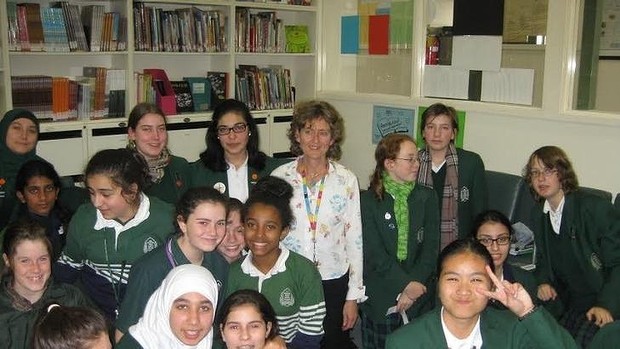
June Laurie, literacy co-ordinator at Pascoe Vale Girls Secondary School, has taught at primary and secondary schools for more than 20 years and says about one third of students who arrive in year 7 are reading at grade 3 or 4 level.
And, according to Ms Laurie, there are many secondary school students who have never managed to finish a book. Not one.
“They read the first chapter of many books,” she says.
Now, she’s trying to change that one-chapter-many-times-over experience with a book she’s written aimed at both reluctant readers and students of low literacy.
The self-published book Blake Collider – Into Thin Air is the tale of a 16-year-old bored misfit who goes on an exchange program to Italy and gets caught up in romance and a physics experiment known as the Hadron Collider project.
It has particle physics “string theory” research at its heart and, despite being written by a non-scientist, has a focus on some quite sophisticated science.
Readings’ review describes it as “a page-turning romp through Italy, neo-Nazism and dimension travel. A love story with a twist of physics, ethics and Italian!”
The book has been bought by several schools across the state including Williamstown High School, Essendon Keilor College and her own school, Pascoe Vale Girls’. She says while the novel is also engaging and interesting for confident readers, Blake Collider is particularly aimed at those low-literacy or reluctant readers. Ms Laurie says the key to engaging these students is to “keep the plot structure simple but the action engaging.”
“Most of the books promoted for teenagers, such as The Hunger Games, are too complex in their plots,” she says. And when those complex plots cause reluctant or struggling readers to stumble and stall, they just give up – often at the end of the first chapter.
Ms Laurie says the best way to improve student literacy levels is to get children reading, and backwards-and-forwards plots don’t help that. “We learn to read by reading.” And once children have learned to read, students need to keep reading. “Research tells us that if students stop reading, they actually lose skills they might have acquired. Years 7 and 8, then, are crucial years to keep students reading.”
But where does it all go so wrong in the first place? Much of the focus on literacy is on difficulties children with dyslexia have but Ms Laurie says her experience teaching lower primary grades reveals a more complex mix.
She says around grade 1 and 2, when students are starting to become literate, many start borrowing books and developing the “reading resilience” that is crucial to becoming a strong reader. These young readers start persisting with difficult words and finishing books; they are on their way.
By contrast, also around this time, it also becomes clear that in any classroom some students have a “major learning difficulty” and some will have “missed a lot of schooling at a crucial stage”. Ms Laurie says it becomes evident in early secondary school, if not before, that some students’ reading is hampered because they have missed some crucial learning such as blends, “igh” and “ough” which make fluent reading harder.
It is these students who can reach years 7 and 8 never having finished a novel but with secondary schooling ahead of them, the reading and finishing of books only becomes more important.
Ms Laurie says there is no magic to helping students read but making books interesting and engaging is a start. And the goal is always the same: “to finish a book”.
Blake Collider is stocked at Melbourne Museum, Readings Carlton and from the author blakecollider@yahoo.com
by Stone Marshall | Nov 10, 2014 | parent-news |
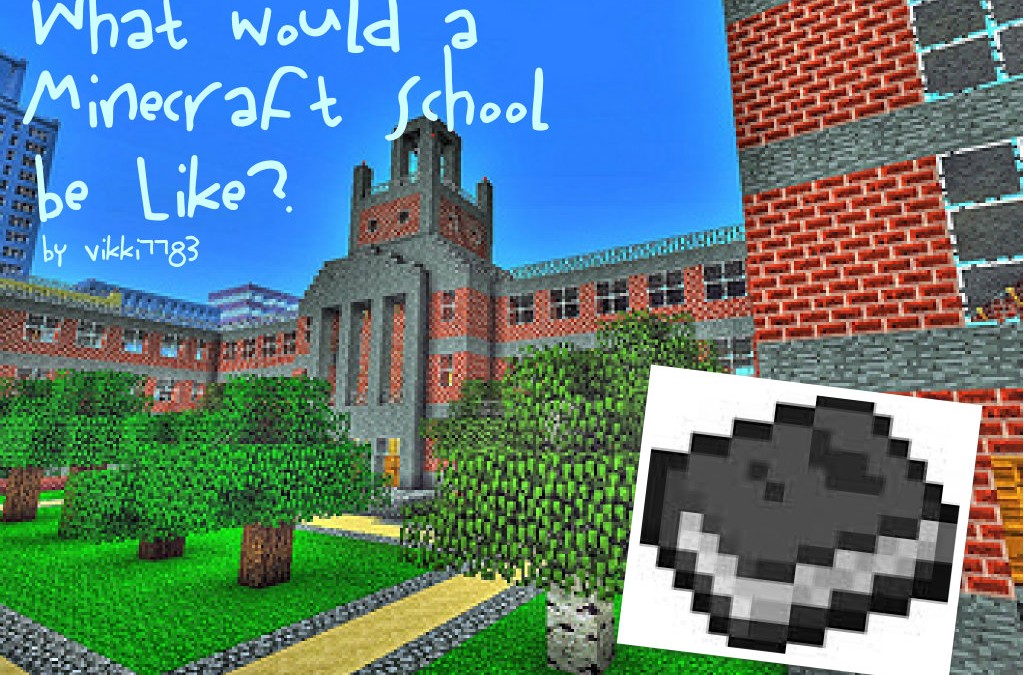
If you ask teachers around the world why they use Minecraft, they might come up with a wide array of answers. Colin Gallagher lists his reasons in this chapter from
Minecraft in the Classroom: Ideas, inspiration, and student projects for teachers.
You may have had to answer some questions from school administrators, parents, and other teachers as to why Minecraft is so important to implement in your school. Normally, just looking at teachers’ work online (especially in my Minechat series!) is enough to prove the benefits, but sometimes a clear set of reasons comforts people more.
If you ask teachers around the world why they use Minecraft, they might come up with a wide array of answers. I’ve listed my reasons in this chapter, but I’m sure I’ll add to the list as teachers find more incredible ways to use Minecraft in their teaching.
Collaboration
Working with other people is probably the most challenging aspect of school (and life). Teamwork activities happen regularly during the year in my school, and they involve students trying to learn a lot of very tough collaborative skills, such as negotiating, listening, following directions, and accepting criticism. I think that we, as adults, also struggle with these things at times.
In Minecraft, there is huge potential for developing these collaborative skills. I’ve talked with dozens of teachers about their Minecraft projects, and they explained that usually students work together to complete tasks. If they are not working together, they are usually in the same world trying to ignore distractions and avoid conflicts. Minecraft is, in essence, a social game. It begs to be played with other players. In an educational setting, students can work on collaborative skills in Minecraft when planning, building, and presenting a project as a group.
When students work as a group in Minecraft, it is vital that they work effectively. There’s something interesting about Minecraft: Often, at least initally, working together effectively does not happen. I think the freedom is too much for some students, or they have not adjusted to using Minecraft in an educational setting. Conversations, guidance, and advice between group members and between groups and teachers can help develop the collaborative skills needed for effective group work.
Read Original Article:
by Stone Marshall | Nov 10, 2014 | parent-news |
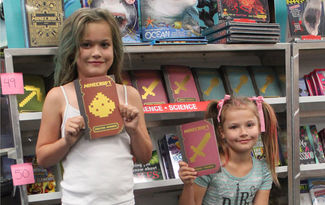
Pine Bluffs Elementary school was one of many schools to host the Scholastic Book Fair Event. To bring more awareness to the community, the school had a Community Event on Thursday, Oct. 30.
After walking over a man-made moat, the library opened up into a castle-themed book store including snacks, posters, pens, pencils and, of course, lots and lots of books.
Pine Bluffs Elementary School Librarian, Deb Leininger, said the proceeds of the Book Fair go towards the Reading Counts Program and Classroom Wish List Program. Scholastic will match 100 percent of the proceeds and provide books for Kids in Distressed Situations.
A giant stuffed dog was being raffled off to bring in more money. The winner of the dog was announced Tuesday, Nov. 4 during the elementary’s award assembly.
Leininger said she enjoys the Book Fair because of the decorations and also because it’s exciting for the kids. Leininger said the Book Fair helps put books in kids’ hands and encourages them to read more. She also said the new “Diary of a Wimpy Kid” by Jeff Kinney was available, which kids were very excited about.
Heather Becerra, of Pine Bluffs, said she’s a mother of a kindergartener and third-grader. She said she enjoys the Book Fair because reading is very important and she wants to do whatever she can to support the library. Her son, Tomas, a kindergardener, picked out two books including “Dolphin Tales 2.” He was able to get his books with a $10 certificate he won.
Becerra said Partners in Education donated $10 to the Book Fair for each student who was awarded Student of the Quarter. Tomas was one of those students.
Students who reached their reading goals were also awarded with a certificate from the Reading Counts Program.
The Book Fair offers specially priced books and educational products, including popular series, award-winning titles, new releases, adult bestsellers and other great books from more than 100 publishers.
Read Original Article: