by Stone Marshall | Feb 25, 2015 | parent-news |
 Not sure how many of us would work for $2.65 an hour, 32 hours a week and find it fulfilling.
But for Mary Astorga, Arnetta Gardner and Irene Susbilla, it’s a rewarding gig to be part of the federal Foster Grandparent Program and teach children how to improve their reading skills by offering one-on-one time with underprivileged elementary school students.
The three are among 55 “Grandmas” and three “Grandpas” who work at 15 low-income schools throughout Clark County and are themselves low income.
To qualify for the program, the adults are at least 55 and on food stamps.
These three “Grandmas” work at Rundle Elementary School near Nellis and Stewart avenues.
Astorga, whom second-graders call “Grandma Mary,” is 60 and has worked as a Foster Grandparent for two years.
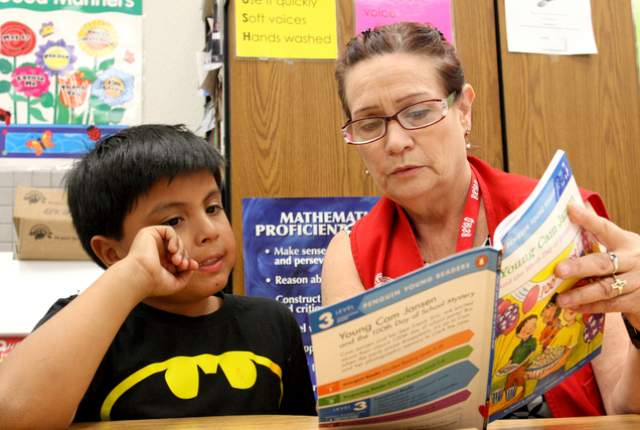
Watching Astorga work one-on-one first with Adrian Guzman and then with Katie Samson in the midst of second-grade teacher Israel Carrillo’s class was the highlight of my Tuesday. Their efforts showed on their faces and their smiles of success. Katie chose the book “The Plot Chickens” and clearly understood it when asked. Demonstrating his comprehension, Adrian wrote a book report on his choice, “Young Cam Jansen.”
Astorga corrected pronunciation, made sure words were not skipped and then asked questions to make sure the young reader understood what they were reading. (And they did.)
Assistant Principal Lorraine Watson said the program works and provided records for three anonymous students. One was reading at 12 words a minute at the beginning of the year and had improved to 42 words per minute. A second second-grader went from 32 words per minute to 59, and a third went from 15 to 39 words per minute. The end-of-the-year goal is 106 words per minute. Rundle joined the program in 1995.
Progress information on each student is reported to Catholic Charities of Southern Nevada, which has operated the program since 2006, taking over from the Equal Opportunity Board.
Sabrina Tolson, who supervises the program for Catholic Charities, approached me recently at the Review-Journal’s Successful Aging Expo to pitch the program.
The fact that the nationwide Foster Grandparent Program is 50 years old is another sign that it works, making it a dual program helping poor children and poor senior citizens.
Gardner, aka “Grandma Netta,” is 68 and in her third year with the program. With six children and 38 grandchildren, she is a natural. Like most involved in the program, she heard about the old- fashioned way: word of mouth. “I was not doing anything with my life, and I enjoy being productive.”
The $391,000 annual budget doesn’t allow advertising, but Tolson said the program would like to add more grandparents to expand into more schools. Her goal is to increase the current 58 to 76 grandparents.
“It takes patience, but they love us to death,” said Astorga, who works with younger children.
The qualities necessary to be a good Foster Grandparent include patience, good reading skills and being open to learning, Tolson said. “They have to be kind and have the ability to work with another generation.”
Grandparents (and you don’t have to be an actual grandparent to join) would need to understand the importance of the movie “Frozen” to these youngsters. Because the same grandparents work with the same students, it provides consistency.
Tolson said their average age is about 70, and they do lose some grandparents. An 89-year-old grandma recently had to retire. Another is still working after 22 years.
The program pays mileage and provides bus passes, but it’s not always easy to get to the schools, and the foster grandparents have to commit to a minimum of 15 hours a week. Another benefit is an annual physical at no cost.
“They’re not disciplinarians,” Tolson stressed. “They’re mentors, they’re roles models, they’re tutors.”
“My program has a lot of seniors who are not mobile. They get there on shuttle buses and use walkers. I know all of them, and they really want the kids to learn how to read. They are truly focused on how to say the words. Even though they have children speaking different languages.”
The program is a dual program, and the little extra they learn makes a difference, Gardner and Astorga agreed.
At Rundle about 43 percent of the students are English Language Learners and Foster Grandparents make a difference, Assistant Principal Watson said. “It’s really a joy having these grandparents here.” She wants two more at Rundle, if she can get them.
Read original article here:

by Stone Marshall | Feb 24, 2015 | Awesome Book News, parent-news |

This week’s new DVD releases include two films that have top-notch acting performances overlooked by the Academy.
“Nightcrawler,” Grade B+: Jake Gyllenhaal’s performance as a hustler looking for work selling footage to local TV news falls somewhere between Norman Bates and Gordon Gekko in his entrepreneurial efforts.
At times he seems driven by sociopathic tendencies, while other times his work borders on the madness of a great artist. The combination makes Bloom a character to be feared, but also the guy you want wading into the latest carnage to get the story.
Dan Gilroy is fearless in his writing and direction. He never backs off from making his main characters morally bankrupt and overly zealous when it comes to the job. These are not people to like as much as fear and respect for their lack of boundaries.
“Kill the Messenger,” Grade B+: Although the story deals with an important moment in history, the film finds its power in the personal story of those involved — the heralded and eventually crucified San Jose Mercury News reporter Gary Webb (Jeremy Renner).
Renner finds the perfect beat to show the stages of Webb’s rise and fall. At the start, he plays Webb with the kind of optimistic enthusiasm writers have when they latch on to a big story. Just as quickly, Renner shifts to a reserved humbleness after his story becomes a sensation. What makes Renner’s work so masterful is that he’s equally as believable when Webb’s life and career crash.
“Alexander and the Terrible, No Good, Very Bad Day,” Grade: C+: This movie banks heavily on the natural charms of Steve Carell and the motherly ways of Jennifer Garner to win over an audience.
Just as in movies like “Holes” and “Diary of a Wimpy Kid,” the key is how much moviegoers will like the movie’s central young star. Ed Oxenbould comes across as an average kid, a trait that must make his family happy but is not the best description for the person at the core of a feature film. The audience would be more sympathetic to Alexander if his own bad day was filled with more disasters.
“Laggies,” Grade B-: In lesser hands, “Laggies” would have been little more than an after-school special about the uncertainties highschoolers have about their future, emotional connections and family. That perspective is offered through Annika (Chloe Grace Moretz ), a confused teen living with her divorced father, Craig (Sam Rockwell).
The film never gets overly deep in its examination of generational and parental frustrations. It’s the dependable Moretz, Keira Knightley and Rockwell who get the most out of the script and make this production work.
ALSO NEW ON DVD THIS WEEK
“Addicted”: Sharon Leal portrays a woman who puts her career and family life in jeopardy when she has an affair with a painter.
“We Are Giants”: Filmmaker Greg Barker targets dilemma of justice and freedom through different mediums.
“Love at First Bite/Once Bitten”: Double feature of the George Hamilton and Lauren Hutton comedies.
“Mama’s Family: Season 6”: Vicki Lawrence stars in this spinoff from the “Carol Burnett Show.”
“Turbo Charged Chugger”: The latest release in the “Chuggington” series.
“Poker Night”: Detective is caught in sadistic game. Ron Perlman stars.
“Dora and Friends: Into the City”: Dora and her friends go on adventures.
“Captain Scarlet and the Mysterons: The Complete Series”: Includes 32 episodes of the TV series.
“Nurse Jackie: Season 6”: Jackie (Edie Falco ) enjoys her sobriety.
“Batman: Season 2: Part One”: The Dynamic Duo continue to protect Gotham City.
“Syncopation”: William Dieterle’s 1942 musical feature with Benny Goodman.
“The Song”: Romantic drama inspired by the Song of Solomon.
“Strawberry Shortcake: Snowberry Days”: Playtime is interrupted when someone notices that the squirrels are low on supplies.
“Frankenstein vs. the Mummy”: Two monsters face off in an epic battle.
“Tarzan”: Animated tale of the jungle lord featuring the voice of Kellan Lutz.
“RPG”: Rutger Hauer plays a multimillionaire who faces battle for survival.
“Open Sesame: The Story of Seeds”: Documentary on what can be done to protect the source of nearly all food.
“EARTH A New Wild”: Examination of the way humans are connected to wild animals.
“The Lookalike”: Frantic search starts when the obsession of a drug lord dies.
“Brotherhood of Blades”: Young emperor’s determined to take down a major threat to his people.
“101 Dalmatians Diamond Edition”: The animated tale of Cruella De Vil and all of the puppies has been re-released.
“Kink”: Documentary on sexual extremes.
“Quiero Amarte”: The telenovela is a remake of “Imperio de Cristal.”
“A Mouse Tale”: Magic crystal must be found to stop an attack by evil rodents.
“Transformers Rescue Bots: Jurassic Adventure”: Dino-themed collection of mystery tales.
“Digimon Fusion”: Includes all 30 episodes from the first season.
“Foreclosure”: Family deals with a haunted house. Michael Imperioli stars.
“Walker, Texas Ranger: War Zone”: Walker must deal with the death of a close friend.
“Power Rangers Super Megaforce – The Silver Warrior”: Rangers are joined by an unexpected ally.
“Predestination”: Temporal agent travels through time to stop future killers.
“Olive Kitteridge”: Cable mini-series starring Frances McDormand.
Read more here: http://www.theolympian.com/2015/02/10/3570721_new-dvds-feature-top-performances.html?rh=1#storylink=cpy

by Stone Marshall | Feb 24, 2015 | parent-news |
 Let’s face it, reading affects every area of our lives. If kids struggle with reading, it is highly likely they will struggle in other areas of their academic life too. Parents can influence kids to form better reading habits and help them become better readers. Check out these five tips to inspire your kids to love reading:
READ WITH YOUR KIDS: Parent involvement is the No. 1 predictor of early childhood reading success and future academic achievement. Kids learn from parental modeling. Starting a daily reading ritual for pre-kindergarten kids is vital for developing a child’s love for reading. Kids who own 100 or more books tend to be more ready to tackle academic challenges. Using books with popouts help stimulate imagination and make reading fun.
Before getting started, read the title and ask your child to make a prediction of what the story is about. Point to words and pictures as you read to helps kids make the correlation between the story and the illustrations. Read with enthusiasm and energy by changing pitch and intonation to punctuate the story and character’s voice.
Follow up each story by asking questions to ensure they understood the story and can relate it to another story or personal experience. The love of reading is partially developed by relating stories to real life.
SET TECHNOLOGY LIMITS: Set a predetermined amount of time for kids to plug in to technology (including TV) each day. Replace TV and gaming time with daily reading rituals by scheduling reading time for your kids each day. Reading on an e-reader is good, but be sure kids have an appreciation for traditional books too. Shared reading time with the family as well as individual reading time reinforces good reading habits. Reading with good comprehension sets kids up for success in all of their other subjects like social studies, math and science.
HELP KIDS CREATE A READING LIST: It’s important to keep your child’s reading level in mind when helping him choose a good book to read. Use your intuition when asking him questions about what he wants to learn about, who he’d like to meet or what he wants to be when he grows up. All of these things make a good list of things to read about.
For infants and toddlers, choose books with bright colorful pictures and familiar objects. Cardboard or washable fabrics prevent little hands from getting too excited and ripping pages. Books that appeal to their senses and explore different textures will be fast favorites. Poems and rhymes are fun for parents to recite over and over again.
Preschoolers love illustrations that are colorful and engaging. Short stories that have simple plots and actions to follow will hold their short attention spans. Stories that are about everyday life can help them explore their world and stories about how things work will help them learn new concepts. Characters that are about the same as age as your child will help him relate to the character and take an interest in the storyline.
Choosing books for young readers, up to age 11, take on a new dimension. They enjoy stories that take several days to read.
They also like to read more in-depth versions of their childhood favorites. They still enjoy illustrations and photos, especially in how-to books. By this time, your child may have developed favorite authors, so reading other books in a series by the same author is a good strategy.
Adolescents like to read books with characters that are facing similar teen related challenges in their lives. Novels that take them to faraway places and times can foster their love for science fiction or history. Biographies, folk tales and mythology can be good options too.
SET CONTENT GUIDELINES: It is totally fitting for parents to monitor what their kids read. Just like television and movies, it is reasonable to consider that parents wouldn’t want their kids to engage in books with vulgar language, sex, violence or drugs. It is also important to only allow kids to read material that is age appropriate.
SCREEN FOR LEARNING DISABILITIES LIKE DYSLEXIA: Kids who don’t like to read typically don’t have good reading skills. This could be because reading wasn’t part of their early childhood experience, therefore, they don’t appreciate the value reading could have in their lives. It is important for parents to delve deeper into the reasons their kids don’t like to read. If kids find reading boring, it could be that they only read school assignments that don’t tap into their interests. Finding books that are more in alignment with their hobbies or interest might help them enjoy reading more.
Some kids find reading difficult or tedious. That could be related to how they learned to read. Check in with his teacher and see if there are learning disabilities like dyslexia involved or if a tutor could help get them up to speed. Poor reading skills can lead to kids falling behind in school and not liking school. Kids like to know that things are relevant to their lives and some kids haven’t made the correlation between books and real life.
Finding books that tie into their hobbies, interests or aspirations can help improve their interest in reading.
Reading opens up new worlds for kids. Stories can take their imaginations to foreign lands and spark an interest in travel, culture and adventure. Reading biographies can provide positive role models and inspire kids to excel in sports, academics and service. Give your kids the gift of reading by making it fun and exciting.
Read original article here:
by Stone Marshall | Feb 22, 2015 | parent-news |
 FAIRBANKS — Cool guys read. If anyone claims differently, ask for a footnote.
Longtime Fairbanks resident Greg Hill is one of the coolest guys, and he’s on a mission to invite every boy attending school in Fairbanks North Star Borough to join the club. Hill, who before retirement was the executive director of Noel Wien Public Library, is the creator and coordinator of Guys Read — a program that aims to get fourth-grade boys interested in reading.
Hill works with men from all around the borough, each of whom has his own set of interests and talents, to come serve as reading role models to fourth-grade students.
From radio hosts to engineers, from firefighters to social media curators and from current high school star athletes to police chiefs, Guys Read connects these volunteers with schools to show students that adults with some of the best and most interesting jobs available think reading still is in vogue.
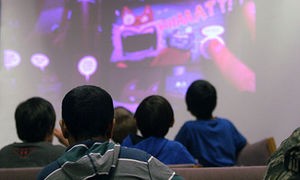
Adult readers volunteer their lunch hour for several days over a three week period, during which time they visit one of the borough’s public elementary schools and read an engaging age-appropriate book to the fourth-grade students. The books usually take the form of comic books or heavily illustrated novels — something that can engage students both through the narration of their reading travel guide and the pictures projected on a nearby wall.
Students gather in a library or common room, where they get the dinner-and-a-show treatment, eating their lunches while taking in the story read by their volunteers.
Explaining the purpose of using comic books and illustrated books for the program, Hill references British author Neil Gaiman, who once referred, as others have, to comic books and fiction in general as a gateway drug to literacy.
Students, economically boys disadvantaged in particular, often lose interest and fall behind the reading curve in fourth grade. It’s a phenomenon so well researched it even has its own monicker: “the fourth-grade slump.” So Hill’s program focuses its efforts there, at that integral point of reading interest.
Guys Read runs for one three-week period each school year. This year’s iteration, the program’s ninth, wrapped up on Friday.
Steve Dutra, the chief at North Pole Police Department, volunteered with Guys Read for the first time this year. He says he hasn’t specifically asked the boys what they think about the reading, but their enjoyment is obvious from they way they get engaged.
At home, Dutra reads to his daughter, in fourth grade, and his son, in fifth grade.
“I wasn’t much of a reader as a kid, and I have absolute passion about my children reading,” he said. “We read every night. That’s kind of our time together.”
Dutra’s son just barely missed the chance to experience the Guys Read program with his father as one of the readers, but that’s OK, Dutra said, because his son gets to read with him every night already.
Since Guys Read Alaska first began nine years ago, it has expanded to other Alaska regions outside the Interior, spawning programs in Barrow, Nome and elsewhere.
Read original article here:
by Stone Marshall | Feb 22, 2015 | parent-news |
Sometime in the mid-1960s, I began to take an interest in boys. However, the boys in my class did not reciprocate that interest.
I complained to my mother about this deficit in the male of the species. She assured me things would pick up eventually. “Boys,” Mom said, “take longer to mature than girls.” I expect I rolled my eyes.
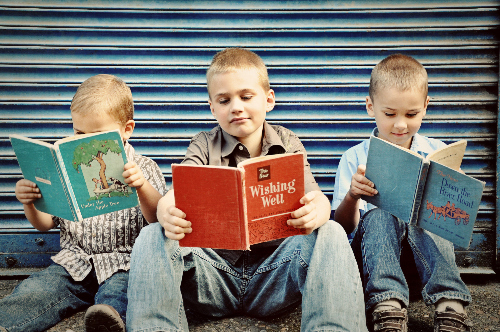
Last month, my local children’s librarian (a mature boy) introduced me to the book “Raising Boy Readers,” with more than 300 recommended boy-friendly books, by Michael Sullivan.
I have to give Mom points. Somehow, without ever having read a single scientific study, she understood the truth about the differences in the maturity rates between boys and girls.
But the science behind the facts, as revealed by Sullivan, is both compelling and enlightening.
Did you know that, on average, girls’ brains reach their full adult size by age 11? But boys’ brains achieve this growth around age 14. (page 2).
Sullivan calls this phenomenon “brain-lag.” This brain-lag is responsible for the gaps in verbal and written language skills often seen between girls and boys.
Boys catch up to girls eventually, but not until they are 15 years old. Sullivan writes “It isn’t that boys don’t read as well as girls; they simply read at a different time ”
The chances are then that, whatever standardized tests may indicate, most fourth-grade boys aren’t behind in their truly appropriate reading levels, just in that pseudo-appropriate reading level set by the powers that be.
What a relief! Still, the pseudo-level (and resulting bogus grade) may leave boys discouraged and turned off to reading.
This is an outcome adults can change, according to Sullivan, by giving boys reading-for-pleasure time.
In “Raising Boy Readers,” Sullivan lists 300 books from which to choose.
Get Sullivan’s book. Or ask your own children’s librarians for suggestions. They would love to help you. Sometimes they’re even boys.
Read original article here:
by Stone Marshall | Feb 21, 2015 | Minecraft News, parent-news |
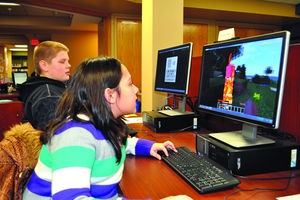
NEWARK — If you have a child (especially a boy), you likely know what Minecraft is.
This computer game is all the rage among the younger set. Played on multiple platforms (computers, Xbox, Kindle, iPad, PlayStation, etc.), the game allows players to build three-dimensional buildings and worlds from textured cubes. Players can explore, craft, fight and gather resources in the game. Think of it as advanced Legos in the computer age.
And now local Minecraft fans can meet once a month at the Newark Library to share their passion.
Youth Services Director Krystina Hardter launched the club last Tuesday evening. She did so because she’s seen firsthand in the library how popular the game is. Young patrons ask for Minecraft books, but the shelf where the series is kept is often empty.
“They just fly off the shelves,” she said. “We just know how kids are obsessed with it. They love it — the creating, the survival, the building.”
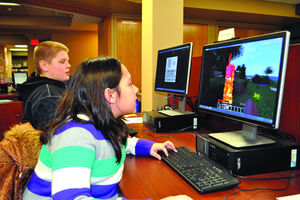
Hardter had set aside a table with Minecraft coloring sheets and instructions on how to make three-dimensional paper Minecraft figures, but the four young patrons who braved the snow last week were more intent on getting on the computers and playing the game itself.
Since some of them had played on different platforms, there was a learning curve as they started building on the computer. Questions flew as the young library patrons started clicking away with their computer mice.
“How do you eat?” “How do you build a ladder?” “How do you make a door?” were among the queries being traded.
Anthony Merced, 7, was in the water and afraid he would drown. He asked his classmate Ryan Hinks, also 7, what to do.
“Press the space button to float,” Ryan answered.
The Newark youngster has been playing Minecraft since he was 6, usually on his Kindle tablet. He was a little distracted to explain the game in depth, especially to an obviously clueless questioner.
“It’s very, very complicated to explain. You just mine and then you craft,” said Ryan, noting everyone in his family plays except his parents. His mother, he added, has said she might have to learn just to be able to interact with her children.
Ryan said he’s hooked because “you can craft and be creative about it. It’s a real world that you are building.”
As the children pressed their faces close to the screens and talked to both the computers and each other, Hardter and Youth Services Librarian Caitlin Simonse mingled about. They helped as they could and asked plenty of questions.
Hardter said one of the reasons she started the club was because “I wanted to learn from them what the big deal is.”
“I’m impressed with how quickly they are building houses and things,” she said, noting when she tried the game all she was able to accomplish was chasing some bunnies and cutting grass. “I’m kind of understanding the concept … kind of.”
Blake Aldrich, 11, said he has been playing Minecraft “a long time now” and called it his favorite game.
As Hardter complimented his work, she wondered why his house was built underground.
“It’s most common for houses to be built underground because it’s safest,” Aldrich said.
“Who do you need to be safe from?” Hardter asked.
“Zombies, creepers, and skeletons,” the kids answered.
Despite asking the others, Blake still had trouble constructing a ladder. Hardter pulled out her phone, loaded up a YouTube video and showed him how.
Meeting kids where they are at — in the library — is certainly a goal of hers.
“My hope is to start them younger and build their love for the library so by the time they get to the high school it’s still cool,” Hardter said.
Read original article here: