by Stone Marshall | Feb 12, 2015 | Minecraft News, parent-news |
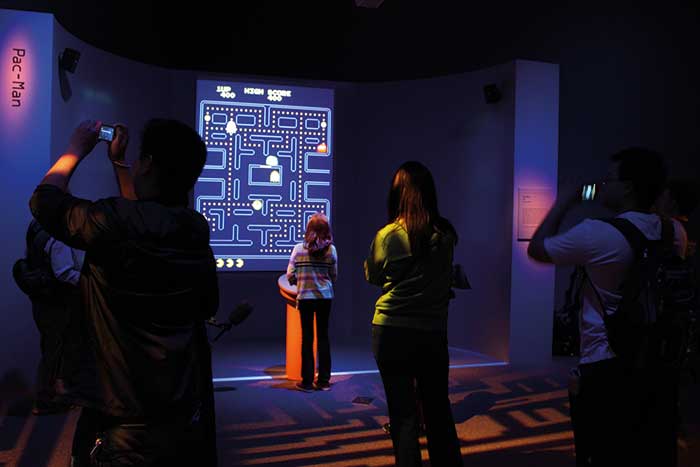
 Visitors to the “Art of the Video Game” exhibition at the Smithsonian American Art Museum
The British Museum posted a message on the website Reddit last September asking for volunteers for its “build the British Museum in ‘Minecraft’” project, hoping for 20 applicants. “It exploded… Twitter went berserk and we had more than 1,000 applicants in a single day,” said Nick Harris, a broadcast assistant and content producer working on the London institution’s Museum of the Future project, in a talk at the British Library last December. One of the respondents wrote: “Yes, please. I love ‘Minecraft’ and I would really like to help build it. I’m ten (my mother knows).”
The Tate received an equally enthusiastic response when it launched a project to recreate works from its collection, including André Derain’s The Pool of London, 1906, in the “Minecraft” video game: within 48 hours, amateur videos on how to navigate “Tate Worlds” appeared on YouTube. When London’s Wellcome Collection released the video game “High Tea”, 2011, a strategy game based on the 19th-century opium trade in China’s Pearl River Delta, to coincide with an exhibition on recreational drug use, the museum discovered that, on average, people spent four times longer playing the game than they did browsing its website.
The popularity of video games shows no sign of waning, and museums have ramped up their interest in the medium. From mounting exhibitions like the Smithsonian American Art Museum’s (Saam) blockbuster travelling show “The Art of Video Games”, which drew 3,400 visitors a day during its run in Washington, DC, in 2012, or the “Game Masters” show at the National Museums of Scotland (until 20 April), to acquiring or commissioning games around their permanent collections or exhibitions, museums are looking at video games as both an art form and a means to reach a wider audience.
“It’s an innovative way to get the public interested in collections, especially audiences that wouldn’t normally engage with them,” says Stella Wisdom, the British Library’s digital curator. She is behind the library’s Off the Map competition, in which university students use items from the collection to design games. This year’s contest—a collaboration with the GameCity festival—is based on Alice in Wonderland, to mark the 150th anniversary of Lewis Carroll’s book, and will coincide with an Alice show at the British Library in the autumn. “There’s a lot of potential for creative industries to work with cultural institutions and vice versa,” Wisdom says. “We’re just at the start of a journey.”
Danny Birchall, the Wellcome Collection’s digital manager, says that the games “are part of a larger strategy of using many different things to engage the public. You use video games to reach those who play games, like you create documentaries for those who watch television. We’re not trying to convert museum people into games players.” The museum has commissioned several games related to its collection and exhibitions. In developing them, the institution follows the cardinal rule that content is paramount. “Our motto is ‘no chocolate-covered broccoli here’,” he says. “We’re not making unpalatable things tasty by wrapping game magic around them.”
The museum’s latest game, “Criminel”, developed by graduates from the National Film and Television School, relates to “Forensics: the Anatomy of a Crime”, which is due to open on 25 February (until 21 June). Inspired by the famous French police officer Alphonse Bertillon, who promoted the use of scientific systems to identify criminals, the iPad-based, “CSI”-style game is set in late 19th-century Paris.
Digital natives
The museum world is now being populated by video-game enthusiasts. Kieran Long, the Victoria and Albert Museum’s (V&A) senior curator of contemporary architecture, design and digital (and a long-time video-game fan), who joined the London institution in 2012, says that games “were a big part of my strategy from the start”. The museum, which has two video games—a copy of “Sonic the Hedgehog”, 1991, which the V&A’s Museum of Childhood acquired in 2004, and the 2013 mobile app “Flappy Bird”—is becoming more systematic and strategic in its engagement with the field. It has hired a video-game specialist on a one-year contract and an exhibition on video games is “in the works”.
Like Saam, which has hosted gaming events such as a pop-up Indie Arcade in its courtyard and “hackathons” that encourage people to create games around the collection, the V&A has held a Games Jam, where designers had 48 hours to create games around the Medieval and Renaissance collections. The museum’s evening based on “Minecraft”, in which players build constructions using textured blocks, proved particularly popular, with artists responding to the collection through a “Minecraft” lens, as well as workshops and DJs playing remixes of “Minecraft”-inspired music. There was also a talk by designers from Mojang, the Swedish studio behind the game. “I’ve never seen 350 teenage boys so wrapped up in the V&A for an hour and a half,” Long says. For another event, FyreUK, a group that makes time-lapse videos of massive “Minecraft” builds, took over the Raphael Court. “They’re engaged in a new kind of folk design,” Long says.
Alex Flowers, the V&A’s team leader for digital programmes, says these events have shown that video games are “powerful tools” for looking at collections in new ways. The actions, emotions, cognition and problem-solving skills of the player breathe life into objects and their rich histories. The V&A also had its first game-designer-in-residence last year: Sophia George created a game inspired by William Morris’s tapestry Strawberry Thief, 1883, in which players sketch and colour in the textile’s pattern. The game, developed with colleagues from the University of Abertay in Dundee, Scotland, was downloaded 60,000 times in its first two weeks.
“Minecraft” was acquired by Microsoft in November 2014, when the computer giant bought Mojang for $2.5bn, and is the game of choice for many museums. Jane Burton, the creative director of Tate Media, says that its big audience and ethos made it attractive. “It’s not heavily commercialised or expensive to join, so it feels fairly democratic. The game’s whole ethos is about being open and encouraging imagination, and for people to create things and share their creations. It’s a very generous and imaginative platform.”
Knee-jerk criticism
“Sorry MoMA, video games are not art” was the headline on Jonathan Jones’s blog on the Guardian’s website after New York’s Museum of Modern Art (MoMA) announced the acquisition of 14 video games, including 1980s classics “Tetris” and “Pac-Man”. “All hell broke loose in an interesting way,” said Paola Antonelli, a senior curator in the museum’s department of architecture and design and its director of research and development, in a Ted talk filmed shortly after the acquisition in 2012.
Antonelli says that the negative responses “were based on a knee-jerk, defensive reaction”. She points out that the museum did not acquire these games as works of art, but as forms of interactive design. Similarly, the V&A acquired “Flappy Bird” as a design object. “I don’t think video games are art, I think they are design, and as a design museum, we are committed to collecting all fields of design,” Kieran Long says. When he was tasked with covering the field of digital design, he felt that video games were a good place to start, as they are made by some of the most creative design teams around. “It’s a good way for the V&A to begin to seriously engage with born-digital artefacts and digital design in general, because you have to start somewhere and we weren’t going to collect the whole internet,” he says.
The Smithsonian, however, did not make such distinctions when it acquired “Flower”, 2009, and “Halo 2600”, 2010, in 2013. “We didn’t qualify it; we acquired them as great works of art,” says Elizabeth Broun, Saam’s director. “It’s been important for us for some time to represent games as this fantastic and unique expression among artists,” says Michael Mansfield, the museum’s curator of film and media arts. He says these games were chosen because they represent “unique paths for the artists and the medium”. Broun develops the point. “We understand that video games are their own platform for art and expression in the same way that photography, television or films are. You can have great films or terrible ones, and the same goes for games,” she says.
Broun describes “Flower”, in which players become the wind, as a “thrilling exploration of the American landscape” by the Chinese-born designer Jenova Chen, who found inspiration in the open spaces of the US West Coast. “How is this not like the Hudson River School?” Broun asks. “Land and landscape have always been crucially important in American art.”
Mansfield argues that the video game is not the first medium to have its viability as an art form questioned and certainly won’t be the last. “There were concerns about photography being a viable art form. I think one critic defined it as the bastard child of science left at the door of art. The same issue has been raised with video and performance art,” he says.
The perils of acquisition
Museums have different approaches to how they buy games. The V&A wants to acquire “Minecraft”, but Long is undecided as to how to go about it. “It’s the culture around the game, the amazing creativity of the kind of machinima videos [film-style narratives created in real time with computer graphics] around it, the works of makers like FyreUK that maybe we should collect,” he says.
For MoMA, it’s all about the source code. “It’s the holy grail of the acquisition,” Antonelli says, explaining that it enables the game to be replicated on new platforms. “It’s like the recipe for Coca-Cola. It’s the company’s deepest intellectual property.” When MoMA cannot get the code, it tries for an emulation of the code. If that is not available, the museum acquires the package software, which is not ideal because these items are perishable. MoMA “tries to get as deep as possible within the company” so that if the firm goes out of business, the museum could become the code’s repository.
Even a powerhouse like MoMA does not always get what it wants. “In some cases, we simply haven’t cracked the nut. You’ll notice we don’t have Nintendo games because there was just no way,” Antonelli says. Tracking down the current holders of the intellectual property rights in some early games has also been problematic. “[There are] some games we’d like, but we can’t find them,” she says. “The issues in the acquisition of video games are sociological, aesthetic, cultural, legal, technological and communicative—it’s one of the most interesting and dense kind of acquisitions I’ve ever tackled.”
The Wellcome Collection’s Danny Birchall argues that “museums are just scratching the surface of what’s possible” with video games. “If the same budget for an exhibition was devoted to a game, you could… probably reach the same raw numbers as an exhibition. I think people are less willing to take that risk because it doesn’t have that intimacy of contact with the venue. Knowing that 100,000 people have done something online is never quite as reassuring as seeing 10,000 people walk through your door.” But as museums continue to cross digital thresholds, one senses that this hierarchy between physical and online visitors is beginning to dissolve.
Read original article here: