After taking a back seat to consoles for the past few years, personal computers are enjoying a resurgence in gaming, thanks to the popularity of e-sports, customisable machines and faster software releases.
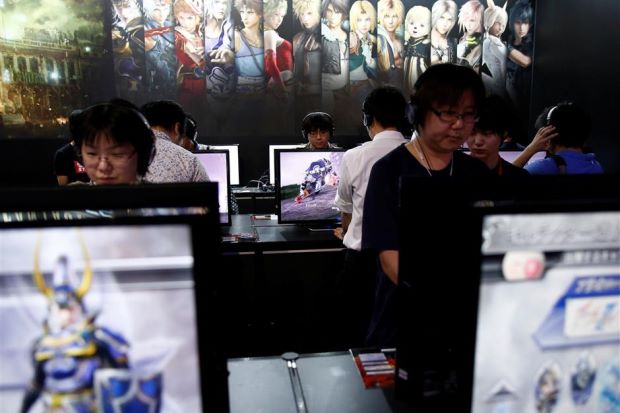
This week’s Tokyo Game Show will feature a main-stage tournament for PlayerUnknown’s Battlegrounds, a hit online survival PC game that’s been downloaded more than 10 million times since March.
Sony Corp’s PlayStation 4 and Microsoft Corp’s Xbox One consoles are heading into their fifth years, while Nintendo Co’s Switch is in a bit of a lull before new titles are released for the year-end holiday shopping season.
Spending on gaming-ready PC rigs are on track to climb an average of 6.6% per year through 2020, while the market as a whole is projected to decline 3.8% annually, according to Gartner Inc. Revenue from PC titles will grow by 3% to 4% over the coming years, while console-game sales are seen flat, according to DFC Intelligence.
Written off years ago for being too expensive, complex and bulky for mass appeal, gaming PCs are seeing a resurgence that could even threaten consoles, according to Kazunori Takahashi, Japan gaming head at Nvidia Corp.
“The abundance of titles and the popularity of e-sports is bringing a lot of excitement to PC gaming,” said Takahashi, whose employer supplies graphic chips to PC and console makers. Even in Japan, “it’s not unreasonable to think that PCs can eventually become a presence that threatens console gaming.”
Although consoles have traditionally dominated in Japan, their long development cycles and lead times for new game releases have started to frustrate consumers who want to get their hands on new titles. Consoles also can’t offer superior graphics and cheaper online networks for multiplayer gaming. Valve Corp’s Steam, a popular game downloading site, lets developers release titles for PCs months or years before they’re available on consoles.
PlayerUnknown’s Battlegrounds, known within the gaming community as PUBG, was released through early-access six months ago. Since then, it has sold more than 10 million copies and achieved a record for the most concurrent players on Steam, beating out well-known titles such as Minecraft, League of Legends or Counter-Strike. That’s even driving gamers to buy PCs just to play PUBG, according to NVIDIA’s Takahashi, a phenomenon that’s more common in the console market.
Sony and Microsoft haven’t ignored the threat, and last year began releasing upgraded versions of their consoles to prevent gamers from migrating to PCs. Consoles are also priced lower than PCs, and have a rich library of exclusive titles that keep customers hooked on their platforms for years. The console market is also much bigger; Sony forecasts that it will ship 18 million PlayStation units in the year through March, and Nintendo is predicting 10 million units for the Switch. By comparison, PC gaming-rig sales will be about 7 million units this year, according to Gartner.
In June, Microsoft announced a deal to release PUBG on Xbox by the end of the year. Sony hasn’t said when a version might be available for the PlayStation 4. Meanwhile, the game’s graphics demands make it unlikely it will appear on Nintendo’s Switch.
Laptops are another reason for the renewed popularity of PC games. With graphics chips getting smaller, along with better cooling systems and battery technology, some laptops now offer performance that can rival desktops, letting PC gamers play outside their home offices and living rooms. Gaming notebook builder Micro-Star International Co has seen revenue from gaming notebooks in Japan doubling every year since 2014, according to Ricky Chang, head of sales and marketing in the country. Shares of the Taipei-based company have more than doubled since 2013.
At the Tokyo Game Show, Japanese publishers, which built their businesses through consoles, are also showing signs of change. Square Enix Holdings Co will unveil new title Left Alive, which it plans to release on PC and PS4 around the same time in 2018. Similarly, Konami Holdings Corp’s Metal Gear Survive will see a PC release at the same time as the PS4 version next year.
The Tokyo Game Show started on Sept 21, and is open to the public Saturday (Sept 23) and Sunday (Sept 24).
“PUBG isn’t even available on consoles, so being able to play it on PC is hugely appealing,” said Satoshi Fujiwara, a 25-year-old Tokyo gamer who grew up playing consoles but recently spent US$2,000 (RM8,395) on a PC gaming rig.
“All the YouTubers and streamers and pro-gamers are using PCs. For those who really want to play competitively, they all end up going to PC.” — Bloomberg
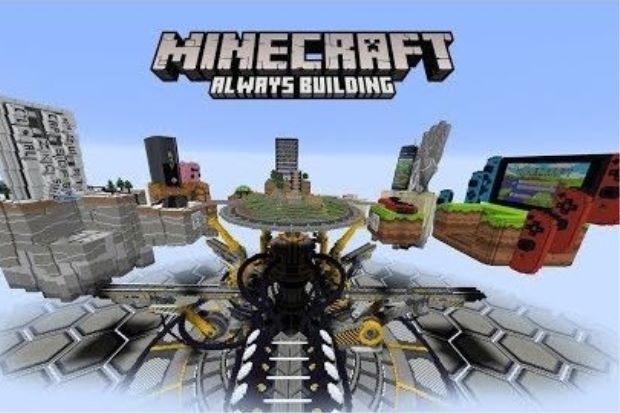
Players of generation-defining creation, construction and exploration game Minecraft can now play with each other regardless of the console, computer or phone they’re dialing in from – with a few but notable exceptions.
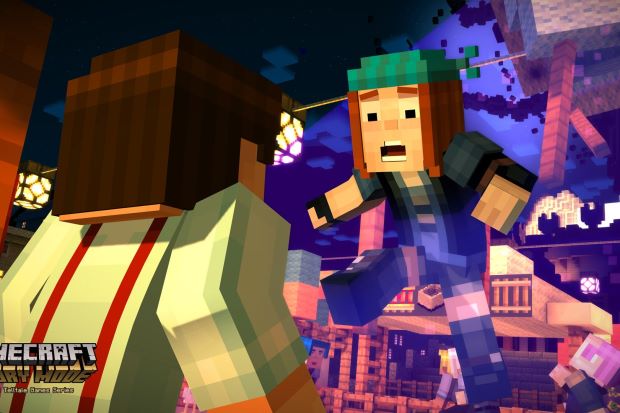
First emerging in 2009, the explosion of enthusiasm surrounding Minecraft saw it become a phenomenon, at first confined to computers but in 2011 spreading to mobile through iOS and Android editions.
From there, games consoles got in on the act with a 2012 release for Xbox 360 and subsequently for PlayStation and Nintendo platforms.
Since midway through 2016, Microsoft – which bought Minecraft studio Mojang in 2014 for US$2.5bil (RM10.49bil) – has been working on ways to unify the various home and portable editions of the game.
A Windows 10 Edition, released in 2015, encouraged computer users to upgrade from previous versions of Microsoft’s operating system and enjoy local multiplayer with iOS, Android and Windows Phone players.
That feature’s now been expanded to consoles – specifically, the Xbox One – thanks to the arrival of a Sept 20 update called Better Together.
Using Mojang’s proprietary Bedrock Engine, editions of the game capable of cross-platform multiplayer will be known as Minecraft while legacy versions will have relevant suffixes attached: the original Java-based computer game is now Minecraft: Java Edition, while the Wii U edition, which is not getting the update, is still Minecraft: Wii U Edition.
One other bonus of the transition is that progress can be logged on one machine and continued from another.
The update’s major caveat is that owners of the Xbox One disc edition have to play five or more hours, or purchase a digital add-on, by Jan 30 2018, in order to receive the digital update.
The whole thing is co-ordinated through Microsoft’s online network Xbox Live, and while Nintendo is happy to play ball when it comes to the Switch console’s upcoming Better Together update, Sony hasn’t been so keen with regards to potential PlayStation 4 action.
While Sony’s lack of participation appeared to be to do with legal responsibility for minors – “exposing what in many cases are children to external influences we have no ability to manage or look after” an executive said in June – a more profound level of objection is thought to rest on the PlayStation 4’s popularity relative to other modern home consoles.
Though Microsoft stopped reporting unit sales of its Xbox One in late 2014, the PlayStation 4 is thought to have outsold its nearest competitor by a ratio of at least 2 to 1.
It’s in Sony’s interest that players migrate to PlayStation in order to play with friends that are already there, rather than plump for another platform and link up with their Minecraft mates on PlayStation all the same. Why would Sony erode its advantage and encourage existing users to sign up for Xbox Live accounts in one fell swoop?
Evidently the appeal remains for Mojang. “We would love to work with Sony to bring players on PlayStation 4 into this ecosystem as well,” explains the Better Together FAQ. — AFP Relaxnews
Minecraft fans now, in theory, never have to stop playing their favourite game thanks to an update that brings it to a variety of platforms, including Xbox One, Android and Windows 10 computers.
The Better Together Update from developer Mojang not only connects more gamers, allowing them to play together, but it also facilitates new usage scenarios, for example the option to start a game on a console and then move onto a smartphone when you leave the house.
The update also brings new features such as playing time on community servers and automatic synchronisation of updates and content across all devices when you’re logged in with an Xbox Live account. — dpa
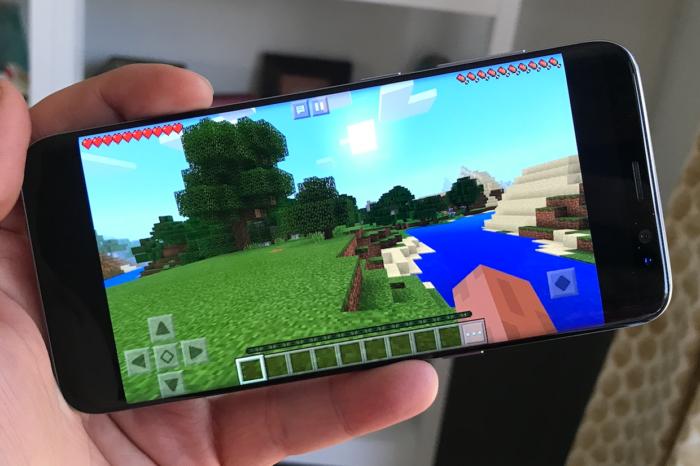
Mojang released Minecraft: Pocket Edition [$6.99] on the App Store back in August 2011, and initially the game didn’t feature many things to do besides very simple crafting and survival compared to its desktop counterpart. This led to our underwhelmed feelings in our original review of the game from November 2011. Despite that, Minecraft: Pocket Edition became the number one paid game for quite some time on the App Store, and it continues to hover near the top to this day. Mojang has released many updates to Minecraft: Pocket Edition since its original release, completely transforming it, which led us to re-review the game in October of 2015, giving it its rightful 5 stars. And even since then Minecraft: Pocket Edition has continued to receive significant updates, adding in the Minecraft Marketplace this past June and then the ginormous “Better Together” update just last month. Mojang rebranded Minecraft: Pocket Edition to simply “Minecraft” and introduced many features that may make you want to reinstall the game on your iOS or Android device. Rather than try to re-review the game yet again, we’ve put together a short list of some of the most significant new features that may make you want to revisit the mobile Minecraft if you had given the lesser versions a try previously.
A highly requested feature by many Minecraft fans was that if you played on mobile, console, or even PC you could play with other Minecraft players no matter their device. Well, with Microsoft’s help Mojang was able to integrate cross-play on iOS/Android, Xbox One, Nintendo Switch, and (of course) Windows 10’s edition of Minecraft (which is available in the Windows 10 store). This is a massive feature to be added to Minecraft since it hasn’t ever been playable across devices.
Marketplace to Spend Your Coins
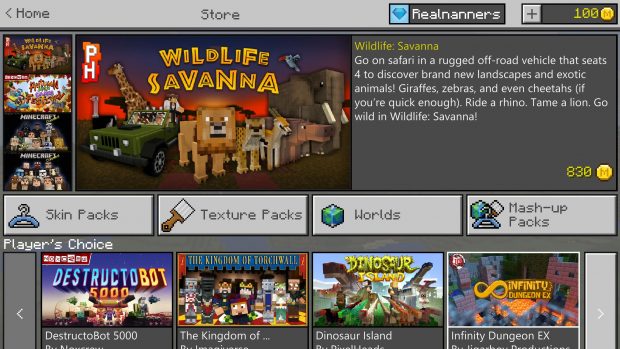
Minecraft has always been a “build your own” game unless you hop onto some servers and build with other players. With the newly released Minecraft “Better Together” update, it allows for the community to chip in and offer some sweet things like maps, texture packs, skins, mash-up packs, server items, and much more through the Marketplace. You can purchase these items in the Marketplace by spending actual money and purchasing “coins” which allows you to spend money on any items on the Marketplace.
Featured Servers
When I see new players playing Minecraft, I always seem to find them to never be able to find servers since they’ve just joined the community and unsure of where to find servers. Mojang has made it easier than ever to join servers if they’re approved by Mojang. Currently, there are only three featured servers which are Lifeboat Network, InPvP Network, and Mineplex. These are really great servers and seem to be very high quality. Those servers alone are a great reason to reinstall Minecraft.
Advanced Settings
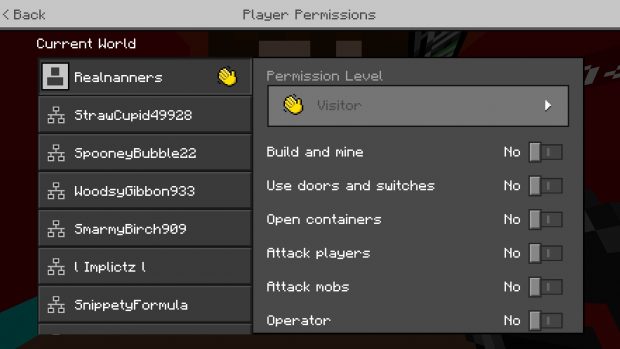
Minecraft on the mobile side of things has always lacked in the settings area of things considering the game relies a lot on customization and with the Better Together update it’s added a ton of new settings. Mojang allowed for more settings in-game like how storage is managed, quick switching of texture packs, skins, and even a better player permissions in settings, which allows for a lot better customization when playing the game with a lot of users.
Xbox Live Support
Lastly, Xbox Live support. This may seem like a terrible thing since Xbox doesn’t make mobile games and it’s one of Microsoft’s gimmicks but it actually has a really great use. If you own multiple copies of Minecraft; let’s say Xbox One, Windows 10, and on iOS, they’ve allowed for great syncing of information so all your stuff stays the same so you’ll never notice when you switch to different platforms. It’s all the same across both platforms.
If you’re a superfan of Minecraft, you’ve got to be there.
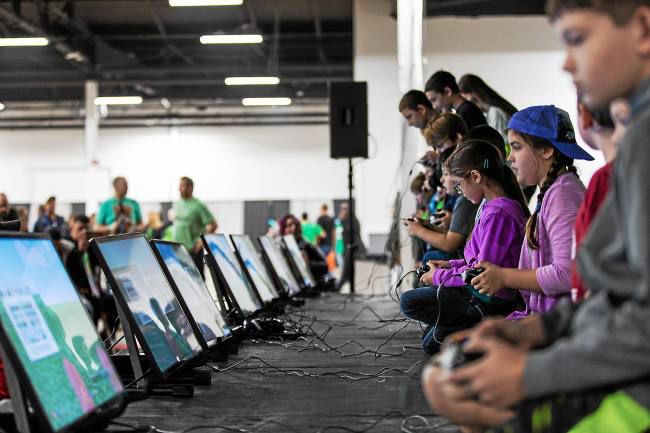
Minefaire, an official Minecraft fan experience, returns Oct. 14-15 to the region where it was created. Earlier this year Minefaire was held in Houston, Charlotte and Washington DC. Did you know that guinnessworldrecords.com says last year’s Minefaire held at the Greater Philadelphia Expo Center set a Guinness World Record for largest convention for a single video game?
Minecraft is the virtual game where you build new worlds, block by block, by mining the resources you find.
“It’s not just a game,” Minefaire cofounder Gabe Young said in a press release. “While you’re making dinner and your kids are playing Minecraft, they’re experiencing the huge educational and inspirational aspects that are driving them to become an engineer or an architect — to think really, really big.”
Chad Collins, one of the Bucks County fathers who founded Minefaire, also had a statement: “Minefaire is a chance for parents to connect with their kids through their favorite game and have a blast. We were determined to create a one-of-a-kind Minecraft experience you won’t find at home.”
So how big is Minecraft?
The Minefaire folks tell us that Minecraft is the second best-selling stand-alone video game of all time, with more than 122 million units sold. That’s second only to Tetris.
Where is Minefaire being held?
Halls A and B of the Greater Philadelphia Expo Center, 100 Station Ave., Upper Providence. That’s 150,000 square feet of all things Minecraft. Hours are 9 a.m. to 5 p.m. for both Saturday and Sunday.
Give me a summary of what’s going to be there.
A Mineplex with more than 45 original free-to-play games for varying skill levels (and 10 million players); Minecraft Virtual Reality Experiences; live performances on four “mega-stages;” a Minecraft costume contest; meet and greets with Minecraft YouTube stars; Build Battles for both kids and adults; a Learning Lab with official Minecraft mentors and educators that are using Minecraft in local classrooms; and new, rare and custom Minecraft items.
What’s the admission price?
All-inclusive tickets start at $29.50, free for ages 2 and under.
Frustration over Final Fantasy XIV’s housing shortage has come to a head after two players angered a lot of others by buying up 28 homes in the land-strapped massively multiplayer online game. Now, players are questioning whether virtual housing is an equal right or a privilege meant for the rich and over-dedicated.
The two players bought their homes in a formerly vacant corner of the game, a server called Mateus, where they could pursue dual ambitions of opulence and privacy. Their critics say they’ve hoarded land from dozens of FFXIV citizens, who feel they deserve a chance at housing. That criticism has gotten ugly as players hotly debate whether their elitism—or desire for mass amounts of property—has any place in a game where everybody pays the same fee.
Martyr Igeyorhm and Seraph Altima
“Given we both came to Mateus for the quiet, it’s distinctly uncomfortable to have others come in and insult us,” one of the bulk home-owners, a player who goes by the name Martyr Igeyorhm, told me during a tour of their two-occupant neighborhood today. “We’ve had to report people for harassment a few times.” Her housing partner Seraph Altima agreed, adding, “I think it’s wrong that people ignore the work and just see themselves being deprived.”
FFXIV has had housing drama as long as it’s had houses. When producer Naoki Yoshida introduced housing to FFXIV in 2011, he emphasized fair land distribution. But in the intervening years, housing has become a contentious topic in the game as speculators and thick-pocketed players monopolized property on big servers. Other times, players didn’t even use the houses they buy; it’s just a status symbol.
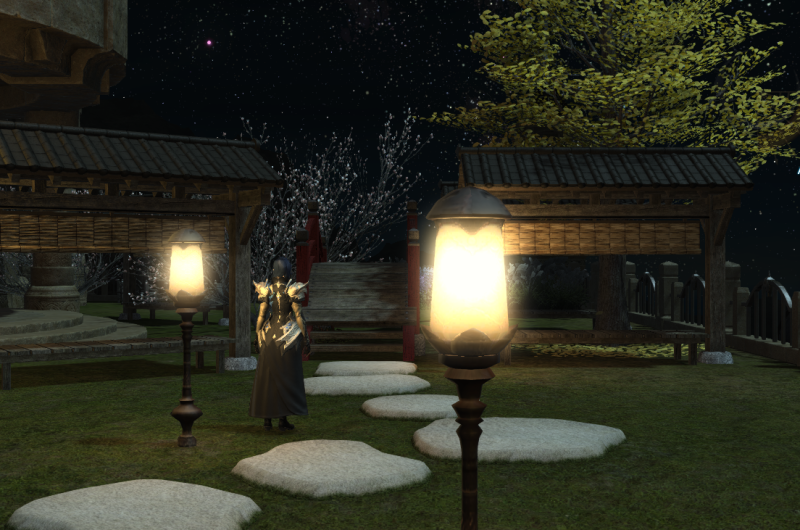
About 2,500 houses are available for each of FFXIV’s servers, which on average host over twice that amount of players. Houses aren’t a necessity in FFXIV, but owning one means having your own space to invite new raiding friends, host parties and, most importantly, decorate. Players paste ornate wallpaper to their walls, fill rooms with carved wood chests and candles and decorate with garlands and gold trimming. They cost several million FFXIV gil, unfurnished. Fur rugs, wall-to-wall bookshelves, portraits and hot tubs garnish the homes of more thick-pocketed players who choose to sink their resources in home decor. Smaller apartments remain available too, but without the grandeur of a garden or street entrance (and on some servers, houses are still available.)
Out of this design frenzy, an FFXIV adaptation of Cribs has even emerged. A year ago, it featured the player Seraph Altima and her “sanctuary,” complete with a lush garden, an attended full bar and stone partitions.
The reporter’s alternate account in Altima and Igeyorhm’s home
Altima had carved out sanctuaries on two of FFXIV’s most populous servers. There, not even apartments, the less sought-after housing option, remain on the market. Publisher Square Enix has been adding more plots to keep up with demand, and will add more in the future, but right now, there’s not enough to go around. Over e-mail, a Square Enix representative told Kotaku that players are only able to purchase one house per character. But because both individual players and Free Companies—FFXIV’s guilds—can own property, players break that mandate a lot.
Last year, Altima fled the game’s more populous servers and established her new home on the quaint Mateus. At that point, it was one of the only servers with a wealth of land. She and Igeyorhm claimed 28 plots and thought they’d have that space to themselves. Likely, their land avarice wouldn’t have become a problem if thousands of refugees hadn’t recently fled booked-up servers searching for fresh housing frontiers.
Square Enix started offering free server transfers prior to FFXIV’s June Stormblood expansion, so players who wanted to avoid the influx of returning fans could game in peace. Mateus, which was unofficially designated a new role-playing server and was still a pristine (and cheap) housing frontier, was quickly full of home-scouters. Eventually, the housing options in that server filled up, too. When incoming transfers realized that they could no longer purchase plots on Mateus, of all places, and noticed that two players owned a plush 28 plots, accusations of greed and unfeeling avarice spread. Over Facebook and Reddit, hundreds of players had angry words for the alleged gentrifiers who felt “entitled” to own all that property when so many recent transfers (and players still saving up) never had a chance to carve out a home on Mateus.
Altima and Igeyorhm’s underground library
Altima estimates that their 28 homes, the majority of an entire ward, cost around 150 million gil. If they had bought that gil, it’d have cost $375. On FFXIV this morning, Igeyorhm described themselves as “omnicrafters,” or players who “make all of our own items and sell other items for profit.” (To save a few bucks, most of their decor was made using FFXIV’s crafting system, too.) It took a lot of time. And she doesn’t feel sorry for players who put in less effort, or got to Mateus later along with the crowds. On a now-viral Tumblr post in response to public outcry, Altima wrote, “Many people feel entitled to own a house. They feel that even knowing there are only 2,160 plots (soon to be 2,880) on any given server, they can and should be allowed to go at their own pace and have free access to any content they like, including housing. They want a house of their own, but they don’t want to accept that lots of other people want it badly enough to work harder for it than they did.”
“Good lord,” a Redditor wrote. “People who aren’t rich enough to afford houses just aren’t TRYING hard enough? Not wanting neighbors putting up ‘ugly’ Paissa houses in ‘MY neighborhood?’ It’s like the most stereotypical rich snob attitude I’ve ever seen, except it’s apparently REAL (other than being in a video game).” Another described their actions as “selfishness because this person wanted to make a bastion of single-player content in a multiplayer game.”
Altima and Igeyorhm’s cake shop
I met Altima and Igeyorhm at the entrance of Goblet Ward 12 on FFXIV’s Mateus server. There, they fielded my questions while we toured through their saccharine two-floor cake shop, picture-perfect schoolyard, somber church to the FFXIV deity Zodiark and many, many gardens. Igeyorhm excitedly pointed out ice crystal formations and bubbling fountains between dives into hand-designed underground libraries and the like. I asked whether home construction was something she pursued in other games.
“Not really,” she said. “A lot of people like to ask us, ‘Why not play the Sims?’ Because we do so much other stuff!” Igyorhm said that, after her husband died, she hasn’t decorated much in real life. A few months later, she met Altima, and together they’ve spent an estimated thousand hours curating their 28 plots.
Neither thinks they’re unfairly eating up FFXIV’s limited housing resources. They blame Square Enix for not accommodating players’ passion for home-ownership—at least with houses. Although more cramped apartments are available on some servers and more housing will be added soon, the problem is more of philosophy than accessibility: Are players entitled to property in FFXIV—any more than they’re entitled to raiding mounts or veteran rewards? Is it the richer players, or the ones with more free time to grind out crafting exp, who are more entitled to take up space?
Altima and Igeyorhm’s schoolhouse
I asked Altima and Igeyorhm whether they’d give up any one of their plots for a new transfer desperate for a home. They paused. “These are our memories. Our precious time spent together,” Igeyorhm said.
Of course, some players still think they should be able to get those houses. “Not everyone needs everything in-game,” counters Altima. She argues that she’s not depriving anyone of housing; the plots were empty for years before they took them. “For example, not everyone deserves the Savage raiding mounts if they don’t do Alexander.”