
by Stone Marshall | Apr 24, 2016 | Awesome Book News, Minecraft News |
You now need a Prime subscription to buy games such as Grand Theft Auto 5, Rainbow Six: Siege or FIFA 16 direct from retail giant Amazon.
The bizarre change, spotted by Videogamer, appears to have quietly taken effect overnight.
But there’s a big caveat to the above. All of these games are still available to buy via Amazon through third-party sellers, whether you have Prime or not.
To many customers, little will actually change.

Note the new warning box on the right, but also the third-party sellers which are still available, and cheaper than Amazon itself.
Amazon uses third-party sellers extensively itself, listing many as being the option it uses to fulfill orders. Again, these are still available to non-Prime subscribers.
Still, the change is notable for the worrying precedent it sets and because it appears to be targeting a very specific section of its customer base – those who play video games – at least initially. It’s not hard to imagine a future where some games are locked behind Amazon Prime completely.
Other games affected by the change include Minecraft, Far Cry Primal, Dishonored: Definitive Edition, Middle-earth: Shadow of Mordor, Elder Scrolls Online, Assassin’s Creed Syndicate, Metal Gear Solid: Ground Zeroes, Battlefield Hardline. Even Farming Simulator.
An Amazon Prime subscription currently costs £79 per year.
Amazon marks GTA5, FIFA 16, Minecraft and more as “exclusively for Prime members”
![‘Minecraft’ News, Updates: Education Edition In The Works; No More Mods? [VIDEO]](https://www.stonemarshall.com/wp-content/uploads/an-image-from-minecraft-of-microsoft-that-is-about-to-get-an-education-edition.jpg)
by Stone Marshall | Apr 23, 2016 | Minecraft News |
Since “Minecraft” is already a big hit in schools and universities, Microsoft intends to release another update of its building block video game in order to be suitable for education. In May, hundreds of schools will commence testing the Education Edition of the game.
However, the tech giant did not reveal how much the schools will cost final version, or when it will be released. Microsoft creates the software as well as the projects to teach the instructors to use it.
Microsoft revealed via Cnet, “During the summer months, we are also going to be focused on working with educators on building out lesson plans, sharing learning activity ideas and creating reusable projects.”
One factor that made “Minecraft” suitable to almost everything from computer, programming to art and history, is its “endless possibilities.” Particularly, students take their own initiatives to study the game by themselves, Education World reported.
This development for “Minecraft Education Edition” is a slice of the giant leap for the game. Mojang, Swedish developer started by utilizing Java programming language for the said project. That has been known for people who like to create changes, named mods that modify how “Minecraft” works. On the other hand, “Minecraft” Pocket Edition that operates on Apple iPads and iPhones, tablets and smart phones powered by Google’s Android, are encrypted in the C++ language, Tech Times reported.
The game’s Education Edition will utilize the same language, according to Micrsoft. This implies no mods. Microsoft plans to include command blocks and mods, which is next to the C++ version. This will need Apple’s OS X 10.11 El Capitan and Windows 10.
The C++ foundation is also used in the updated Microsoft’s reality headset, Hololens and Facebook’s Oculus Rift virtual reality headset.
Are you excited for the Education Edition of “Minecraft”? Let us know what you think by leaving your comments below.
‘Minecraft’ News, Updates: Education Edition In The Works; No More Mods? [VIDEO]
by Stone Marshall | Apr 23, 2016 | Minecraft News |
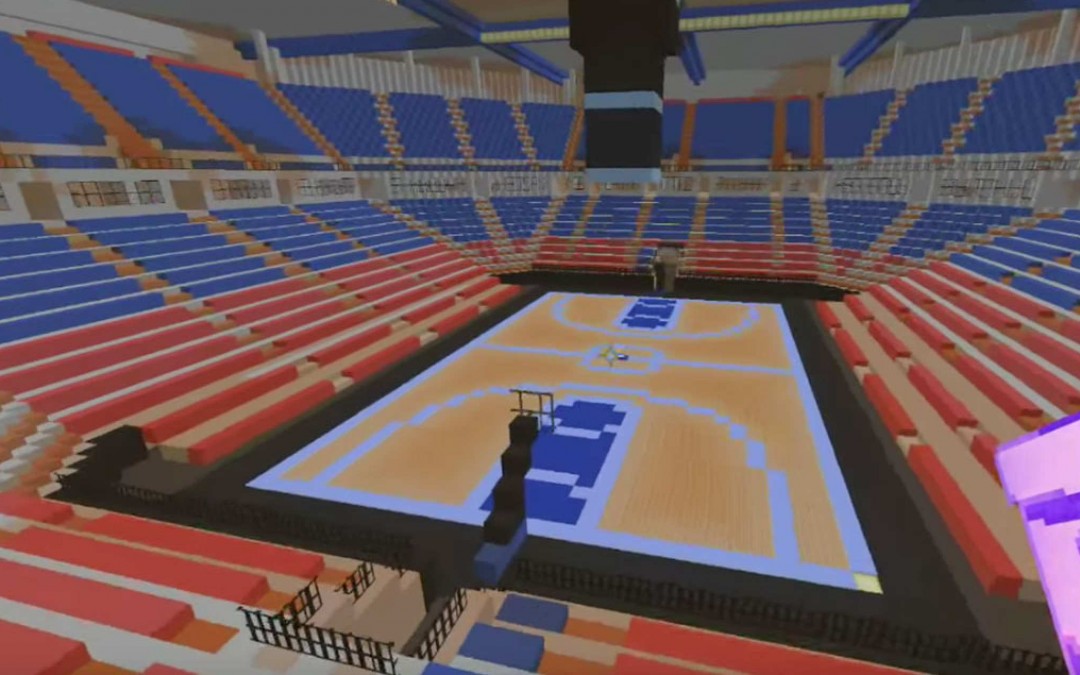
As Sleep Train Arena closed its doors to NBA basketball, an avid Minecraft builder recreated the legendary Sacramento venue.
The popular computer game Minecraft allows players to live without traditional structure or direction. Thus, gamers are free to create whatever they want inside of the Minecraft world.
User “The Greynation” did just that, by creating popular, NBA, MLB and NFL stadiums via Minecraft building blocks.
Prior to the start of the final season at Sleep Train Arena, he made a near-exact inside/outside replica of the venue the Kings have called home since 1988.
Check out the video below of the numerous in-arena entertainment setups as envisioned by “The Greynation:”
Fan Creates Sleep Train Arena in Minecraft
by Stone Marshall | Apr 22, 2016 | Minecraft News |
For those not in the know, Minecraft is a bestselling open world game where players can explore and interact with a world of blocks (each carrying different attributes inside that world). The phenomena has spread far and wide, laying the foundation for one of the most creative digital playground in the world. A recent report from The New York Times reveals that the game is selling 10,000 copies per day. Considering that the game was first launched five years ago, that’s a very impressive sum.
Most games enjoy remaining relevant during a release window spanning no more than the first few months, which is when games tend to sell the most. Meanwhile,Minecraft has sold over 100 million units to date, helped in no small part to its availability on a multitude of platforms.
Given its simple graphics and enormous creative possibilities, it’s no surprise thatMinecraft also has seen huge success in the younger generation. These blossoming gamers can mine blocks and then use them to create defenses against enemies, or they can play around freely and create whatever they want. You can choose one of five different game modes, but you can boil it down to either playing or creating. The game’s creative mode is the component that engages players to recreate things like the U.S.S Enterprise from the Star Trek series, or the main capitol from Game of Thrones.
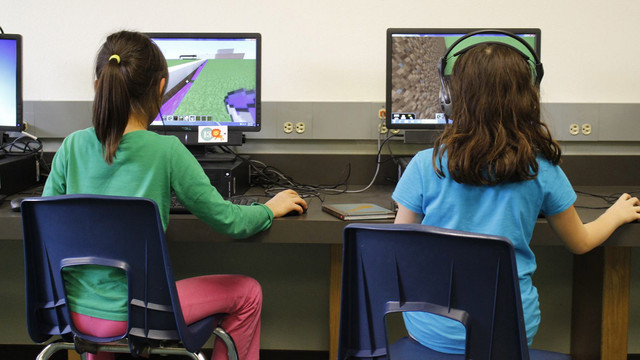
For kids, a playground that allows for all these different creations is driving their understanding of computational thinking. The report argues that this is one of Minecraft’s most powerful effects. It’s no surprise then that Microsoft announced Minecraft: Education Edition.
Minecraft’s worlds are enormous; an unaltered world consists of up to 60 million blocks. The block that drives this computational thinking is primarily the redstone, which allow players to experiment with logical functions and create other games inside the game itself. Some players have even created functioning computers. These stones basically work like electrical circuits, and specific objects you create inside theMinecraft world will be activated and perform a predetermined action when activated by a redstone. Of course, you can also connect redstones to one another, opening up a whole slew of possibilities. Working like this requires a lot of rewiring, and things won’t always work the way you imagine.
Kids are learning to engage in a visual form of debugging, where they have to experiment and find the issue. The report mentions a fifth-grader that tried creating a redstone door that didn’t open when activated, so she had to track down the failing component of her redstone setup and fix it manually.
Young gamers are learning problem solving by playing around in digital worlds, and they’re doing it in a way that resembles programming logic. Thus Minecraft is, perhaps, teaching our kids to learn programming more effectively than our educational systems.
MINECRAFT SELLS 10,000 COPIES PER DAY — TEACHES COMPUTATIONAL THINKING
by Stone Marshall | Apr 18, 2016 | Minecraft News |
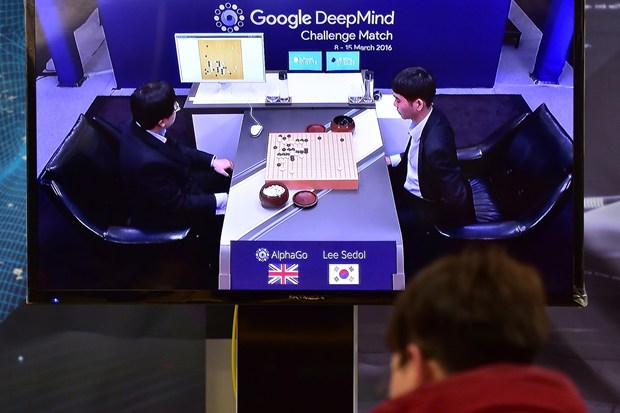
The artificial intelligence created by Google and London-based DeepMind has taken a two-game lead in a landmark championship against the one of the world’s best players at the ancient board game of Go.
The AlphaGo AI defeated South Korean grandmaster Lee Sedol in another tense game, at the Korea Baduk Association in Seoul on Thursday.
The match was another tight encounter, which entered overtime before AlphaGo eventually triumphed. “AlphaGo played some beautiful creative moves in this game,” said Demis Hassabis, Deepmind founder, on Twitter. He added that 100 million people had watched the first match online, including 60 million in China.
The victory puts Deepmind on the verge of a remarkable triumph, which some experts have suggested is a decade or more ahead of schedule in the development of true, ‘thinking’ AI.
The two sides will play three more times over the next week, with the winner taking a $1 million prize. Lee will have to win every remaining match to take home the prize.
Deepmind had already defeated the European champion of Go, the company said in an announcement made in the journal Nature in January. Google purchased Deepmind for an estimated £400 million in July 2014.
The territorial 3,000-year-old game is regarded as one of the most complex that a computer could be asked to tackle, having simple rules that extrapolate out into virtually endless, intricate scenarios. Unlike chess, which can be theoretically masted by memorising an admittedly vast number of moves and scenarios, Go requires human-like intuition, thinking and forward planning to be successful.
AlphaGo combines advanced search techniques with neural networking, allowing it to both think creatively and take advantage of huge amounts of data about previously played games of Go. Using 12 ‘layers’ of AI, it selects its next move using just one element of its system while the others predict how the rest of the game will play out. Predicting the future in this way, it adjusts its strategy and moves gradually towards victory.
The development of AlphaGo is regarded as an early step towards a true artificial intelligence, which could have an incalculable impact on human lives, economics and technology.
Deepmind AI beats human champion again

by Stone Marshall | Apr 18, 2016 | Awesome Book News, Minecraft News |
From the start, the enemy aliens are making kills — three times they destroy the defending laser cannon within seconds. Half an hour in, and the hesitant player starts to feel the game’s rhythm, learning when to fire back or hide. Finally, after playing ceaselessly for an entire night, the player is not wasting a single bullet, casually shooting the high-score floating mothership in between demolishing each alien. No one in the world can play a better game at this moment.
This player, it should be mentioned, is not human, but an algorithm on a graphics processing unit programmed by a company called DeepMind. Instructed simply to maximise the score and fed only the data stream of 30,000 pixels per frame, the algorithm — known as a deep Q-network – is then given a new challenge: an unfamiliar Pong-like game called Breakout, in which it needs to hit a ball through a rainbow-coloured brick wall. “After 30 minutes and 100 games, it’s pretty terrible, but it’s learning that it should move the bat towards the ball,” explains DeepMind’s cofounder and chief executive, a 38-year-old artificial-intelligence researcher named Demis Hassabis. “Here it is after an hour, quantitatively better but still not brilliant. But two hours in, it’s more or less mastered the game, even when the ball’s very fast. After four hours, it came up with an optimal strategy — to dig a tunnel round the side of the wall, and send the ball round the back in a superhuman accurate way. The designers of the system didn’t know that strategy.”
In February, Hassabis and colleagues including Volodymyr Mnih, Koray Kavukcuoglu and David Silver published a Nature paper on the work. They showed that their artificial agent had learned to play 49 Atari 2600 video games when given only minimal background information. The deep Q-network had mastered everything from a martial-arts game to boxing and 3D car-racing games, often outscoring a professional (human) games tester. “This is just games, but it could be stockmarket data,” Hassabis says. “DeepMind has been combining two promising areas of research — a deep neural network and a reinforcement-learning algorithm – in a really fundamental way. We’re interested in algorithms that can use their learning from one domain and apply that knowledge to a new domain.”
DeepMind has not, admittedly, launched any products — nor found a way to turn its machine gameplay into a revenue stream. Still, such details didn’t stop Google buying the London company — backed by investors such as Elon Musk, Peter Thiel and Li Ka-shing — last January in its biggest European acquisition. It paid £400 million.
DeepMind: inside Google’s super-brain
