MARVEL ANNOUNCES “STAR WARS: POE DAMERON” SERIES FROM SOULE & NOTO

MARVEL ANNOUNCES “STAR WARS: POE DAMERON” SERIES FROM SOULE & NOTO

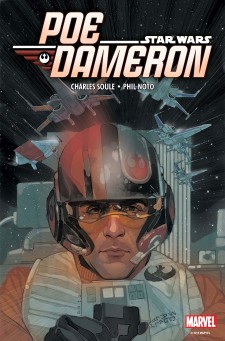
Following the record-obliterating box office run enjoyed by“Star Wars: The Force Awakens,” it seemed like only a matter of time before Marvel announced a comic book tie-in. Now, USA Today has announced that Poe Dameron, the best fighter pilot in the Resistance, will get his own ongoing comic book series.

Launching in April, the ongoing “Star Wars: Poe Dameron” comes from a pair of comic creators — Charles Soule andPhil Noto — that are veterans of Marvel’s Star Wars line. The series marks writer Soule’s third entry into the canon, following the “Lando” and “Obi-Wan & Anakin” limited series. Noto will serve as Soule’s co-pilot, making “Poe Dameron” the artist’s second Star Wars series following “Chewbacca.”

Poe as played by Oscar Isaac has become a breakout character from “The Force Awakens,” and series writer Soule told USA Today that seeing “people reacting to him so strongly now just feels like we’re hopefully in a great position.” Soule reacted strongly to Poe, sharing his enthusiasm for the character during “Force Awakens'” opening weekend.

tumblr o0ym16PoSp1tcxkqzo2 r1 1280

“Poe Dameron” sketches by Phil Noto

“I’ve seen people on Twitter and Instagram looking for Poe Dameron in the comics,” added Noto. “Now the pressure’s on us to deliver.” Writer Charles Soule was also one of those people tweeting praise for Poe Dameron.

The series will be set prior to the events of “Star Wars: The Force Awakens,” in the gap between “Return of the Jedi” and the latest Star Wars film. The series will also introduce a new threat from the First Order that will serve as Poe’s primary antagonist, with Soule commenting that the new villain “is going to feel fresh and cool.” BB-8 and some of the newly introduced X-wing pilots will round out Poe’s supporting cast.

“Poe Dameron” will be the second series set in that 30-year gap, following last year’s “Journey to the Force Awakens – Shattered Empire” limited series. A prose novel, “Before the Awakening,” also explored Poe Dameron in this time period.

“Star Wars: Poe Dameron” arrives in April.

MARVEL ANNOUNCES “STAR WARS: POE DAMERON” SERIES FROM SOULE & NOTO

Marvel Confirms Shelving ‘Fantastic Four’ as Ongoing Comic Book Concern

Marvel Confirms Shelving ‘Fantastic Four’ as Ongoing Comic Book Concern

Marvel Confirms Shelving ‘Fantastic Four’ as Ongoing Comic Book Concern
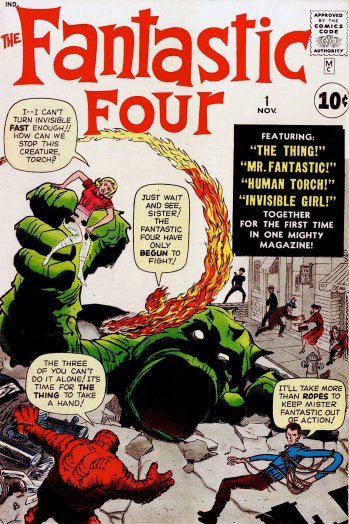
This will be the first time Marvel has not had a Fantastic Four comic in publication or development in more than five decades. Jack Kirby/Marvel Enterprises
This will be the first time Marvel has not had a Fantastic Four comic in publication or development in more than five decades.

It’s not a good time for Marvel’s first family. Not only did Fox’s second attempt at the Fantastic Four movie franchise crash and burn at the box office last year, but with the release of the much-delayed final issue of Marvel’s Secret Wars series, the publisher has brought the comic book adventures of the team to a close as well. Spoilers for Secret Wars follow.

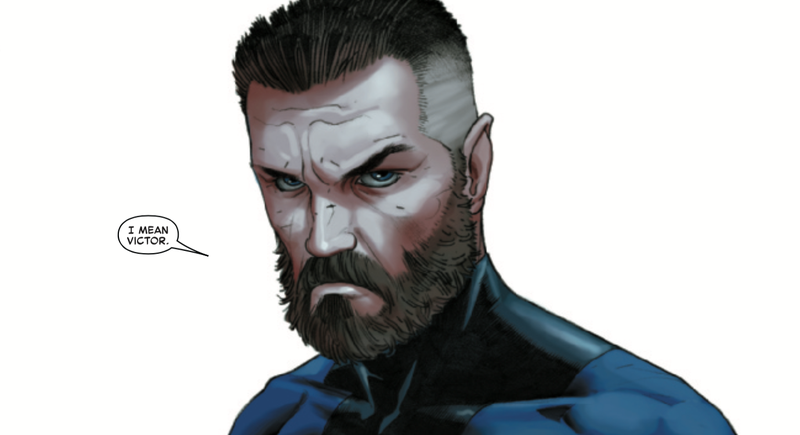
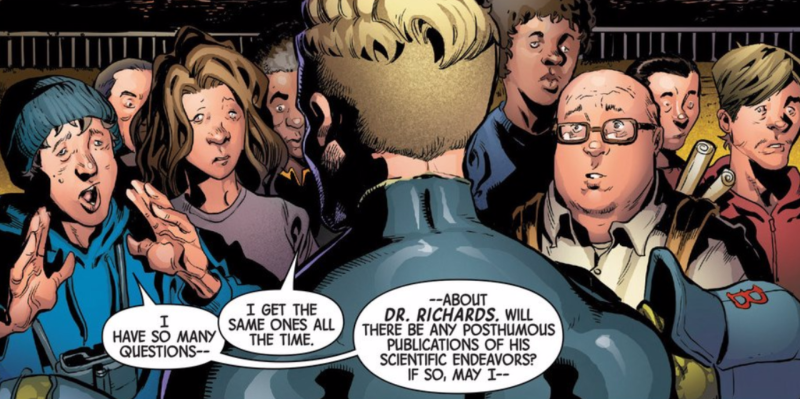
By the close of Secret Wars No. 9, Reed Richards, his immediate family — wife Sue, and children Franklin and Valeria — and group of students the Future Foundation end up outside reality, creating new universes in an attempt to repopulate a comic book multiverse decimated by events leading up to the series. A bearded Richards makes a metatextual comment to emphasize his retirement to the reader: “No more superheroes for a while, just science. And no more Mister Fantastic, just Dad. That doesn’t sound too bad, does it?”

In an interview with Comic Book Resources, Marvel executive editor Tom Brevoort said that, “at a certain point, we set out [in Secret Wars] to do the last Fantastic Four story, at least for the time being,” although he admitted that, “we didn’t necessarily start with that as the original goal.”

The end of the Fantastic Four as a comic book property has been a matter of much speculation for months, with the title not being listed among the many relaunches as part of the publisher’s All-New, All-Different Marvel comic book line reboot. The idea that the comic book was a casualty of a struggle between Marvel and Fox was often floated, but Brevoort said that the reason for the decision has more to do with reader and creator apathy toward the concept.

“Fantastic Four has been one of those books that, for a number of years, has been effectively taken for granted,” he told CBR. “It’s been considered stodgy, or old school, or some people see it as a thing that’s there and people are comfortable because it’s there, but they’re not particularly passionate about it. So we’re not going to have that book for a while.”

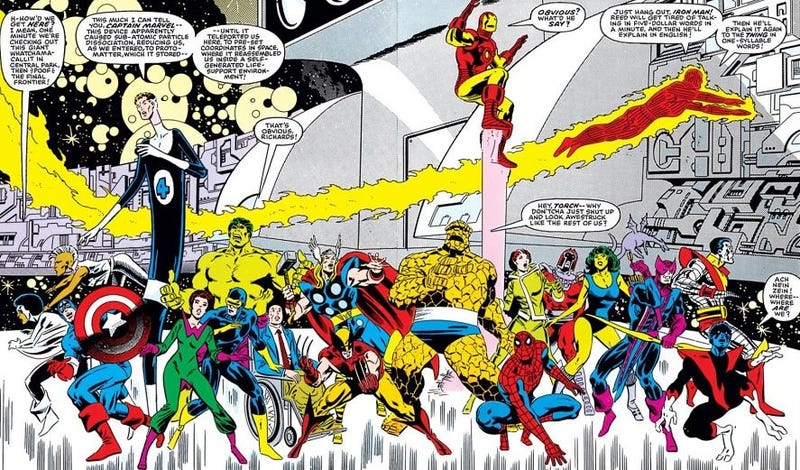
Fantastic Four was the series that launched Marvel Entertainment as it’s known today, with the success of the book’s 1961 debut leading to the creation of such characters as Iron Man, Spider-Man, the X-Men and the Hulk. A handful of Marvel characters, most notably Captain America, predate the creation of the Fantastic Four, but it was the response to the work of Stan Lee and Jack Kirby on Fantastic Four that led to those characters being brought back into use, as well as the creation of the shared “Marvel Universe” seen in Marvel Studios movies today. This will be the first time Marvel has not had a Fantastic Four comic in publication or development in more than five decades.

Some of the FF characters will continue to appear in other series — the Thing is part of the Guardians of the Galaxy cast, with the Human Torch appearing in both Uncanny Avengers and Uncanny Inhumans — and Brevoort said that “inevitably and invariably” the rest of the cast will return at some point in time. (An evil alternate universe version of Reed Richards is already appearing in the New Avengers series.)

“We didn’t have a Thor book for a while,” he explained. “For a couple of years, there was absolutely no Thor book, and when Thor came back, it was a huge book. It continues to be a huge book to this day. I think that absence was part of what made people cherish its return, and then it was just having great talent to execute that return. If the same sort of thing happens with Fantastic Four that would not be the worst thing in the world.”

Marvel Confirms Shelving ‘Fantastic Four’ as Ongoing Comic Book Concern

Secret Wars’ Finale Says Goodbye to the Marvel Comics of Old

Secret Wars’ Finale Says Goodbye to the Marvel Comics of Old

Secret Wars' Finale Says Goodbye to the Marvel Comics of Old

The final issue of Marvel’s everything-changing event series bids farewell to the fictional father figure of its superhero reality. Reed Richards doesn’t exit the stage quite the way we’ve been led to believe, either.
Secret Wars' Finale Says Goodbye to the Marvel Comics of Old

The end of Secret Wars comes a few months deep into an aftermath that’s well underway. Marvel Comics’s All-New, All-Different initiative is a complete re-imagining of their universe’s characters and status quos. The changes so far have given readers a Spider-Man who runs a global tech conglomerate, a female Wolverine and a Hulk who isn’t Bruce Banner. All of this takes place eight months after the end of Secret Wars. The Fantastic Four is no more, and the Human Torch and the Thing fight evil on different super-teams. The whereabouts of Reed Richards (the original, not his evil alt-reality counterpart) have been an ongoing mystery for a while, with allusions to his apparent death.
Secret Wars' Finale Says Goodbye to the Marvel Comics of Old

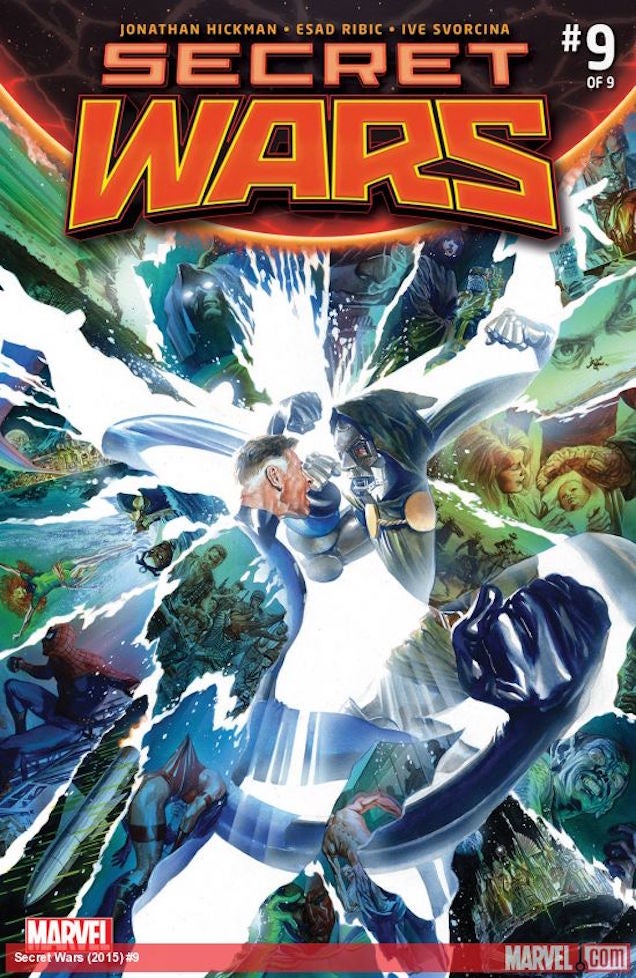
Secret Wars #9—out this week from Jonathan Hickman and Esad Ribic—shows what happened to Mr. Fantastic just before the Marvel Universe gets reborn.

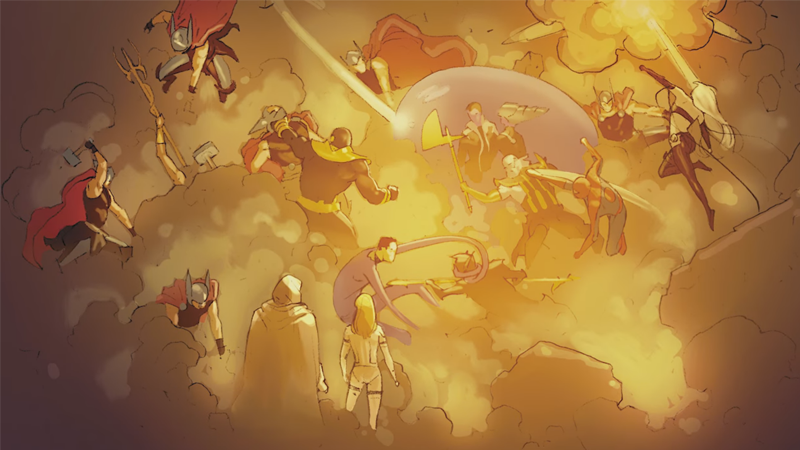
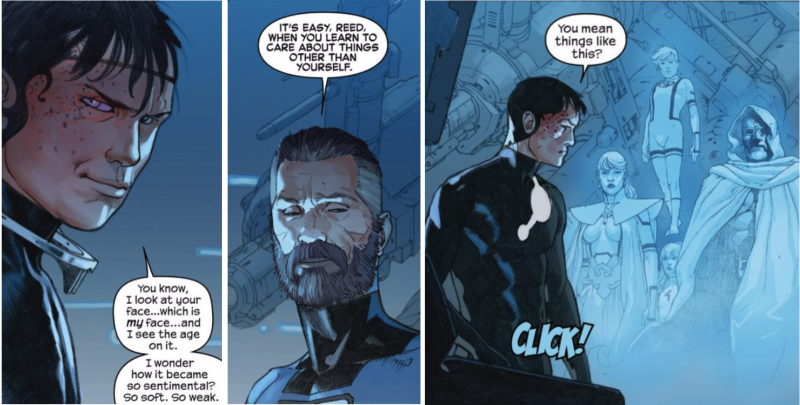
Secret Wars has been happening on a cosmic scale. It is set on a patchwork planet created by Dr. Doom after snatching omnipotence from mysterious beings who were orchestrating the end of all existence. What’s made the series the best mainstream crossover event in recent memory, though, is that it’s actually a focused character study. It’s largely been concerned with Victor Von Doom and the way that the archvillain has embodied godhood, but there’s been an increasing focus on his lifelong enemy, too. After surviving the erasure of the multiverse, Reed Richards has found himself in a reality where his life has been stolen. He’s been focused on working with the Black Panther, Namor and other survivors to come up with a way to defeat Doom-turned-God. The scenes where he reckons with what’s been lost, like the ones below from Secret Wars #6, have been wrenching.
Secret Wars' Finale Says Goodbye to the Marvel Comics of Old

The difference between superficial and meaningful change can be hard to chart in superhero comics. Death, estrangement and other reversals are just storytelling tools used in panels and word balloons. But Marvel Comics’ latest mutations have been consequential in game-changing ways. The company whence Iron Man, Captain America and the X-Men sprung isn’t just a comics publisher anymore. Even before its acquisition by Disney five years ago, Marvel was acting on ambitions to make their characters the source of an ambitious multimedia business. Those ambitions have been largely met, manifesting in a reality where multiple Marvel-branded movies and TV shows come out every year.

This issue’s best subtext is in how Hickman comments on the real-world shifts that are seemingly influencing how Marvel is grooming its stable of characters. Despit rampant speculation, it’s never been explicitly confirmed that 20th Century Fox’s command of the Fantastic Four film rights is the reason that Marvel isn’t publishing a monthly series featuring their beloved super-family. But the way that the publisher has reconfigured its fictional landscape is clearly prioritizing characters whose film and TV rights are under Marvel’s control. For example, the X-Men franchise is another one whose multimedia rights are controlled by a non-Marvel/Disney entity so the new Marvel Universe is a place where mutants are becoming extinct while the Inhuman population booms. Those are the same Inhumans who are a major part of Disney-owned ABC TV show Agents of SHIELD. If they are what they seem to be, editorial decisions like these—driven by outside factors—are a big change from how Marvel used to craft its storylines.

That change is deeply felt in Secret Wars #9, which reads like an explosion of all the series’ various attributes. There are giant battles of epic scale, shot through with heated monologues revealing how characters see themselves and others. The issue ends with a glimpse of the new reality Marvel’s heroes inhabit and teases the reason that Miles Morales got his mother back. Early on, as the Black Panther and Doom face off in a prelude to the series’ final showdown, Doom sneers at the attacks on his rule, characterizing them as “machination.”

It’s a sly beat that reminds readers that all superhero universes are the aggregate results of decades of tweaks, feints and left turns. Machinations, both metafictional intratextual, aren’t anything new in cape comics. What’s changing now is the fact that the successes of various adaptations appear to be filtering back into the wellspring that the TV shows and movies came from. It’s an undeniably plausible reason that, say, Daredevil has a secret identity again.

There’s also a sense of closure here, as Hickman returns to characters and scenes from his tenures on various Marvel series. The Black Panther counsels young charges in his kingdom like he did in New Avengers #1, but it’s the beginning of a new universe—and not the impending death of many—that serves as a backdrop. Epitomized by a stellar stint on the Fantastic Four family of titles, Hickman’s time at Marvel linked many of the publisher’s franchises into a sprawling mega-story, concerned in part with the hard choices superheroes have to make to preserve entire societies. Fittingly, Secret Wars ends with Reed Richards peacefully resigning himself to the idea of a new Marvel Universe built off of the emotional resonances of the old one. He can’t be part of it now, but serves in a role that’s a tacit acknowledgement that he’ll always be the foundation stone upon which Marvel’s superhero successes were built
Did You Forget What Marvel’s Secret Wars Was About? Let Us Remind You!

Did You Forget What Marvel’s Secret Wars Was About? Let Us Remind You!

Did You Forget What Marvel's Secret Wars Was About? Let Us Remind You!

Marvel finally did it. Eight months after it began, Secret Wars came to a close today, after nine issues of reality-bending madness. No idea what the fuss is? Want to get in on the event that brought us an All-New Marvel universe, juuuust as it’s ending? What the hell happened to the Fantastic Four? Here’s our guide.

Just a warning, going in—we’re not going to be spoiling the final issue of Secret Wars #9, which was released today. But obviously, plot points from the first 8 issues of Secret Wars, by Jonathan Hickman, Esad Ribic, Ive Svorcina, and Clayton Cowles, will be detailed below. You’re been warned!

Did You Forget What Marvel's Secret Wars Was About? Let Us Remind You!

So. Secret Wars. Didn’t that happen in like, the ‘80s?

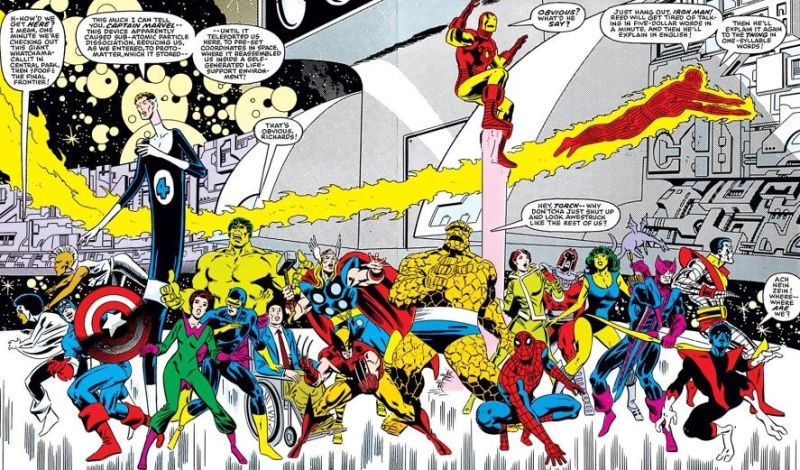
It did! The 2015 series shares its name with the classic Marvel “event” series that took place in 1984. The new Secret Wars only really shares a name and the concept of the “Battleworld”, which all 9 issues of Secret Wars and its various spinoff series took place on.

Battleworld?

We’ll get to that, first, you have to deal with the Universe exploding.

Whaaaaaaaaaa?

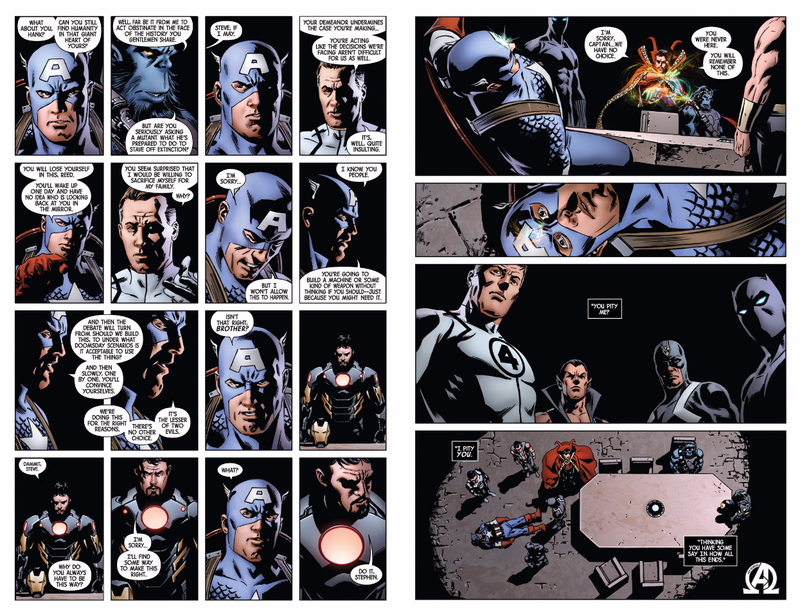
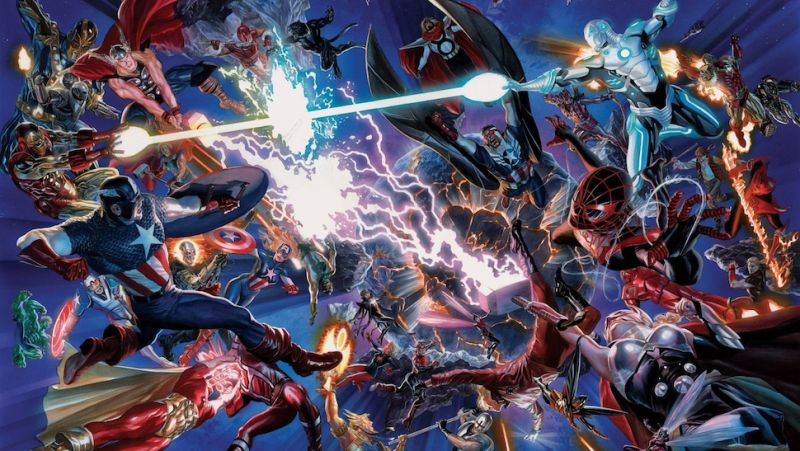
Okay, let’s actually dial it back a little bit further, because Secret Wars is essentially the culmination of a plot that’s been swinging around in writer Jonathan Hickman’s New Avengers comic series. Basically, the New Avengers—Captain America, Tony Stark, Reed Richards, Namor, Doctor Strange, and Black Bolt—faced a terrible battle. Parts of Marvel’s various alternate universes were smashing into each other, creating “Incursions” that essentially destroyed either one of the universes or both in the process. The Avengers had to be willing to do anything to stop that happening to their own reality.

Did You Forget What Marvel's Secret Wars Was About? Let Us Remind You!

Sounds dark.

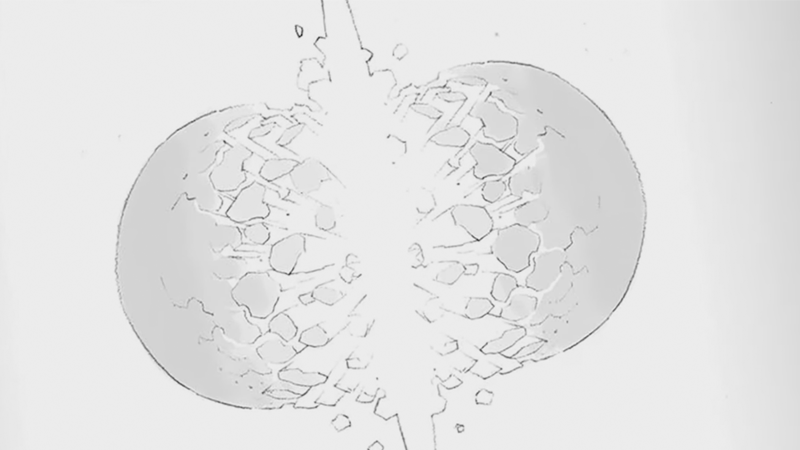
It was very dark—Hickman’s New Avengers saw some of Marvel’s greatest heroes sacrifice a lot to ensure the safety of their universe. They erased Steven Rogers’ memory when they decided they needed to go beyond Cap’s moral code. They kept a woman from an alternate universe captive. Hell, at one point they actually destroyed another universe to save the main Marvel reality. In the end, even these heroes sinking to their lowest didn’t save them. The Ultimate Marvel universe, known as Earth-1610, smashed into the main Marvel Universe, Earth-616, destroying both.

Wait a second. What the hell is Ultimate Marvel? Doesn’t that mean the best Marvel? Why isn’t that one the main universe if it’s the Ultimate one!?

The Ultimate universe first appeared in 2000, an alternate take on Marvel’s most iconic heroes that updated their origins and stories for the modern day. Peter Parker’s no longer a freelance photographer but the Daily Bugle’s website admin—things like that. The Ultimate universe was one of Marvel’s most popular alternate takes on its heroes, and home to some fantastic characters. Like Miles Morales, who took over from Peter Parker as Spider-Man.

Did You Forget What Marvel's Secret Wars Was About? Let Us Remind You!

So it was a big deal when it ended, seemingly for good, by taking out the prime Marvel universe in a big fiery explosion. Many heroes from the 616 and 1610 Earths survived though, after figuring out there was no point fighting each other and instead getting on some spaceships, hoping to ride out the cataclysm.

So where does Secret Wars take place, if the Marvel universe is dead?

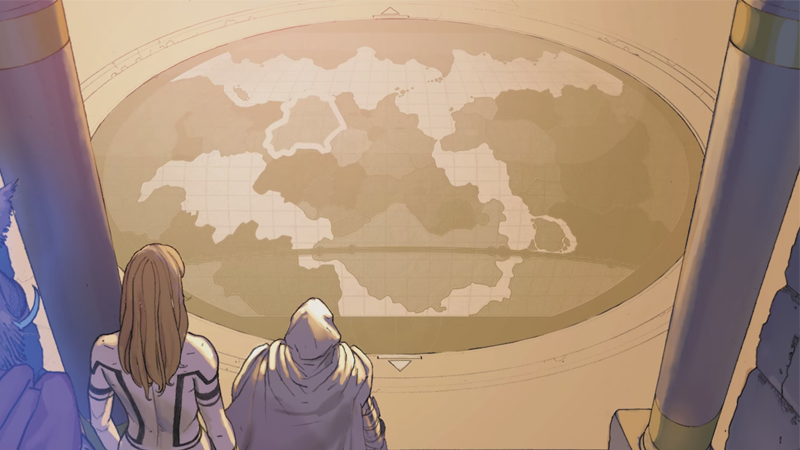
Remember when I mentioned Battleworld earlier? The Battleworld is a mish-mash of different alternate worlds, smushed together into one. The escape crafts of the surviving heroes crash land there, only to find out each region—populated by alternate versions of many heroes, with recreations of old Marvel events, like Age of Ultron or X-Men Apocalypse, alongside new things like the wild-western 1872—was ruled by the iron fist of Doctor Doom, the God-King of the new universe.

Wait. How the hell did Doctor Doom survive? And become god?

While the New Avengers were going around being morally problematic in their quest to save the world, arguably Doom tried to be the most noble—in his own, Doom-y way. Victor realized that the Beyonders, godlike beings who played a part in the creation of the Marvel cosmos, were the ones behind the destruction of the alternate realities. Doom, with the help of Doctor Strange and Molecule Man, managed to thrash the Beyonders, hoping that by taking their power he could save reality. He couldn’t, but he used it to reforge the remaining shards of different universes into one single remaining world.

Did You Forget What Marvel's Secret Wars Was About? Let Us Remind You!

Seems kind of benevolent, for a Supervillain.

Well, having absolute power let Doom basically create a fantasy world for himself to play about it. The “Baron” of each region of Battleworld had to report to Doom, the ultimate ruler of the world—something Doom has wanted forever—and a man who could reshape reality at the click of his fingers.

He commanded an army of alternate Thors to police the world (they were called the Thor Corps. Cute name aside, they were not to be trifled with). He erased the memory of Reed Richards from the mind of Sue Storm and Richard’s children, Valeria and Franklin, and made them his own family, to spite his longtime nemesis. Hell, he even made Galactus his personal lapdog, for christ’s sake.

Okay, less benevolent. No one tried to stop him?

No—the Thor Corps ensured that there was no travel between different regions of the Battleworld, and after all, Doom had godlike powers. He could do whatever he wanted, and Battleworld was mostly fine to exist with him ruling it all. He did so happily for eight years, until the escape ships containing the survivors of the Ultimate and Prime Marvel universes arrived. Being the superheroes we know and love, they didn’t take too kindly to Victor Von Doom being god.

Did You Forget What Marvel's Secret Wars Was About? Let Us Remind You!

But how do you fight god?

Good question. They tried to battle Doom, but with his almighty power they couldn’t beat him. Before he could deal the killing blow that would’ve snuffed out Marvel’s most iconic superheroes, Stephen Strange—who had spent those eight years as Doom’s lackey, believing his closest allies were lost—used his magic to scatter the heroes across the Battleworld, something Doom snapped his neck for.

Oh, and he blamed Strange’s death on the heroes, charging Valeria Richards, who still thought Doom was her father, with hunting them down.

Okay. But when this Secret Wars thing started, Marvel cancelled a bunch of my comics and replaced them with all these Battleworld comics. What’s the deal with that?

With the universe destroyed, those comics couldn’t really continue. Secret Wars was designed to be a total reboot of the Marvel comic universe, something they hadn’t really done on this scale. Its current crop of comics ended, and were replaced by tons and tons of new miniseries that were set in the different regions of Battleworld, exploring these strange places and offering twists on old stories like Civil War or Armor Wars or even things that weren’t wars!

Do I have to read all of them to understand Secret Wars then? I don’t have the time, money, or sanity to do that.

No one does. If you just want to catch up on the main thrust of Secret Wars, just read the main Secret Wars series, which ran for 9 issues and ended today.

Great! So, heroes scattered, Doctor Doom triumphant. What happened next? Were our heroes… doomed?

See what you did there. Well, the heroes were scattered, but not broken. They even managed to find regions that were disgruntled with Doom’s long rule, and slowly built an army of resistance that could march upon Doom’s castle in the appropriately-titled region of Doomguard.

Did You Forget What Marvel's Secret Wars Was About? Let Us Remind You!

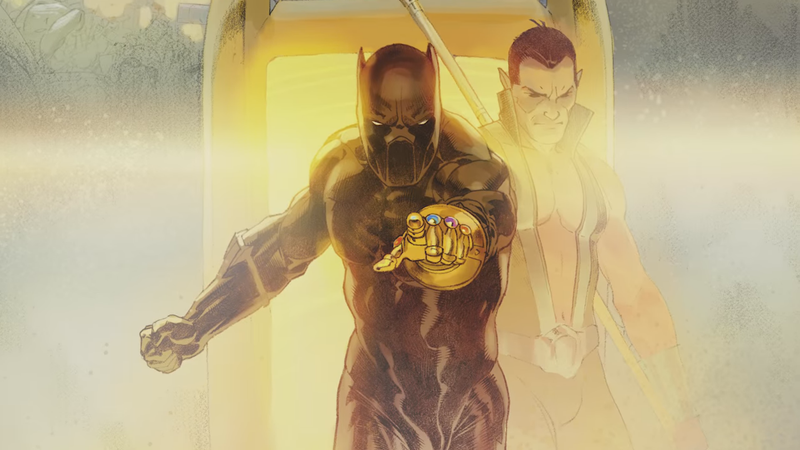
And Black Panther got hold of the all-powerful Infinity Gauntlet, because how else are you going to fight a dude with the powers of a god?

So Doom’s armies fight the heroes’ armies. What about Doom himself?

Well, you’ll have to find out by reading the final issue—the heroes and villains of Marvel’s old universe have made their move, and Doctor Doom stands to lose everything he’s made. Suffice to say, it’ll have some big questions about the fate of certain Marvel heroes, especially the Fantastic Four. But this catches you right up, so you can dig in straight away.

Marvel director Joe Russo hints at looming Avengers cull

Marvel director Joe Russo hints at looming Avengers cull

Film-maker set to helm Captain America: Civil War and Infinity War movies says studio may jettison key superhero characters from its ‘cinematic universe’

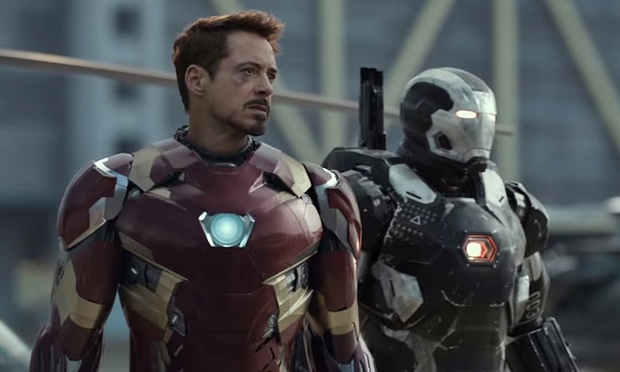
A bruised Iron Man prepares for battle in forthcoming superhero smackdown Captain America: Civil War.
Last stand … A bruised Iron Man prepares for battle in forthcoming superhero smackdown Captain America: Civil War. Photograph: YouTube

Russo told an audience at the Wizard World New Orleans convention that film-makers planned to deal with an increasing proliferation of costumed heroes in Marvel’s “cinematic universe” by removing some of its key players. The film-maker, who will oversee Captain America: Civil War, due to be released in the UK in April, and the two-part Avengers epic Infinity War alongside brother Anthony, also said lesser-known figures might move to the fore.

“I want to see some storytelling from some of the secondary characters,” Russo told fans at the Wizard World New Orleans convention. “We’re focusing on that right now with Infinity War while we’re breaking into those movies, [to see] which characters we can pull to the forefront who potentially haven’t had their own ‘A’ story arc to this point. I think you’ll see that the supporting Avengers are going to become primary Avengers.

“Everything is finite, right? Nothing can last for ever,’ he added. “It’s cyclical. Some new Avengers in [future movies] are going to become prominent and then maybe some Avengers might not be around any more.”

There have been rumblings of change for some time at Marvel, with Robert Downey Jr, who played Iron Man, now 50 and having failed to sign up for future solo outings as the power-suited hero. The looming debut of Benedict Cumberbatch’s Doctor Strange, a key member of The Avengers in some of the original comic books, has also inspired speculation that the sorcerer supreme could eventually join the superhero team on the big screen.

There is also a precedent for the disappearance of Captain America, currently played by Chris Evans, from the Marvel universe. In a 2007 comic book chapter, the original patriotic hero, Steve Rogers, was revealed to have died after being shot at close range by sometime paramour Sharon Carter, who had been hypnotised into committing the murder. Rogers remained “dead” for two years before a 2009 series, Captain America: Reborn, revealed he had simply been phasing in and out of space and time.

Infinity War parts one and two will be released in 2018 and 2019 respectively. Doctor Strange, with Scott Derrickson directing, marks Cumberbatch’s debut lead role in a big-budget Hollywood production and will be released in November.

Marvel director Joe Russo hints at looming Avengers cull

Alan Rickman, Harry Potter and Die Hard actor, dies aged 69

Alan Rickman, Harry Potter and Die Hard actor, dies aged 69


Actor Bill Paterson has said he had “no inkling of the seriousness” of Alan Rickman’s illness despite visiting him just two weeks ago

Actor Alan Rickman, known for films including Harry Potter, Die Hard and Robin Hood: Prince of Thieves, has died at the age of 69, his family has said.

The star had been suffering from cancer, a statement said.

He became one of Britain’s best-loved acting stars thanks to roles including Professor Snape in the Harry Potter films and Hans Gruber in Die Hard.

Harry Potter author JK Rowling led the tributes, describing him as “a magnificent actor and a wonderful man”.

She wrote on Twitter: “There are no words to express how shocked and devastated I am to hear of Alan Rickman’s death.”

She added: “My thoughts are with [Rickman’s wife] Rima and the rest of Alan’s family. We have all lost a great talent. They have lost part of their hearts.”

A look back at some of Alan Rickman’s most memorable rolesEmma Thompson, who appeared with Rickman in productions including Love Actually and was directed by him in The Winter Guest, said he was “the finest of actors and directors” and “the ultimate ally”.

She wrote in a statement: “Alan was my friend and so this is hard to write because I have just kissed him goodbye.

“What I remember most in this moment of painful leave-taking is his humour, intelligence, wisdom and kindness.

“His capacity to fell you with a look or lift you with a word. The intransigence which made him the great artist he was – his ineffable and cynical wit, the clarity with which he saw most things, including me, and the fact that he never spared me the view. I learned a lot from him.”

She added: “He was, above all things, a rare and unique human being and we shall not see his like again.”

Announcing his death on Thursday, a family statement said: “The actor and director Alan Rickman has died from cancer at the age of 69. He was surrounded by family and friends.”

Alan Rickman in Harry Potter
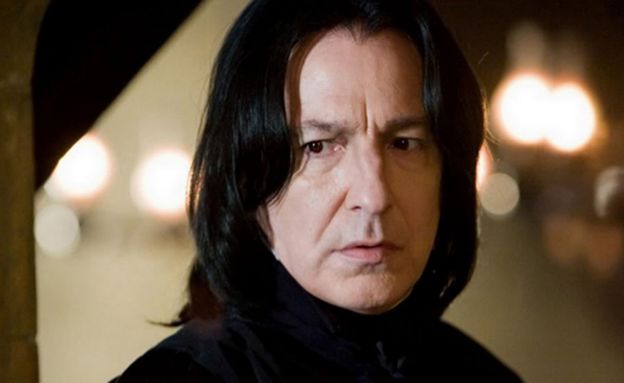
Rickman played the mysterious Professor Snape in all eight Harry Potter films
Media captionGambon remembers friend Alan Rickman

Harry Potter star Daniel Radcliffe said Rickman was “undoubtedly one of the greatest actors I will ever work with”.

He wrote on Google Plus: “Working with him at such a formative age was incredibly important and I will carry the lessons he taught me for the rest of my life and career.

“Film sets and theatre stages are all far poorer for the loss of this great actor and man.”

Sir Michael Gambon, who appeared with Alan Rickman in Harry Potter as well as on stage, told BBC Radio 4 he was “a great friend”.

He added: “Everybody loved Alan. He was always happy and fun and creative and very, very funny. He had a great voice, he spoke wonderfully well.

“He was intelligent, he wrote plays, he directed a play. So he was a real man of the theatre and the stage and that’s how I think of Alan.”

Director Ang Lee, who cast Rickman opposite Kate Winslet in 1995’s Sense and Sensibility, called him a “brilliant actor… a soulful actor… [and] a great human being.”

Alan Rickman

1946-2016

  • 41 when he played Hans Gruber in Die Hard, his breakthrough film performance
  • 68 film credits to his name
  • 16 awards, including an Emmy, golden globe, and BAFTA

Actor Richard E Grant wrote on Twitter: “Farewell my friend. Your kindness and generosity ever since we met in LA in 1987 and ever since is incalculable.”

TV star and Bafta ceremony host Stephen Fry wrote: “What desperately sad news about Alan Rickman. A man of such talent, wicked charm and stunning screen and stage presence. He’ll be sorely missed.”

Actor David Morrissey also paid tribute. He said: “So sad to hear the news of Alan Rickman. A wonderful actor and lovely man. Tragic news.”

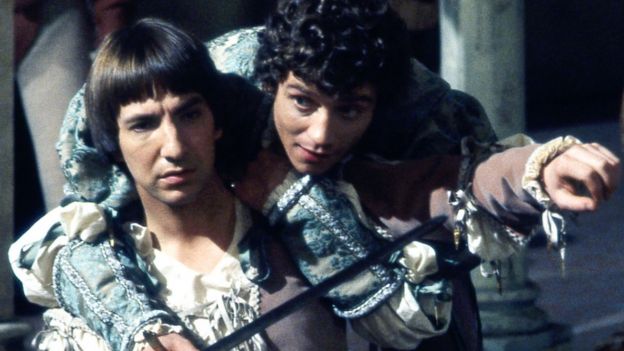
Alan Rickman in 1978's Romeo & Juliet
Rickman (left) made his TV debut in 1978’s Romeo and Juliet
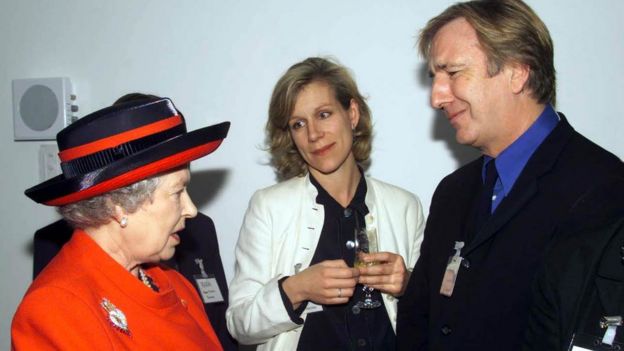
Rickman and Juliet Stevenson with The Queen in 2000
Rickman and his Truly Madly Deeply co-star Juliet Stevenson met the Queen in 2000

The London-born star began his career in theatre, including with the Royal Shakespeare Company, before winning roles in TV dramas like Smiley’s People and The Barchester Chronicles in the 1980s.

His performance as the manipulative seducer the Vicomte de Valmont in Les Liaisons Dangereuses on Broadway in 1986 brought him the first of two Tony Award nominations.

It also brought him to the attention of Die Hard producer Joel Silver, who offered him his film debut as a result.

Media captionFilm critic Jason Solomons: “He had a gift for being sneeringly withering”

He went on to become best known for playing screen villains – including the Sheriff of Nottingham in 1991’s Robin Hood: Prince of Thieves, for which he won a Bafta award, and Judge Turpin opposite Johnny Depp in 2007’s Sweeney Todd: The Demon Barber of Fleet Street.

But he showed his gentler side in films like 1990’s Truly Madly Deeply, in which he played Juliet Stevenson’s ghost lover and which also earned him a Bafta nomination.

Further Bafta nominations came for his roles as Colonel Brandon in Sense and Sensibility and the calculating Irish politician Eamon de Valera in 1996’s Michael Collins.

The following year, he won a Golden Globe for best actor in a miniseries or television film for the title role in Rasputin: Dark Servant of Destiny.

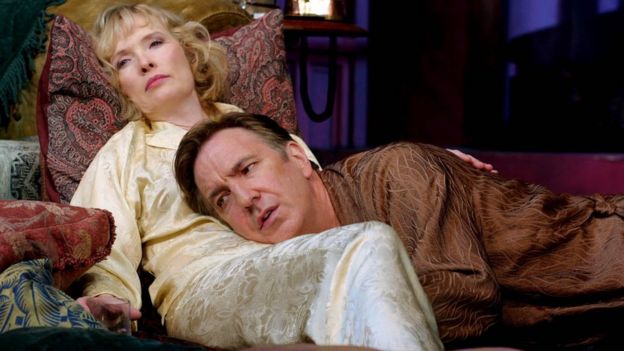
Linsday Duncan and Alan Rickman in Private Lives

Other film credits ranged from Tim Robbins’ 1992 political satire Bob Roberts to Richard Curtis’s 2003 romantic comedy Love, Actually, 1999’s sci-fi spoof Galaxy Quest and the voice of the Blue Caterpillar in Tim Burton’s Alice in Wonderland.

He also moved behind the camera in 1997 directing Thompson and her mother, Phyllida Law, in The Winter Guest.

Two years ago, he also directed period saga A Little Chaos, in which he co-starred with Kate Winslet.

Meanwhile, he continued to be a major presence on the stage in London and New York.

Another Tony nomination came for Private Lives in 2002, in which he appeared opposite Lindsay Duncan on Broadway following a transfer from London.

He recently revealed he had married Rima Horton in secret last year. The couple had been together since he was just 19 and she was 18.

Alan Rickman, Harry Potter and Die Hard actor, dies aged 69