
Free book for boys and reluctant readers
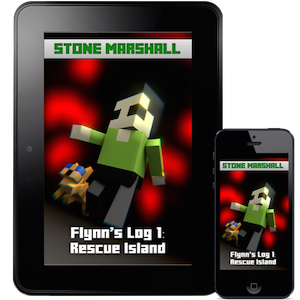
Flynn’s Log is free on the following devices
Choose your device
KindleiPad/iPod/iPhoneGoogle Play (Android Tablets)nookkoboRead Online
US$8.99 Paperback
Get Reluctant Reader Book News from Stone Marshall
Reading is important
Any book that helps a child to form a habit of reading, to make reading one of his deep and continuing needs, is good for him. –Maya Angelou
Most adults would agree that reading is important, but many kids detest reading. Video games, devices, and TV are preferred entertainment and escape. They provide instant gratification. Reading takes time. For some kids, reading isn’t engaging.
I had this same problem with my son, so I solved the problem.
The classic stories I remember enjoying as a kid don’t interest my son and his immediate attention span. If he doesn’t enjoy the story from page one, he will not read further.
So how did I get my son to read?
I showed him how much fun it is to get sucked into a story.
Your book is amazing I can’t stop reading it – Joseph Young via twitter
Contemporary and Classic titles alike don’t interest many kids. Don’t worry, the love of reading is learned. We need a starting point. We need that one book that is just as engaging on the first read as the fifth, just like a really great movie that kids want to see again and again. A positive association with reading will make kids want to read more.
A love of reading is cited as the number one indicator of future success. My son didn’t have the desire to read. He didn’t care about the books I chose to read to him, and was overwhelmed with the selection at the library. I want my son to succeed, so I had to do something. Since we struggled to find books he cared to read, I wrote one. An epic saga about the things he loves. I put it in a world he loves and addressed the issues he faces in his life.
I just love your books I’ve been reading them over and over again. -Carson via twitter
But it’s a video game book
Don’t worry; it’s not a book about video games, nor is it a game strategy book. Flynn’s Log is a hero’s journey that takes place inside the Minecraft world that today’s kids know and love. The protagonist, Flynn, naturally flows through Maslow’s hierarchy of needs (builds shelter and tools, learns what to eat and discovers a digital friend) and faces questions about his destiny. He learns important life lessons about friendship, integrity, and trust. Flynn’s Log is good for kids without being boring.
Thank you so so much for the free ebook. My son loves Minecraft now with this book I can get him to read to me. – Jennifer Wilkins
Start your son or daughter on journey today, reading Flynn’s Log 1: Rescue Island. Free on available these devices and apps.
Flynn’s Log is free on the following devices
Choose your device
KindleiPad/iPod/iPhoneGoogle Play (Android Tablets)nookkoboRead Online
US$8.99 Paperback
Why is Flynn’s Log 1 Free?
My son loves reading — finally. If you have experience with a reluctant reader then I know your pain and I want to help. I’ve seen thousands of kids transform with this book. My readers, who don’t usually read books during the summer, couldn’t put Flynn’s Log 1 down.
Good book I thought I would never read a book on my summer but I feel I’m gonna finish it soon – Multigamer 47 via twitter
Let this book change your kid’s life too. You have nothing to lose and an avid reader to gain.
Once you learn to read, you will be forever free.
–Frederick Douglas
I am giving away Flynn’s Log 1 free because I want to give you a risk-free way to hook your reluctant reader.
Please and I mean PLEASE, WRITE MORE! I absolutely love it! They’re outstanding books.
-Devon123321 via twitter
What are Books for Boys?
I spend lots of time with teachers and parents. I hear parents ask, “How do I get my son to read? Do you have books for boys?”
I wrote the Flynn’s Log series for my son, and this book is interesting for boys. However, the series is a non-stop read for both boys and girls, especially those who are interested in Minecraft.
The more that you read, the more things you will know. The more that you learn, the more places you’ll go.
—Dr. Seuss
What are you waiting for?
You have nothing to lose!
Flynn’s Log is free on the following devices
Choose your device
KindleiPad/iPod/iPhoneGoogle Play (Android Tablets)nookkoboRead Online
US$8.99 Paperback
News for Parents of Reluctant Readers
Get Reluctant Reader Book News from Stone Marshall
Author Spotlight-Stone Marshall | jessicawrenfiction
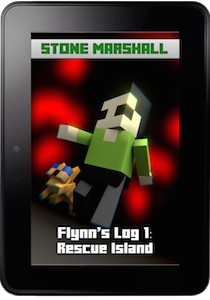
Author Spotlight-Stone Marshall
Posted on March 22, 2015 by jessicawrennovels
Ah, the nostalgia. There is nothing like playing the old-school video games. My personal favorites were Super Mario Bros. and Sonic the Hedgehog. Mario, Luigi, Sonic, Knuckles, etc, had to journey through various worlds, battle different creatures, overcome various obstacles, and along the way, collect various helpful items such as coins, mushrooms, stars, and flowers that helped them shoot fireballs. If they touched a monster once, they shrank. Twice, they died in a very dramatic manner (jumping straight up in the air with a look of shock on their face before falling off the edge of the edge of the screen. Goofy synthesizer music plays both during the game and upon the death of a character.
I haven’t played Minecraft (and I’m afraid to start; it might become addictive and cause me to waste a lot of time), but from Marshall’s description of it in his children’s novel Rescue Island: Flynn’s Log 1, it sounds like it operates under the same principles. The characters battle monsters, eat food provided by the digital world to restore their lives, and collect items necessary for survival or extra protection. The novel revolves around a hacker known as Flynn. Flynn has no memory of his previous life as he finds that he is a digital character in Minecraft. He battles giant spiders, hunts and fishes for food, and builds shelter. His only companion is an ocelot named Verve (and later, Verve’s daughter Khan). Soon, he finds out that it is his destiny to connect the digital and the physical worlds, and is unsure of how to do that.
If there is a secret to getting kids engaged in reading, I think Marshall has it. Marshall seems to understand that you have to write around kids’ interest and not try to enforce outdated, archaic material on them. I hope elementary schools are beating down Marshall’s door to buy the book. If there were more novels like Rescue Island, then schools wouldn’t struggle so much to get kids to read. I will be ordering a copy for my daughter. If you have a child age 5-12, I highly recommend this as a must-read. I also think adolescents and adults would enjoy this whimsical but action-packed novel as well.
To buy: http://www.amazon.com/Flynns-Log-Rescue-Island-Marshalls-ebook/dp/B00JOUMLYU/ref=sr_1_1?s=digital-text&ie=UTF8&qid=1427045129&sr=1-1&keywords=rescue+Island
‘Rad American Women A-Z’ Is The Empowering Book Both Girls And Boys Need
The children’s book world is about to get a lot more rad.
Writer Kate Schatz teamed up with illustrator Miriam Klein Stahl to create an empowering and educational book for kids about 26 women who helped shape American history, society, and culture. Titled Rad American Women A-Z: Rebels, Trailblazers, and Visionaries who Shaped Our History . . . and Our Future!, this book presents an alphabet that spans from Angela Davis to Zora Neale Hurston.

Unable to find the kind of book she wanted for her young daughter, author Kate Schatz decided to write it herself. “I want her to grow up to be empowered and strong and inspired, and I’m very conscious of the images of women and girls in the media,” she states in the press release.
Rad American Women A-Z features a diverse array of women who don’t typically appear in history books, but deserve recognition for their daring work. Their identities represent different geographical backgrounds, classes, sexualities, abilities and races.
Including women from various backgrounds was important to Schatz, who is a strong supporter of the #WeNeedDiverseBooks campaign. “Children should have easy and plentiful access to books and characters who reflect their lives,” she said. “They should be able to see illustrations that reflect their skin, their hair, their communities, their families, their interests.”
The author also hopes that parents will read Rad American Women A-Z to both their daughters and sons. “I definitely want young girls to be inspired and empowered, but this book is absolutely for boys and men as well, including my own son. These women’s stories are America’s stories — they just don’t always get included in the textbooks.”
Rad American Women A-Z is available for purchase on the City Lights Books website. Below is a sample of some of the strong, smart and brave women featured in the book.
1 Angela Davis Miriam Klein Stahl/City Lights Books
2 Billie Jean King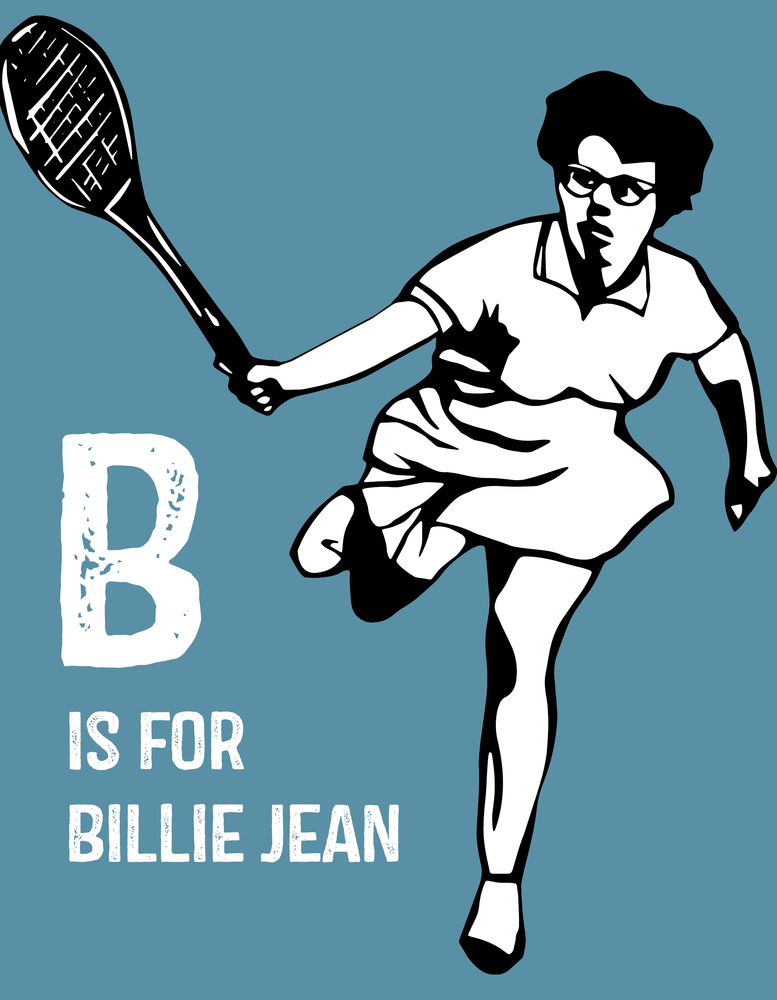 Miriam Klein Stahl/City Lights Books
3 Dolores Huerta Miriam Klein Stahl/City Lights Books
4 Ella Baker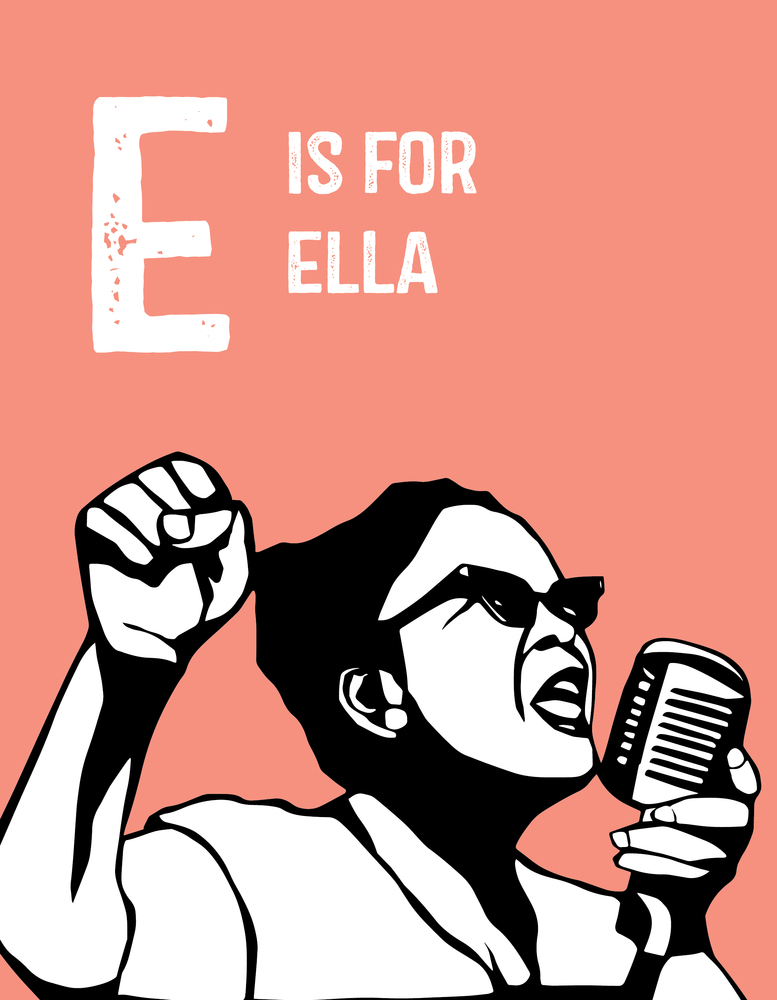 Miriam Klein Stahl/City Lights Books
5 Maya Lin Miriam Klein Stahl/City Lights Books
6 Odetta Miriam Klein Stahl/City Lights Books
7 Patti Smith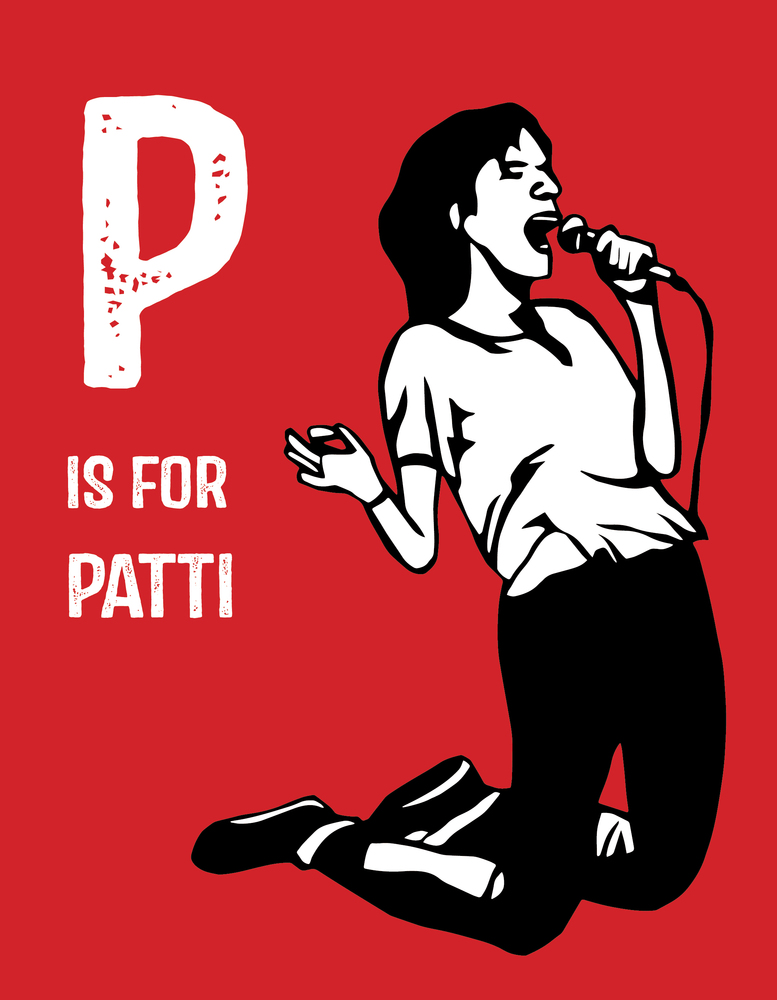 Miriam Klein Stahl/City Lights Books
8 Sonia Sotomayor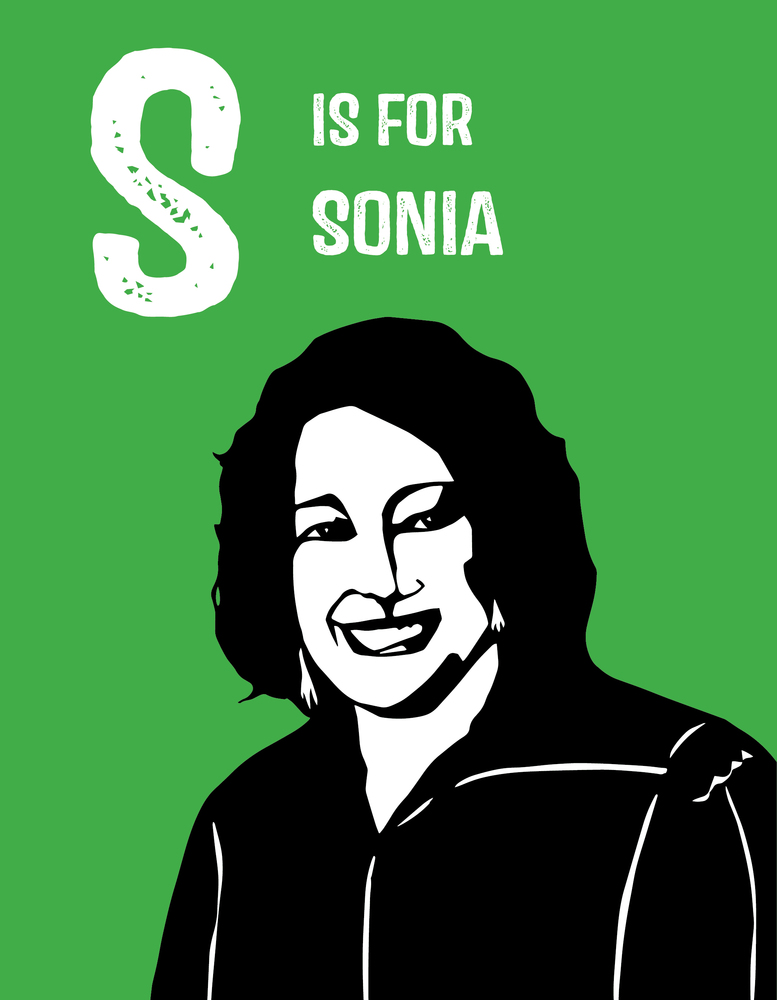 Miriam Klein Stahl/City Lights Books
9 Virginia Apgar Miriam Klein Stahl/City Lights Books
10 Wilma Mankiller Miriam Klein Stahl/City Lights Books
Familiar characters make reading fun at Literacy Night
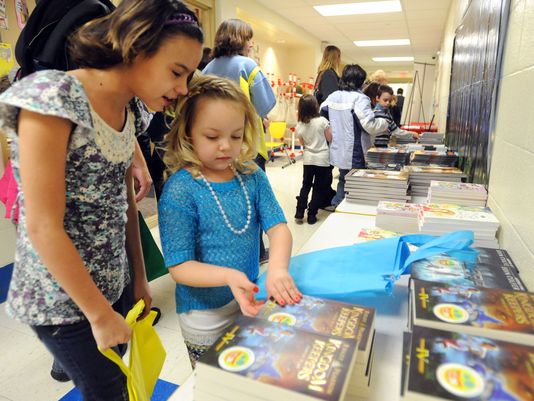 CALEDONIA – Liberty Elementary School students met some elves, frogs and a storytelling spider Tuesday at Literacy Night — all in the form of storybook characters.
Local authors and agencies filled the school, even after a snow day, for a night dedicated to encouraging families to read together.
Students also picked up free books donated by the United Way and the Let’s Read 20 initiative. Iron Man, Spiderman, Phineas and Ferb, Minnie Mouse and other well-known faces adorned the covers.
Mike Ring, director of the initiative, encouraged every parent to read for at least 20 minutes a day to their children.
He said 36.7 percent of 3- and 4-year-olds in the county are in preschool — under the state and national average. He said reading at home and getting kids into school are two ways parents can make them “lifelong learners.”
“Folks wait until their kids are in schools,” he said. “It can’t wait.”
This was just one of many events Ring and his team are attending this year in Marion County. He said Let’s Read 20 has already given away over 33,000 books at various events in 2015.
“It’s not just about books; it’s about creating community partnerships,” he said.
Lynn Bailey, a reading tutor and president of the PTO, said she always makes time to read to her kids.
“I will stop the world if they say, ‘Mom, can you read this to me?’” she said.
Bailey said some students she tutors think reading is boring. Part of Literacy Night, she said, was helping kids realize reading can be fun.
“You need to take the schoolwork aspect out of it,” she said.
Before Literacy Night, students worked on stories with an “Into the Woods” theme; author Shary Williamson chose the best story from each grade level.
The Waldo-based Bender & Bender team and author Janet Sedlacek of Cardington also shared ways to make storytelling fun.
Research shows students who read 20 minutes each day have a better vocabulary and score higher on national testing.
Primary pupils becoming video stars in online book reviews
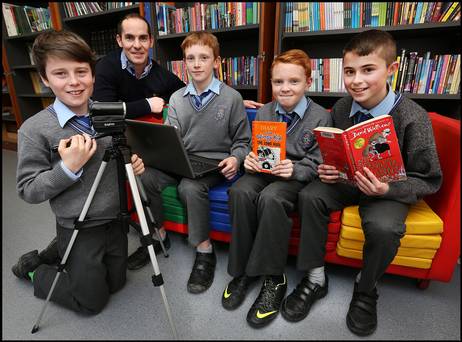 It is an innovative way to encourage children to read. Irish primary schoolchildren are becoming book-show presenters and are posting reviews of their favorite novels online.
At the website of the FÍS book club (FÍSbookclub.ie), there are videos from schools across the country where children discuss books from the Hunger Games to Diary of a Wimpy Kid.
One of the children, Matthew, talks to camera in glowing terms about the Hunger Games, telling viewers about how two characters fight each other to the death.
In sixth class at Star of the Sea Boys School in Dublin, the pupils are keen to make their videos.
Teacher Kevin Munnelly says: “It is a great way to motivate children to read. The lads find it fascinating.
“Some of them might be nervous initially, but then they become much more comfortable in front of the camera. They learn so much from presenting their videos”
The teacher asks the pupils what they want to read, and he often orders the books from the local library.
“I usually give them two or three weeks to read the book. I give them some questions to answer and they record their video.
“They talk about characters in the book and what excited them without giving away too much of the story.”
The book club is part of the Films in School (FÍS) initiative, managed by the Institute of Art Design and Technology (IADT) in Dun Laoghaire and the Department of Education’s Technology in Education service.
Ryan Tubridy recently launched the online book club at Lexicon, the new Dun Laoghaire library.
Brianog Brady Dawson, a learning support teacher at Holy Trinity School in Leopardstown, Co Dublin, says the book club has had a positive effect.
“Kids love to talk and share their recommendations and this marries their love of technology with an interest in books.”
The recording of the videos is now a simple process. Typically they can be recorded on a laptop, an iPod touch, or a smartphone.
Some children present their reviews straight to camera, but Brianog Brady Dawson also tries different approaches.
“I might have one of the children interviewing another, or two children just having a conversation about a book.”
“This not only develops a love of reading, it also encourages co-operation. They have to plan what they are going to present to camera.
“They reflect on what they have read and it improves communication skills.”
The FÍS book club is one of a number of initiatives supporting the national literacy strategy.
Grammarians who wring their hands and allege falling standards of literacy in the age of the internet will have to think again. Test scores for reading among Irish primary school pupils are actually improving.
For years there have been fears that the dominance of digital technology was damaging literacy, but the latest research shows that standards are rising.
Recent research by the Educational Research Centre in Dublin shows that performance in reading is significantly higher than in 2009.
There has been a drop from 35pc to 22pc in the proportion of children in second class whose reading is at the lowest level, and an increase from 35pc to 45pc in high performers.
Eemer Eivers, from the Educational Research Centre, says there’s been a greater concentration on literacy and numeracy in schools in recent years.
She says the use of technology by children is not having a damaging effect on literacy.
“If you are reading online, you are still reading, and these skills are transferable,” says Ms Eivers.
Infographic Brain Differences in a Struggling Reader | WeAreTeachers | Scientific Learning

Did you know? While home environment, access to books, and social and economic factors each play a part in children’s literacy development, brain differences also play a crucial role in the challenges faced by struggling readers. Download our struggling readers infographic and learn about intervention strategies.
via Infographic Brain Differences in a Struggling Reader | WeAreTeachers | Scientific Learning.
How to raise a reader
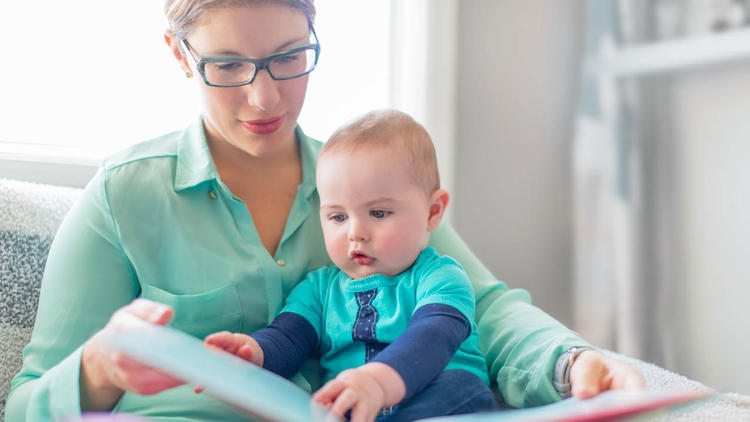 Kids become lifelong readers for all kinds of reasons. Sometimes there’s one key book that captures a kid’s imagination and opens him or her up to the exciting world of fiction. Other times, a teacher who assigns great books in class sparks a hunger for more big ideas and fine writing. In some cases, parents influence kids’ appreciation of books by sharing their own love of literature and modeling reader behavior — always having a book to read, taking books on vacation, reading before bedtime, making regular trips to the library and bookstore, etc.
Here are some tips for nurturing a love of reading that can last a lifetime:
— Read aloud: This comes naturally to lots of new parents, but it’s important to keep it up. Kids will enjoy it longer than you think. When reading to babies, toddlers, preschoolers, and kids in early grade school, it’s wonderful to have a kid on your lap, snuggled next to you on the couch, or drifting off to sleep in bed as you enjoy picture books together. You may have to read your kid’s favorite a hundred times, but just go with it. Your kid will remember the closeness as well as the story. And try nonfiction for those who are curious about pirates, Vikings, robots, castles, history, sports, biography, animals, whatever. For second through fifth graders, read those rich and meaty books that might be missed otherwise, maybe classics like “Treasure Island” or “Alice’s Adventures in Wonderland.”
Many parents think that as soon as their kids learn to read on their own, they no longer need to be read to. But kids still love it and benefit from it as they hear the rhythm of the language, learn correct pronunciation, and get to relax and just take it all in. Kids will get the idea that there’s something worthwhile in books and that there’s something special about time spent with a parent.
— Savor the series: It’s common for kids to become book lovers for life after getting hooked on a series. And there are lots of good ones that keep kids hungry for the next installment. Some reliable prospects: “Ivy and Bean,” “Judy Moody” for beginning readers; “Harry Potter,” “A Series of Unfortunate Events,” and the “Percy Jackson” series for middle graders; and “Hunger Games,” “Sisterhood of the Traveling Pants,” and “Twilight” (unless you think vampires are too creepy) for older kids.
— Grab onto a genre: Kids go through phases of genres they’re passionate about, from girl detectives to science fiction and fantasy. Don’t get hung up on whether it’s considered great literature (although some genre books are). Be happy that your kid is devouring books one after the other.
— Feed the favorite-author addiction: Once your kid finds a writer they love, they may want to read all of his or her books — a great excuse for a trip to the library or an opportunity for book swapping among friends and classmates. Here are some good bets for favorites. Younger kids: Dav Pilkey (“The Adventures of Captain Underpants”), Beverly Cleary (“Beezus and Ramona”). Middle grade: Kate DiCamillo (“Because of Winn-Dixie”), Neil Gaiman (“The Graveyard Book”). Tweens and teens: Judy Blume (“Are You There God, It’s Me Margaret”) and Sarah Dessen (“Just Listen”).
— Count on the Classics: Books are called classics because they continue to engage readers generation after generation. There are no guarantees, but you could try introducing your kids to books you loved as a kid and see which ones click. Some good ones to try are the Dr. Seuss and Narnia books, “Charlotte’s Web,” and “The Secret Garden.”
— Find Books About the Things Your Kid Loves: If your kid adores horses, try “Black Beauty.” If he’s wild about cars, trucks and trains, try “The Big Book of Trains” or “The Rusty, Trusty Tractor.” Librarians, booksellers, and Internet searches will help you find books on any favorite topic.
— Funny Is Fine: Some parents wrestle with letting their kids read “Captain Underpants,” “Diary of a Wimpy Kid,” and other edgy humor books about kids getting in trouble. Talk to your kids about the content, but keep in mind that kids like these books not because they want to imitate the characters’ actions but because they can live vicariously through their bad behavior. Humor is a great pathway to book loving.
— Comics Are OK: Graphic novels are among the hottest trends in children’s publishing, and they can get kids hooked on reading. Kids may start with “Squish” and “Babymouse” and move on to “Diary of a Wimpy Kid.” But these series can also lead to more sophisticated fare such as “Marzi” and “American Born Chinese.”
— Engage with eBooks: Kids can cuddle up with a Kindle, Nook, or iPad before naptime or bedtime. Some recent studies say more than half of U.S. kids are reading digital books at least once a week. The electronic format has proved to be especially engaging for boys and reluctant readers, and you can download or access many books on an eReader, which make it a great choice for air travel and car rides.
But note that some studies show that book apps and interactive “enhanced” eBooks, while fun, can be distracting and inhibit reading comprehension. So to promote reading skills and encourage your kid to be a frequent reader, you might want to stick with eBooks that have the look of a bound paper book. Some even have animation that mimics turning the pages.
— Make Reading a Family Value: Actions speak louder than words. Take your kids to the library once a week or once a month to get new books, make regular outings to your local bookstore, hunt for low-cost books at used bookstores or second-hand shops, and show kids that finding a good book is like a treasure hunt.
Fit reading into your family lifestyle. Set aside time for reading only — turning off the TV, computer, and cell phone. Encourage focused reading time, either for independent reading or reading aloud. Take preschoolers to story time hours at libraries and bookstores. For older kids, a parent-kid book club can be fun. Read to kids at bedtime. Provide time and space for your kids to read for pleasure in the car (if they don’t get car sick!), on vacation, after homework is done, on their own before bed. Warning: It could be habit-forming!
THE COOL KID’S GUIDE TO READING: That sound you hear is the future
I’m sure anyone who went to the recent Gordon Lightfoot concert hoped to hear “Sundown” and “If You Could Read My Mind” yet again rather than a tune Gordon banged out in the past year.
And I’m pretty sure that this same anyone didn’t go to the library the next day and check out a book he’d read oodles of times.
And I’m absolutely sure that if this anyone don’t pay me back those two yards he owes me, it’s going to get Cubist ugly.
Sorry. I need to keep my personal business out of my laugh-a-second column.
So back to the column mentioned afore.
I’m just like this anyone (who apparently has the scratch for concerts but not for me and I swear, O Best Ones, I won’t mention it again). I rarely read a book more than once, but if Elton John’s “Your Song” comes on the radio, I crank it up to 11 and me and Mrs. Cool Kid head-bang in the Honda.
Why is this?
I’m no rocket surgeon, but I figure it has to do with the difference between aural and ocular synapses. That, or alchemy.
I was mulling this recently while sitting on a mule, and I had a brain typhoon. Something that could save the struggling publishing industry.
Singing books!
I’ll let the huddled masses work out the details; the tech specs; the royalties; all that. The Cool Kid is an idea man (some would say an ideal man, but I wish they wouldn’t because it makes me blush).
But I know it will work, because I tested it. Minutes ago, I asked Mrs. Cool Kid if she remembered the financial advice Polonius gave Laertes in “Hamlet.”
She looked at me like I was the one who wrecked the Edmund Fitzgerald.
Then I started singing, “Neither a lender, nor a borrower be!”
She jumped in and we belted out, “Do not forget! Stay out of debt!”
There’s an episode of “Gilligan’s Island” where the castaways set “Hamlet” to music using the album collection Mr. Howell, for some reason, brought on the three-hour cruise.
If you saw it, I’m sure you can sing this: “I ask to be! Or not to be! And that is the question that I ask of me!”
Singing books — can’t fail!
And when they catch on, the Cool Kid fully expects to wet his beak the way Johnny Sacks always did on “The Sopranos.”
How to raise a reader
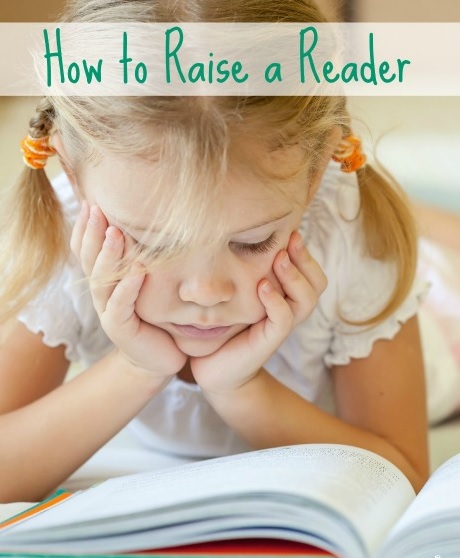 Kids become lifelong readers for all kinds of reasons. Sometimes there’s one key book that captures a kid’s imagination and opens him or her up to the exciting world of fiction. Other times, a teacher who assigns great books in class sparks a hunger for more big ideas and fine writing. In some cases, parents influence kids’ appreciation of books by sharing their own love of literature and modeling reader behavior – always having a book to read, taking books on vacation, reading before bedtime, making regular trips to the library and bookstore, etc.
Here are some tips for nurturing a love of reading that can last a lifetime:
_Read aloud:This comes naturally to lots of new parents, but it’s important to keep it up. Kids will enjoy it longer than you think. When reading to babies, toddlers, preschoolers, and kids in early grade school, it’s wonderful to have a kid on your lap, snuggled next to you on the couch, or drifting off to sleep in bed as you enjoy picture books together. You may have to read your kid’s favorite a hundred times, but just go with it. Your kid will remember the closeness as well as the story. And try nonfiction for those who are curious about pirates, Vikings, robots, castles, history, sports, biography, animals, whatever. For second through fifth graders, read those rich and meaty books that might be missed otherwise, maybe classics like”Treasure Island”or”Alice’s Adventures in Wonderland.”
Many parents think that as soon as their kids learn to read on their own, they no longer need to be read to. But kids still love it and benefit from it as they hear the rhythm of the language, learn correct pronunciation, and get to relax and just take it all in. Kids will get the idea that there’s something worthwhile in books and that there’s something special about time spent with a parent.
_Savor the series:It’s common for kids to become book lovers for life after getting hooked on a series. And there are lots of good ones that keep kids hungry for the next installment. Some reliable prospects:”Ivy and Bean,””Judy Moody”for beginning readers;”Harry Potter,””A Series of Unfortunate Events,” and the”Percy Jackson” seriesfor middle graders; and”Hunger Games,” “Sisterhood of the Traveling Pants,” and”Twilight”(unless you think vampires are too creepy) for older kids.
_Grab onto a genre:Kids go through phases of genres they’re passionate about, fromgirl detectivestoscience fictionandfantasy. Don’t get hung up on whether it’s considered great literature (although some genre books are). Be happy that your kid is devouring books one after the other.
_Feed the favorite-author addiction:Once your kid finds a writer they love, they may want to read all of his or her books – a great excuse for a trip to the library or an opportunity for book swapping among friends and classmates. Here are some good bets for favorites. Younger kids: Dav Pilkey (“The Adventures of Captain Underpants”), Beverly Cleary (“Beezus and Ramona”). Middle grade: Kate DiCamillo (“Because of Winn-Dixie”), Neil Gaiman (“The Graveyard Book”). Tweens and teens: Judy Blume (“Are You There God, It’s Me Margaret”) and Sarah Dessen (“Just Listen”).
_Count on the Classics:Books are called classics because they continue to engage readers generation after generation. There are no guarantees, but you could try introducing your kids to books you loved as a kid and see which ones click. Some good ones to try are theDr. Seussand Narniabooks,”Charlotte’s Web,” and”The Secret Garden.”
_Find Books About the Things Your Kid Loves:If your kid adores horses, try”Black Beauty.” If he’s wild about cars, trucks and trains, try “The Big Book of Trains” or “The Rusty, Trusty Tractor.” Librarians, booksellers, and Internet searches will help you find books on any favorite topic.
– Funny Is Fine:Some parents wrestle with letting their kids read”Captain Underpants,””Diary of a Wimpy Kid,” and other edgy humor books about kids getting in trouble. Talk to your kids about the content, but keep in mind that kids like these books not because they want to imitate the characters’ actions but because they can live vicariously through their bad behavior. Humor is a great pathway to book loving.
– Comics Are OK:Graphic novels are among the hottest trends in children’s publishing, and they can get kids hooked on reading. Kids may start with”Squish”and”Babymouse”and move on to”Diary of a Wimpy Kid.”But these series can also lead to more sophisticated fare such as”Marzi”and “American Born Chinese.”
_Engage with eBooks:Kids can cuddle up with a Kindle, Nook, or iPad before naptime or bedtime. Some recent studies say more than half of U.S. kids are reading digital books at least once a week. The electronic format has proved to be especially engaging for boys and reluctant readers, and you can download or access many books on an eReader, which make it a great choice for air travel and car rides.
But note that some studies show that book apps and interactive “enhanced” eBooks, while fun, can be distracting and inhibit reading comprehension. So to promote reading skills and encourage your kid to be a frequent reader, you might want to stick with eBooks that have the look of a bound paper book. Some even have animation that mimics turning the pages.
– Make Reading a Family Value:Actions speak louder than words. Take your kids to the library once a week or once a month to get new books, make regular outings to your local bookstore, hunt for low-cost books at used bookstores or second-hand shops, and show kids that finding a good book is like a treasure hunt.
Fit reading into your family lifestyle. Set aside time for reading only – turning off the TV, computer, and cell phone. Encourage focused reading time, either for independent reading or reading aloud. Take preschoolers to story time hours at libraries and bookstores. For older kids, a parent-kid book club can be fun. Read to kids at bedtime. Provide time and space for your kids to read for pleasure in the car (if they don’t get car sick!), on vacation, after homework is done, on their own before bed. Warning: It could be habit-forming!
Volunteer Spotlight: Bumble Bee the Labradoodle Helps Kids Learn to Read
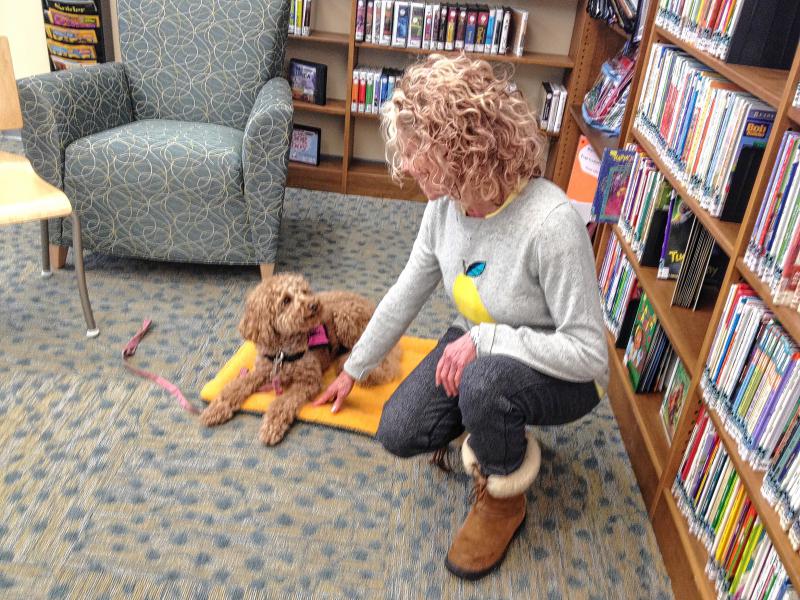 Sunapee — Bumble Bee sits quietly on an orange mat as Amelia Salvitti, of Sunapee, reads aloud from the Dr. Seuss book Fox in Socks .
Children have been reading Dr. Seuss books for generations. What makes this scene at Abbott Library unique is who 6-year-old Amelia is reading to.
Bumble Bee, a 4 1/2 -year-old miniature Labradoodle, has been helping children build their reading skills for two years. Bumble Bee and her owner, Abby Brown, of Sunapee, work with both children and senior citizens as a certified therapy dog team.
“I’ve always volunteered and I wanted a dog, so I thought I’d combine that,” Brown said.
Brown and Bumble Bee earned a Canine Good Citizenship certification and a Therapy Dogs International certification before beginning volunteer work.
In addition to visiting children at the library once a month, the team also goes to Mount Royal Academy to read with first-graders and visit seniors at Woodcrest Village Assisted Living in New London and Summercrest Senior Living Community in Newport, where Bumble Bee p rovides comfort to residents by curling up on their laps.
At one point during their session at Abbott Library, Bumble Bee, wearing a pink vest with her name and certification displayed, stretches out to lick Amelia’s hand .
“We don’t kiss while she’s reading,” says Brown.
In response, the dog rests her paw on Amelia’s leg instead.
Therapy dogs must know how to ignore everything going on around them, Brown said. At the library, this means sounds from children and people elsewhere in the room. Bumble Bee’s attention must be on her subject, and her owner. Bumble Bee typically reads with the children for about 30 minutes.
But Bumble Bee does more than provide children with a safe place to practice reading. She helps them cope with fear, too.
Brown recalled two children who were afraid of dogs before meeting Bumble Bee.
“After one class with her, they now sit next to her and read to her,” she said.
Bumble Bee is Abbott Library’s first canine volunteer, said Mary Danko, the library’s director.
“It’s finding the right partner,” Danko said. “Abby is great to work with. She brings the right attitude and enthusiasm to it.”
Danko has seen children come out of their shells when Bumble Bee is around. Amelia, in particular, always reads to Bumble Bee during the dog’s monthly visits to the library.
“As soon as she saw Bumble Bee, she was asking for a certain book to read to her,” Danko said. “ It was great to see that motivation right away.”
Bumble Bee seems to agree. During the half-hour she spent at the library last m onth, she sat quietly as children read to her. She didn’t interrupt with barks to correct words that were pronounced incorrectly.
She simply listened.
“Whenever they’re here, I just want to go and take a peek,” Danko said. “It’s so satisfying to see the kids reading aloud.”
Read Across America: Special day in Chico brings books to children’s hands
Read early. Read often. Read for the rest of your life.
Those were some of the take-away messages for parents who brought their kids to Chico’s version of the “Read Across America” extravaganza, held Saturday.
The message for kids was that reading is fun.
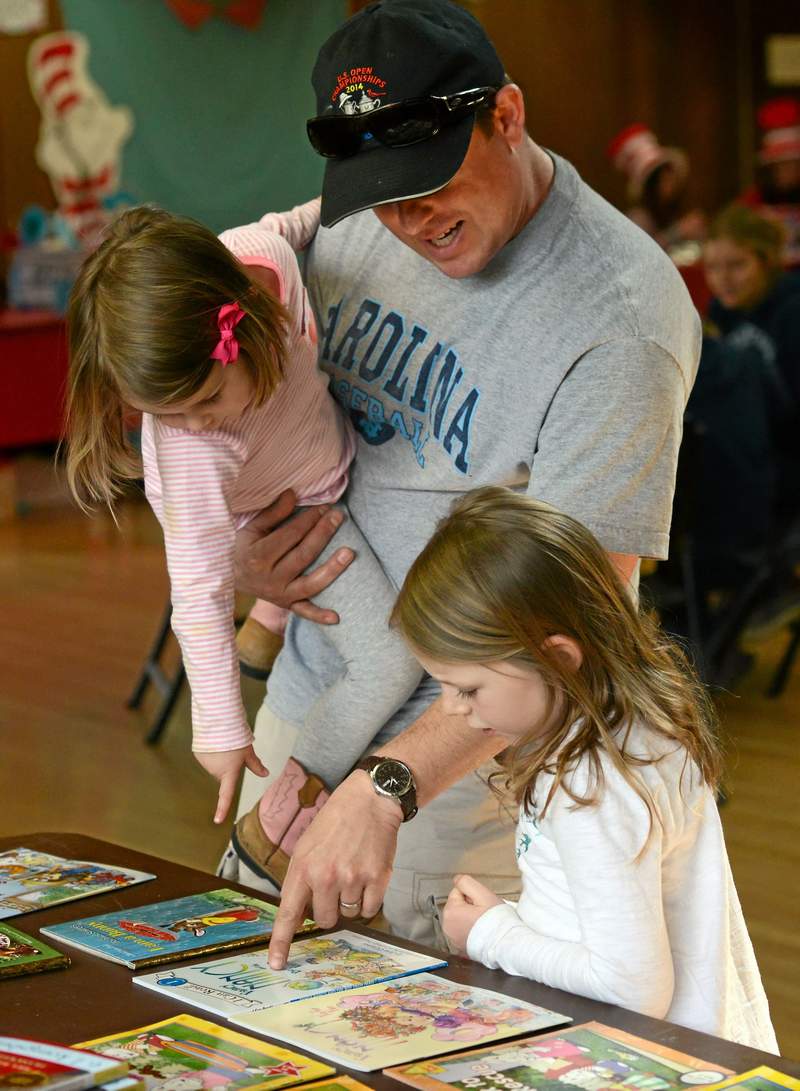
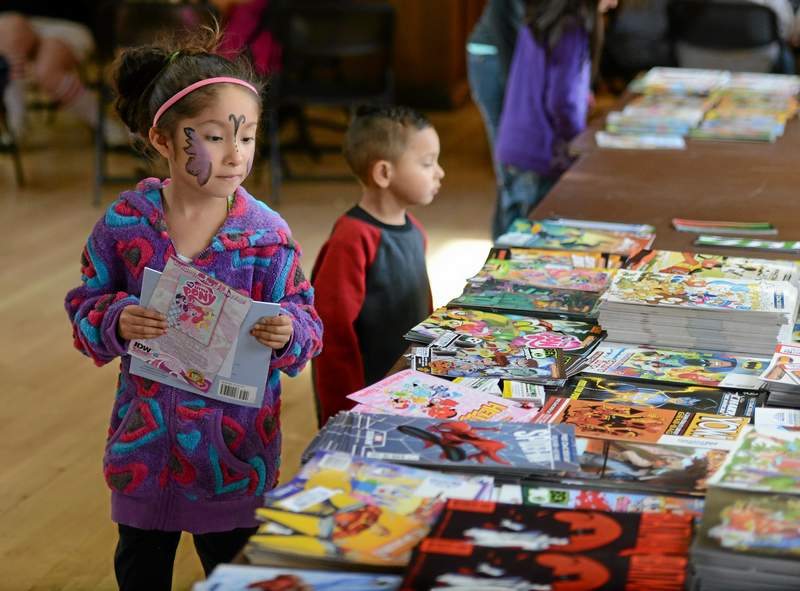
The main room at the Chico Area Recreation and Park District was busy with reading-related activities, including a “book walk.” Children walked in a circle until the music stopped. Winners could pick out a free book from the back of the room.
The event coincides with Dr. Seuss’ birthday, March 2, and posters throughout the room had memorable Seuss sayings.
“You can find magic wherever you look. Sit back and relax, all you need is a book,” one said.
Another poster declared: “The more that you read, the more things you will know. The more that you learn, the more places you’ll go.”
Syrus Copeseeley, age 6, was well on his way to writing a book of his own.
The Butte County Teachers Association and Chico Unified Teachers Association had provided bundles of blank paper where children could put down words of their own.
Syrus’ book was titled “The root that never stopped growing.”
“If I write messy I can still read it,” Syrus said, as he read the first chapter aloud.
His mom, Kate, said she loved books when she was a child and reads to her two children every day.
Research shows that children who read early and keep reading do well in school, explained Michelle Kelley, the elementary school librarian for the Chico Unified School District.
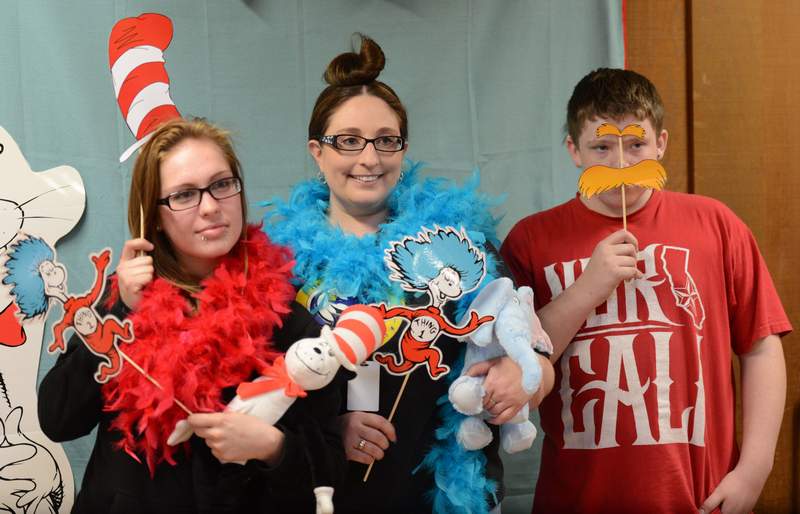
Her job for the day was to guide people to the photo booth, where people could pose while wearing Seuss-related hats and masks.
People who are readers for life never want to stop learning, she said, as her tall Cat-in-the-Hat headgear bopped back and forth.
Publishers have done a good job learning what kids love to read, providing books for all reading levels, she said.
The goal of educators is to find books that children will “devour” to give them a push toward a lifetime of reading.
Parents can help by setting aside time every day for reading, Kelley said. This might include a quiet place with a reading lamp, perhaps making reading a family activity.
Local libraries also have great programs for children, including reading rewards programs and story time. See more details at http://goo.gl/gwLJPK.
Leslie Phillips, a senior library clerk for CUSD, fully embraced the day by dressing like a Sneetch.
Attached to her head, and mostly covering her face, was an elaborately long yellow neck and a Sneetch head.
To complete her look, Phillps wore yellow pants, a yellow sweater and lemon-yellow sneakers.
The Sneetches are Dr. Seuss characters that teach that snobbery is no fun.
Phillips said her mother read to her when she was a child and she grew up to love books. It seemed natural to become a librarian, and apparently to dress like a Sneetch.
With her face barely visible through her costume, Phillips said she loves to find books she thinks a particular student will like.
“It’s exciting to watch them get excited. They’ll come back and tell me about the books they read.”
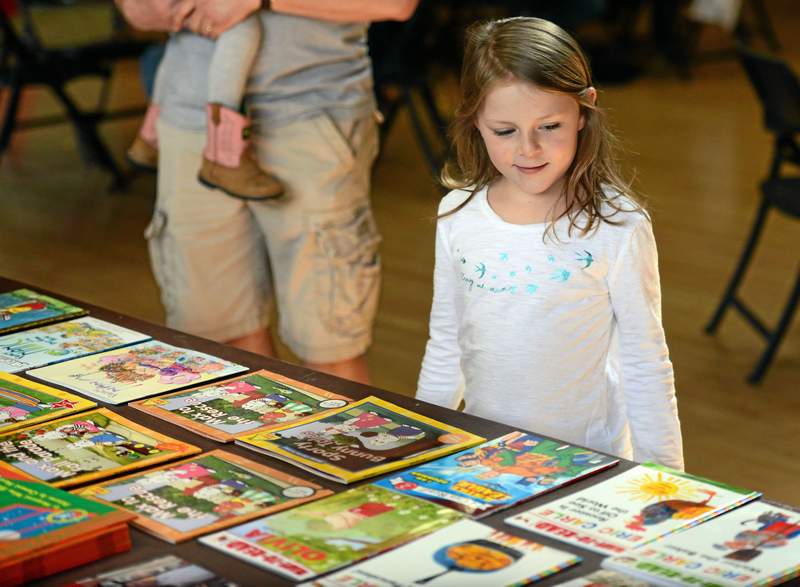
A good assortment of books were available at the back of the room, with each child allowed to choose one. Comic books were also among the mix.