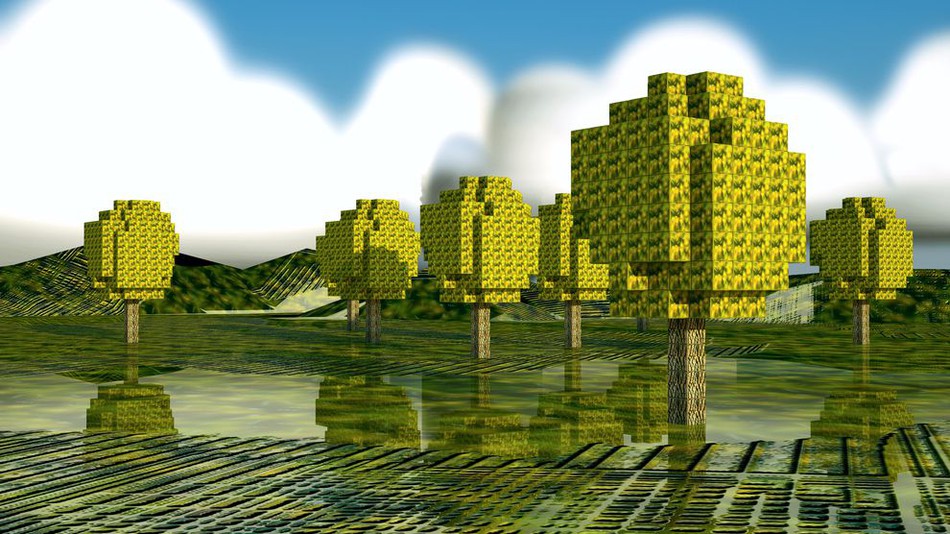
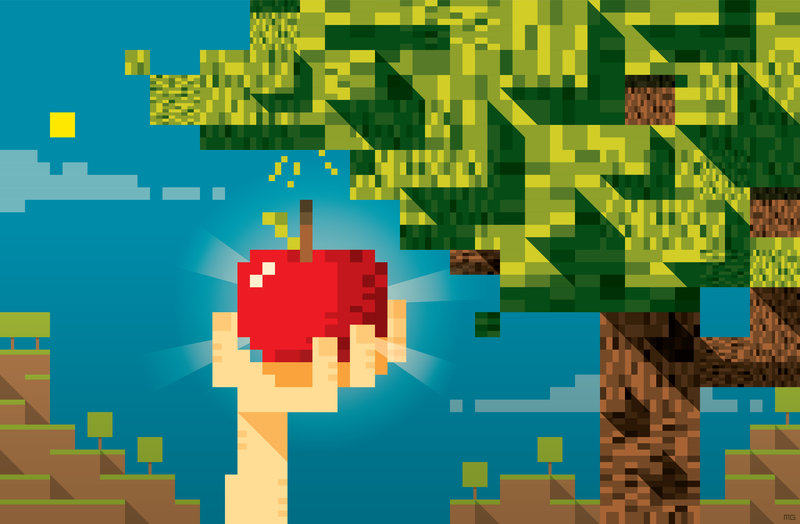
The cubist revolution, now in its eighth year, is thriving.
That’s Minecraft cubes, of course.
The game where you build virtual Lego-like worlds and populate them with people, animals and just about everything in between is one of the most popular games ever made; it’s second only to Tetris as the best-selling video game of all time. There’s gold in them thar cubes: More than 120 million copies have sold since Minecraft launched in 2009.*
So what’s behind the game’s enduring appeal?
For Isiah Hammonds, 9, it’s all about the creative potential every time you fire up your computer.
“You can build anything – anything that you put your mind to! You can work with other people. It’s social. It’s just super fun!” he says while focusing intensely on finishing his virtual ice arena with his multi-player team of fellow Minecraft campers in Richmond, Calif. “It’s for our ice boat racing.”
Hammonds, a third-grader, is in a basement room in Richmond’s City Hall, next to the cafeteria and a janitor’s closet. There are long, narrow white tables with black computer monitors on top.
A lot of tech summer camps like this can cost upwards of $1,000 a week — but these 20 children are in a city hall basement because the space is free.
It serves predominantly low-income African-American and Hispanic children, many of whom face basic barriers to catching the tech and gaming bug — like access to the internet and access to devices.
A lot of the children here are playing Minecraft for the first time, explains the camp’s digital literacy director, Teresa Jenkins. That’s because a lot of the families who come here don’t have computers at home. Or if they do, she says, they can’t afford high-speed internet or it’s simply not a priority.
“Rent. Food. Gas. ‘How am I doing to get the kids back and forth to school? How am I going to get back and forth to work? ‘ ” says Jenkins, “that’s the priority.”
Richmond is gentrifying amid the Bay Area’s tech-driven economic boom. But the city remains one of the area’s poorest, with a poverty rate of nearly 18 percent.
Children here can see San Francisco from their city and hear all about nearby Silicon Valley and its bevy of industry-disrupting companies, “but they don’t imagine they can be a part of that industry,” says Jennifer Lyle, the executive director of Building Blocks for Kids Collaborative.
This Minecraft camp, Lyle says, is trying to change that ‘we’re not welcome in tech’ feeling some low-income families in Richmond have. “To get people to come here and say, ‘No, our child deserves to have access to this,’ ” she says.
It starts by introducing young people and their parents “to the kinds of things wealthier folks get access to because they have the means,” she explains, getting “grounding in computers they’re not getting in school.”
Minecraft gets high marks from diverse quarters for its education potential. The game can help teach the basics of computer literacy and the key foundations of coding, animation, circuitry and more.
Children can absorb the broccoli of computer knowledge while reveling in the popcorn of building elaborate worlds out of cubes. And in camps like this, they can learn to work together as a team, says Morgan Ames, a postdoctoral scholar at U.C. Berkeley who helped create this camp and has studied its impact.
Campers here, she says, get to work through “the steps of designing something technological that somebody else will play.” Using aMinecraft tool called redstone circuits, kids can “think through the basics of circuits.”
But to really get that full experience, kids need the PC or Mac version of the game. A version not all have access to, Ames says. Ames also co-authored a study of Minecraft, this camp, and equity and access gaps by race, class and gender.
“Generally we found that middle- and upper middle-income kids play the PC version more. Boys tend to play it more than girls. And in general, white kids tend to play it more than children of color,” Ames says.
And that’s troubling, she says, because the PC version is simply a richer version of the game. “It has more options. It has more opportunities to learn to code. And we wanted to make it more accessible,” she says.
More accessible for children such as Jaiden Newton, 9. On this day I find her eagerly conspiring with her brother in a multi-player game at the camp.
“So he’s trying to build an underground tunnel to the other person’s arena so he can steal the flag,” she tells me.
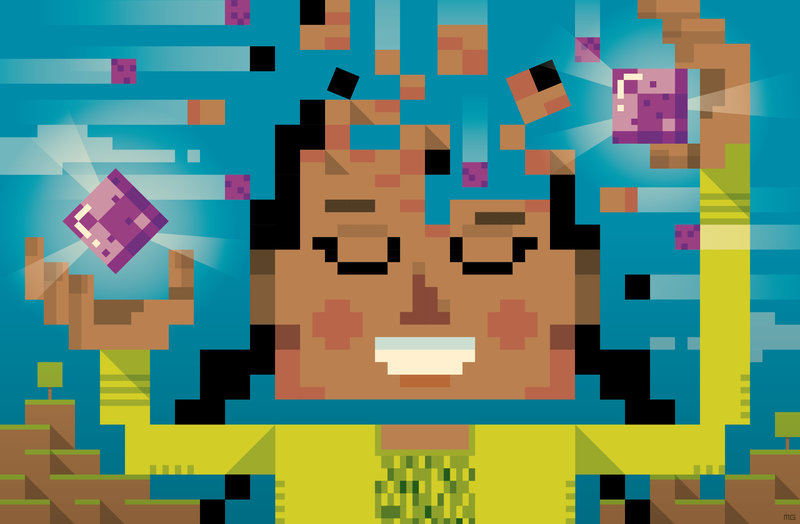
She makes her way past a dazzling cube inside one of her elaborate cube structures.
“Those are Ender Pearls. It’s like a teleportation,” she says.
Ames says she’s collecting more data but her preliminary look shows that the tools out there to learn more about Minecraft — online forums, videos and the like — are dominated by boys.
Camps like this are vital, Ames says, to help change that equation.
Or as program director Jennifer Lyle puts it, this camp helps send a message to our parents, schools and Silicon Valley “we belong here.”
*[Note: Minecraft was purchased by Microsoft Corp. from developers Mojang in 2014. The foundation created by Microsoft founder Bill Gates is a financial supporter of NPR and NPR Ed.]
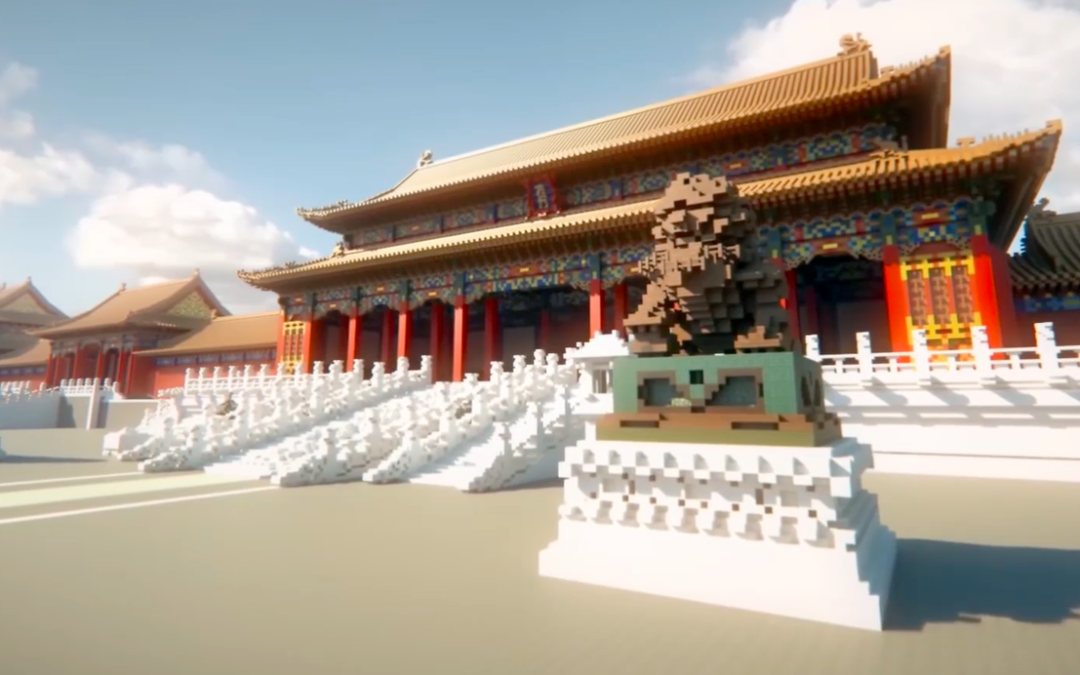
A small team of Minecraft users have spent more than two years building a virtual model of China’s Forbidden City.
The effort eventually came down to two guys labouring over the course of over two years, to lay down billions of bricks to eventually recreate the 600-year-old UNESCO World Heritage site.
The team was led by 22-year-old Su Yijun from Guangzhou, who orchestrated the plan from scratch in 2014, as volunteers dropped out one by one from the gargantuan task, Sixth Tone reports.
Their virtual creation covers a square grid of 100 million blocks, and even replicates furniture inside, from the Emperor’s throne, to the traditional Chinese-style beds of the time.
His video has been viewed some 870,000 times on Bilibili, a Chinese video portal.
The most difficult part of the project, he says, was being unable to visit and construct parts of the Forbidden City that are not open to the public.
“Many areas are not open to the public and….the interior decorations were not as how they originally appeared,” he told Sixth Tone.
Here’s the Forbidden City IRL
Image: PILIPEY/EPA/REX/Shutterstock
The Minecraft version
Image: 国家建筑师/bilibili
Real lion at the gates
Image: LightRocket via Getty Images
Minecraft lion
Image: 国家建筑师/Bilibili
The Forbidden City was a Chinese imperial palace that served as the home for 24 emperors. It was so named because it was closed to the public for hundreds of years.
The palace grounds cover a span of 74 hectares, and attracts over 14 million tourists to Beijing to see it each year.
Minecraft’s “Better Together Update” is rolling out now in beta, for players on Windows 10 PCs and Android devices. That means players on either platform with the beta installed will be able to participate in games from either type of device, together in cross-platform play.
This update was originally revealed at E3 back in June, and includes other feature additions like community servers and a community Marketplace with paid add-ons. There are also a range of new in-game item types, multiplayer host and permission options, and more.
The beta is also set to roll out for Xbox One “soon,” Microsoft says, which will add the gaming console to the cross-platform action. Microsoft also said when the update was announced that it’ll eventually add support for the Play Together Update to iOS, Nintendo Switch and VR devices (Sony was apparently offered the chance to participate in the update for PlayStation, but declined).
To get in on the beta, players will need the Xbox Insider app for Windows 10 and Xbox One, and on Android they’ll need to have Google Play and of course everyone will need a copy of the game.
This could be huge for unifying Minecraft’s massive player community, which is already quite the club.
A Mincecraft player in Taiwan decided to recreate their entire school on the sandbox video game because they missed it so much.
The gamer, along with a few friends who attended the Banqiao Senior High School in Taipei, started working on recreating their school during their first year of university.
It took them two years to recreate the entire campus:
The amount of detail is incredible. From the athletics field:
Image: @MINECRAFTPCSH/FACEBOOK
To the swimming pool:
Image: @MINECRAFTPCSH/FACEBOOK
And just the general facade — there’s nothing this Minecraft player has missed out on.
Image: @minecraftpcsh/facebook
“I started this [project] in my freshman year because of homesickness,” said the gamer in an online blogpost.
The gamer, along with three other high school classmates, then started on the project in 2014.
But the project is far from over.
“There are still many parts of the school that are not completed, because we are very busy,” they said. “Only 87% is complete.”
The group have set up a Facebook page, to keep people updated about the project that they hope to complete soon.
Given it already looks amazing, we can’t wait to see how it turns out.
The Emoji Movie might have been 💯 . It might have been a work of quiet genius, in the manner of Toy Story or The Lego Movie or Inside Out: a quirky and soulful exploration of the worlds that exist in parallel to our own, investing objects that would seem merely to be dully inanimate with story and, thus, empathy. It might have been, too, a particularly timely exploration of smartphones and their contents: Here, after all, are objects that are with so many of us, at our sides and in our hands, humming bits of glass and metal that tell a million little stories with each swipe, and each tap, and each touch of a warm human pulse.
But: no. The Emoji Movie, instead, is a frenetic mishmash—not so much a single story of a parallel world so much as a roller-coaster-y tour of some of the apps of 2017: Spotify, Instagram, Twitter, Candy Crush, even Dropbox. Everything, here, is branded—even the parallel world itself, Textopolis, which is home to Gene, the offspring of two “meh” emojis. Gene is, in the grand tradition of such for-kids-but-also-not-totally-for-kids films, Different. He is not limited, in the way of the emoji, to one expression; he can make them all. But in order to realize that which makes him Different might actually make him Special, Gene first goes on a dizzying journey—through Textopolis, yes, but also through Spotify and Just Dance and YouTube and, in general, late capitalism as it is understood and manufactured by the Hollywood of the moment.
Because of that—and because also, ironically, of the premise that might have been 💯—critics eviscerated The Emoji Movie. Really gleefully eviscerated it. (Schadenfreudenunicoden?) The New York Timescalled it “nakedly idiotic.” BuzzFeed wrote that “it’s barely a movie so much as a confused attempt to both condescend to an audience about their short attention spans thanks to mobile devices while also trying to profit off of that very same audience.” Gizmodo did an all-emoji review of the film featuring, primarily, the Thinking Face emoji in several permutations. So critically unloved was this film—so squandered the promise it represented—that for a moment it seemed to be in contention for that rarest of honors: a 0 percent approval rating on Rotten Tomatoes. (Alas, even that moon-shooting was a failure: The film currently stands at an awkward score of 7 percent.)In a weird way, then, The Emoji Movie is not just a critical flop, but also a metaphor for a Hollywood that is struggling to find the line between branding that audiences love and branding that audiences resent. Here is a film that takes some of the most intimate tools of people’s lives—the hearts and eggplants and joy-tears and tacos and other images that help them to express their love, and their desire, and their sadness—and considers how wacky it would be if one of those images was actually a guy named Gene. Here is a film that takes the revolution that has resulted from the advent of digital communication and whimsically brands it. Emojis, after all, are not just the little doodads that live in your WhatsApp. They are also, in the most basic and most profound of ways, tools—parts of a global continuum that has included everything from hieroglyphs to emoticons to text itself. They ask questions about what it really means for something, at this point in human history, to be “universal.”The Emoji Movie, as it happens, shares a rough premiere date with The Emoji Code, the new book from the scholar and prolific author Vyvyan Evans. Evans’s book (subtitle: The Linguistics Behind Smiley Faces and Scaredy Cats) is an analysis—aimed at a popular audience—of the academic research that has been conducted about emojis since their creation in the late 1990s. It summons linguistics, and psychology, and cognitive science to consider why emojis have proven so popular and, so far, enduring. It reads, often, as a defense of what Evans refers to as Emoji, with a capital E: the complicated system of pictographs that augment text in digital communication. The collection of unicode that, Evans argues, “enables us to provide the non-verbal cues otherwise missing from textspeak.”
Evans’s book is a thorough exploration, in other words, of the extremely two-dimensional stars of The Emoji Movie. But it is also, in its arguments, something of an implied condemnation of The Emoji Movie. In Evans’s science-informed telling, emojis are not a language unto themselves, as has sometimes been suggested, but rather tools of communication that are productively basic: useful bridges of the emotional gaps that can exist in the dull black and white of text as it is rendered on a screen. The Emoji Code in many ways champions emojis against those who have seen the cheeky pictographs not as extensions of English, but as a threat to it—and to, by extension, language as we have known it.
And while that framing can itself occasionally read as overly two-dimensional—there are few people, at this point, who seem to believe that emojis will be the death of English, or any other language—it also situates The Emoji Code well with the ideas espoused by the linguist John McWhorter, and by the linguist Gretchen McCulloch, and by so many other canny observers of English as it lives and grows in its new digital environments: Language, breathing free, is its own kind of democracy. And that is evident online, in particular, where a good turn of phrase, or a new meme, or indeed a cleverly deployed emoji, can be so easily amplified and adapted and woven into the language. Emojis, in particular, are elastic in that way: They can mean whatever the writer, and whatever the recipient, decide they mean, together.
That can lead to a productive kind of ambiguity. Remember that tattoo Drake got a few years ago, which could be read either as two hands, praying, or as two hands, frozen in a high five? The star, as New York’s Adam Sternbergh pointed out, finally settled the matter: “I pity the fool who high-fives in 2014,” Drake clarified on his Instagram. But there would be many more debates in that vein. Are those dancing twins, symbols of female friendship, or Playboy bunnies, symbols of female objectification? Is that a toothy mouth-gape a grin or a grimace? When I texted “Drinks?” and you texted back, “🐙,” what did you mean?
This kind of ambiguity, Evans suggests, also gives way to useful flexibility. It allows emojis the kind of semantic suppleness that helps them to humanize, and augment, and otherwise expand, our text-based communications. Emojis can function as punctuation. They can work as pictographic versions of “lol.” They can convey personality—identity—with notable economy. Slack, the group-messaging service widely used for professional chatting, recently offered users the ability to add emojis to their handles, as a kind of status update—a 📅 would mean “in a meeting,” a 🚌 would mean “commuting,” a 🌴 would mean “on vacation,” and so on. Almost immediately, though, the service’s users expanded on Slack’s idea: They began using the emoji-status capability to augment their handles in more playful and expressive ways. Suddenly, Slack chats proliferated with people whose names were accompanied by screaming cats and expressionless faces and tiny, squared portraits of Jay-Z. The emojis had been used for a different purpose than the one originally intended. They had been made at once more fun and more expressive of users’ identities. They had been, in their way, democratized.
It’s a small point when it comes to emojis but a bigger one when it comes to the political power of language. Emojis are part of a broader phenomenon playing out across social media: English is exploding, at the moment, with new words and new grammars and new modes of human expression. It is alive—not in the way the creators of The Emoji Movie have imagined on our behalf (hey again, Gene), but in a much more meaningful way. As Evans puts it:
While Emoji will surely continue to evolve, and other systems and codes will be developed that will complement and, doubtless, replace Emoji as it currently exists, its emergence provides the beginning of a more or less level playing field, between face-to-face interaction and digital communication—better enabling effective communication in the digital sphere.
The Emoji Movie is notable in part because, in its very conceit, it pushes back against all of that buzzing evolution. It tries to brand it. It tries to turn it into intellectual property. As Alex French reported in a fantastic piece for The New York Times Magazine, there’s a booming business in Hollywood right now, one that involves taking existing intellectual property and, through the insistent alchemy of the studio budget, converting it into a Story.Angry Birds. Battleship.Fruit Ninja.Jumanji. And on and on.
Films like this are of course part of a much larger trend in Hollywood, the one that involves comic-book franchises, and sequels-to-sequels, and a hefty reliance on the general notion of the “universe”—films that give rise to anxieties about the reboot industrial complex and that cause people to wonder, extremely fairly, whether Hollywood is simply out of new ideas. (In 2016, La La Land was the only film of the year’s 20 top-grossers to have been wholly original—that is, not based on existing material. In 1996, nine of those 20 had been based on original screenplays.)
But The Emoji Movie and its fellow travelers are different. They aren’t merely adapting stories from another genre; they are taking something that has no story of its own—the toy, the game, the emotion—and attempting to inject story into it. As the producer Tripp Vinson told French, the changes that have come about in Hollywood over the past decade have “forced me to look at everything as though it could be I.P.” Sometimes, the results of that general approach to the world—everything can be a story—are delightful. Sometimes, they can be creatively Lego Movie-esque, their imagined worlds allowing for satire and allegory as well as entertainment. Many more times, though, those films read as cynical. They scan less as works of cinema than as weary exercises in forced anthropomorphism: big-screen versions of Clippy. (“It looks like you’re writing the script for a soulless cash grab! Would you like help?”)
And that’s another problem with The Emoji Movie. It takes all the productive linguistic experimentation that is happening every day—every minute—every second—in people’s phones and lives and reduces it down to stock characters who go through the motions of extremely conventional storytelling. Sony won The Emoji Movie in a bidding war against, reportedly, Warner Bros. and Paramount. In that sense, Gene belongs to the studio. But in another sense, Gene does not belong to anyone. Those silly little pictographs belong to us all. The Emoji Movie grafts its own plot onto the tools that real people, people who are not Hollywood studio executives, have been using to write their own stories, to have their own fun, to tell their own truths. No wonder the movie made them, in the end, a little bit 😡.
Steven Isaacs — @mr_isaacs on Twitter — is a full-time technology teacher in Baskingridge, N.J. He’s also the co-founder of a new festival that set the Guinness World Record for largest gathering dedicated to a single video game.
The game that cements both halves of his life together? Minecraft.
(In case you haven’t heard, Minecraft, originally developed by Markus Persson of Sweden, offers players the chance to build a 3-D world out of “blocks.” Since its release in 2009, Minecraft has sold more than 121 million copies, making it the best-selling game of all time after another blocky favorite, Tetris.)
Other games allow you to fight monsters, construct giant castles, build power plants, navigate mazes, chop down trees for wood, survive in the wilderness or band together into guilds. Minecraft has all of the above. It is so open-ended, in fact, that some refer to it as a platform instead of a game, or an “infinite Lego set.”
It wasn’t long before an advance guard of teachers like Isaac started using the game in classrooms. One, Joel Levin of New York, co-founded a company called TeacherGaming which came out with a modified classroom version, MinecraftEdu.
In 2014, Microsoft bought Minecraft. This past school year, the company purchased MinecraftEdu and launched an official Minecraft: Education Edition.
Teachers are using Minecraft in every imaginable subject, from literature to social studies to math. Build a 3-D diorama of an archaeological dig; retell a Japanese folktale; test bridge designs in different materials. Isaacs’ students build video games within the game.
In Diane Main’s computer science class at a private school in San Jose, students interview each other and then build each other’s dream homes, based on what they learn about their “clients.”
“It’s the weirdest thing in the world to think about,” muses Meenoo Rami. A 10-year classroom veteran and national board certified teacher, Rami now works for Microsoft, spreading the Minecraft gospel to fellow teachers.
“A little tiny company creates a game and it goes insane,” she says. “It’s not meant for learning, but some adventurous teachers think it might be good for learning” and start doing, she says, “super cool stuff.”
Then, a giant corporation gets ahold of it.
The acquisition by Microsoft, and the transition from Edu to EE, has set up a classic tension: What happens when a phenomenon nurtured by amateurs suddenly goes mainstream? And will it be good or bad for students?
At the skate park
In the Edu days, teachers set up and maintained their own servers — a server is a single version of the game that a certain number of users can play in together. This required some technical know-how, but also allowed for lots of experimentation and customization, or “mods”.
“Scrappy educators and hackers and YouTubers kept adding stuff on, and it was very much an organic, geek-led movement,” says Mimi Ito, a cultural anthropologist at UC Irvine who studies how children and teens use media. She is also the founder of an online Minecraft summer camp.
Ito compares the game to a skateboarding park: a place that kids flock to and have a blast while also picking up wicked cool new tricks. “Kids are mostly hanging out, but they’re also learning from each other,” she explains. “Some are more advanced and are displaying their skills, so there are open invites to level up.”
Minecraft as a teaching tool wraps up so many contemporary trends in education. It’s inherently collaborative. “The multiplayer part is really at the heart of it,” says Isaacs, noting that many other tech tools available are, at best, “two kids, one computer.”
It’s creative, because it’s almost entirely open-ended.
And new features keep expanding the possibilities. The Minecraft material “redstone,” which simulates electrical circuits, offers the chance to layer-in engineering lessons too. Code Builder allows students to use programming tools to perform tasks within the game.
Stampy Cat and Gizzy Gazza, and Office365
But the most important factor that makes teachers gravitate toward Minecraft is that so many, many kids really love it.
That’s what Isaacs discovered when more than 12,000 “crazed fans and their parents” paid between $49 and $79 to attend the first Minefaire, last October in Philadelphia. They’re fans not only of the game itself, but of YouTube celebrities with millions of subscribers. Essentially, Minecraft has its own rock stars, with names like Mr Stampy Cat and Gizzy Gazza.
With all this grassroots enthusiasm, it’s not surprising that Microsoft would identify Minecraft as an important trend. The tech giant has been eager to re-establish itself in the classroom market. Microsoft Office was once standard in schools. But with Apple and Google now dominating in devices and Google in free classroom software, the company needed a new inroad.
Microsoft’s Minecraft is a little different than what came before. The Education Edition conforms better to traditional lesson planning, particularly grading. For example, you can take pictures of what you built with a “Camera” and create a “Portfolio” with commentary to document your project.
If you don’t want students shooting off fire cannons in the middle of a science lesson, you can block that feature. There is a “Classroom” mode and even “chalkboards.”
The Education Edition also has different licensing that makes it, in most cases, more expensive for school districts. It requires schools to be registered on Microsoft’s platform.
Taken together, the changes have some observers wondering whether the company is going to turn Minecraft into a product, with all the ubiquity — and all the fun — of PowerPoint or Office.
‘The scrappy, user-generated Minecraft’
“There’s some danger in having it become more packaged and commercial, losing that energy that was more about this scrappy user-generated Minecraft,” says Ito. In the old days, she explained, teachers bought MinecraftEdu once, with licenses for each machine. Students kept their individual accounts from year to year, and inside and outside school, as they wished.
Now, Microsoft requires that teachers buy licenses for each student who uses Minecraft — $5 per user per year — and to renew them every year. It takes less technical know-how than maintaining a server, but in most cases this is far more expensive than the MinecraftEdu model.
“It’s an equity issue,” says Diane Main, the teacher in San Jose.
Microsoft’s Rami responds that Minecraft is a great value compared with other ed-tech products. There are bulk discounts, and the company is exploring need-based discounting as well.
On Minecraft Education’s official message boards, there are complaints about the new sales model: “As an educator I look at this and I see opportunity,” one teacher wrote. “Microsoft looked at it and said: ‘How can I make a better profit.’ ”
Rami says the company is trying its best to listen to all the feedback. Microsoft has recruited 60 of the most enthusiastic Minecraft teachers, in 20 countries, to serve as “mentors.” They “inform our work by giving us feedback and keep us honest and grounded to the work that teachers actually do in the classroom.” Main and Isaacs are both mentors.
Mentors help bring other teachers on board with Education Edition and provide suggestions for new features.
“It’s a two-way pipeline of feedback,” Main says. This is a voluntary position, but there’s also the potential to earn money by leading professional-development sessions.
In the process of cultivating this community, Microsoft has converted potential critics into supporters.
“Microsoft has been fighting an image problem, but this has softened me toward Microsoft in general,” Main says.
“They’re one of the model companies in terms of ed-tech,” agrees Isaacs.
But an issue with the pricing and licensing changes remains, says Ito. Rather than accounts belonging to individual students, they belong to the school, like a textbook that is yours for just one year.
“It’s pretty significant,” says Ito. “The identity lives within the Microsoft suite. It’s not a user identity that the kid retains and has at home.” For that reason, says Ito, many of the old-school Minecraft teachers are holding on to their MinecraftEdu licenses for now.
Main is one of them. Despite her status as a mentor, she says she can’t use Minecraft: Education Edition in her own classes, because her projects depend on students being able to sign on from home and collaborate. She says she has hope that the company will soon figure out a workaround, based on the progress they’ve made on other issues raised by teachers in the last 18 months.
Nevertheless, the shift away from individual accounts to school-based logins is part of a bigger transition that may be inevitable.
The reason teachers brought Minecraft into the classroom is because young people love it. But anything that is incorporated into schools is touched by standards, tests and grades, and often becomes mandatory.
Isaacs and Main are using Minecraft as a fun gateway to other kinds of learning with tech — and an appeal to students who don’t necessarily see themselves as stereotypical coders.
But by definition, if Minecraft becomes standard issue in more schools, it will no longer be a passionate, personal discovery for most students, or teachers for that matter.
Will it still have the same appeal and foster the same engagement?
Main says she’s had this exact debate with one of her students, a former homeschooler. “She was talking about the risk of making Minecraft suck by schoolifying it. And I said, ‘Just because you schoolify it doesn’t mean you suckify it.’ It doesn’t matter what it is, anything can be done badly or done well.”