Every consumer product goes through three stages of life. It’s invented; it’s improved and adjusted; and, finally, it becomes a commodity. There’s not a lot of innovation anymore in microwave ovens, ceiling fans, or toilets — they’ve pretty much stopped morphing. They’ve reached the third stage, their ultimate incarnations.
Drones, love ‘em or hate ‘em, are still in the second stage: They’re rapidly changing direction, gaining features, finding out what they want to be. It’s an exciting period in this category’s life, because new models come out fast, each better and more interesting than the last.
For proof, just look at the Chinese company DJI, the 800-pound gorilla of drones. It releases a new drone or two every single year.
They’ve just introduced a drone called the Mavic Air ($800). It’s so small and smart, it makes you wonder why anyone would buy the 2016 Mavic Pro, which costs $200 more — but it’s not what you’d call perfect.
View photos
The new Mavic Pro is incredibly tiny, stable, and lightweight.
Meet the Air
The 15-ounce Mavic Air is small — and that’s huge. It folds up for travel: its four arms collapse against the body to make the whole thing small enough to fit into a coat pocket, about 6.5 inches by 3.5 inches by 2 inches. (The top two arms swing horizontally, as you’d expect. The bottom two, though, are hinged in two dimensions: They fold downward and inward, and you have to remember to do those before you do the upper arms. You’ll figure it out.)
View photos
The Mavic Air’s arms fold up.
Of course, there are plenty of small drones — but not in this league. The Mavic Air, for example, can capture gorgeous 4K video. And its camera is on a three-axis gimbal for stabilization; the video looks like it was shot from a tripod even when the drone was being buffeted by 20 mph winds, as you can see in the video above.
The box includes the drone, a remote control (it uses your smartphone as its screen), a battery, a charger, a set of propeller guards for indoor flying, and a spare set of propellers (in crashes, they’re the first to go).
View photos
The Mavic Air comes with four propeller guards for indoor flight, 1 battery, a case, spare propellers and a charger.
The Mavic Air is also smarter than any sub-$1,000 drone DJI has ever made. It has depth-sensing cameras on three sides — forward, down, and backward (that’s new) — so that it can avoid collisions automatically in those directions.
Like most drones, this one has an automatic Return to Home feature that kicks in whenever the battery is getting low or if it loses the signal with the remote control. (You can also call it home with one button press whenever you’re just feeling anxious.) Thanks to the cameras underneath, this thing lands exactly where it took off — within a few inches.
The competitive landscape
The Mavic Air’s primary competition comes from two other DJI drones. Here’s the rundown:
Mavic Pro (2016 model, $1,000). Twice the size of the Air. Folding arms. 4K video. “27 minutes” of flight per charge (in the real world, 22 minutes). Front and bottom collision avoidance. Remote control included with built-in screen (no phone necessary). Very few palm control gestures (see below).
Mavic Air (2018 model, $800 — the new one). Folds up. 4K video. “21 minutes” per charge (more like 18). Front, bottom, and back collision avoidance. Remote control folds up tiny — even the joysticks unscrew and store inside the body, for even smaller packing. Has the most palm gestures of the three drones — and the most reliable palm gestures. 8 GB of internal storage for video and stills, so you can still record if you don’t have a micro SD card on you. Another $200 buys you a “Fly More” kit that includes two extra batteries, an ingenious folding four-battery charger, and even more spare props.
Spark (2017 model, $400). The smallest body of all, but its arms don’t fold, so it winds up being bigger for travel. 1080p video. “18 minutes” per charge (more like 11). Front and bottom collision avoidance. Remote control is an extra purchase ($120); uses your phone as a screen. Responds to hand gestures, but not reliably.
View photos
The Spark may look smaller than the Mavic Air, but remember that it doesn’t fold up.
True, the Mavic Pro gets a little more flight per battery. And there’s an even more expensive model, the $1,100 Mavic Pro Platinum, that gets “30” minutes per charge.
(Do those seem like incredibly short flights? Yup. But that’s drones for you. As it is, a modern drone is basically a flying frame designed to haul its own battery around.)
But in my book, the Air’s tiny size is far more important than the marginally greater battery life. As the old saying doesn’t go, “The best drone is the drone you have with you.”
View photos
Only the front “arms” have landing gear (the white thing), which fold up for travel.
In-flight entertainment
You can fly the Mavic Air in three ways.
First, you can use the included remote control. If you insert your smartphone into its grippers and connect the little cord, you get a number of perks — like actual joysticks, which make the drone much easier to fly than using the phone alone. The remote also has a dial at the outer corner for adjusting the camera’s tilt in flight, as well as a switch for Sport mode, which unlocks the drone’s top speed of 42 mph (by turning off the obstacle-avoidance features).
The remote also gives the drone a much greater range. It uses a Wi-Fi connection to the drone, instead of the proprietary radio connection of the Mavic Pro. DJI says that still gives you 2.4 miles of range, but I say baloney; even in the middle of the Texas desert, you’ll be lucky to get half that distance. It doesn’t really matter, though, since Federal Aviation Administration rules say you can’t fly a drone out of sight. (Speaking of the FAA: You don’t need a license to fly the Mavic Air as a hobby, but you do need to register the drone itself. And if you intend to fly it professionally — this means you, wedding videographers, filmmakers, construction firms, realtors, police, and farmers — you have to get permission from the FAA.)
The second way to fly the drone is using your smartphone. It works, but you get a much shorter range (about 250 feet), and it’s harder; DJI’s app has become one super-crowded, complex piece of software.
The third way: using hand gestures. The drone must be facing you at all times, and it has to remain pretty close to you, so this trick is primarily useful for positioning it for “dronies” (selfies from the air). Keep in mind that you also need the phone app with you, though, to turn on the palm-control mode.
You stand with your arm out, palm forward, in a “Stop! In the name of love!” pose. Now, you can “drag” your hand up, down, or around you; the drone follows as though connected to your palm by a magnet. It’s the next best thing to The Force.
New, two-handed gestures let you push the drone farther away or pull it closer to you. And you can now make the drone land by pointing your palm toward the ground and waiting.
In the previous model, the Spark, those palm gestures were super iffy; sometimes they worked, sometimes not. The Mavic Air makes them far more reliable, although I never got the new “take off from the ground” gesture working.
As in other DJI drones, the Mavic Air can follow you as you ski, bike, drive, or run (it tracks you optically — you don’t have to have the remote control on you). Unlike earlier ones, this one doesn’t just hover when it encounters an obstacle; it actually attempts to fly aroundthe obstacle and keep going.
How’s it look?
“4K” may be a buzzword, but it doesn’t automatically mean “great picture”; it could refer to 4,000 pixels’ worth of ugly blotch.
The Mavic Air contains the same tiny camera sensor as the Spark and the Mavic Pro. The footage and stills generally look terrific — anything shot from the air is automatically kind of stunning, and the Air uses more data (100 Mbps) to record data than the Pro does.
Unfortunately, this sensor is still fairly disastrous when it comes to dynamic range. That is, it tends to “blow out” bright areas and “muddy up” dark areas. Alas, those are things you get a lot of when you’re shooting from the sky.
View photos
The Mavic Air’s footage is often marred by blown-out highlights (sun, left) and goopy, murky shadows (people, right).
The Air can also do half-speed slow motion (in 1080p, not 4K), and take high-dynamic range photos (not videos).
All of these drones offer preprogrammed flight patterns, called QuickShots, that make great 10-second videos, incorporating flight maneuvers and camera operations that would be incredibly difficult to do yourself.
For example, the one called Circle makes the drone fly around you, keeping the camera pointed toward you the whole time; Helix makes the drone spiral out and away from you; and so on. There are two new ones: Boomerang flies a grand oval around you, up/out and back. Asteroid combines a flight up and away, with a spherical panorama. On playback, the video is reversed, so that it seems to start with a whole planet earth viewed from space, as the camera rushes down toward you. Here, have a look.
But it’s small
Like all drones in this price range, the Mavic Air is complicated and sometimes frustrating. It does a lot of beeping at you, it’s still full of options that are “not available now” for one reason or another, and it still doesn’t come with a printed instruction manual.
And yeah, someday, we’ll look back and laugh at an $800 drone that flies for only 18 minutes.
But you can’t buy a dream drone that doesn’t exist. And among the ones that do, the Mavic Air is ingeniously designed, impressively rugged, and incredibly small. Its features beat the cheaper DJI Spark in every category — and even the more expensive Mavic Pro in almost every category.
In other words, if you’re the kind of person considering a drone, the Mavic Air strikes a new sweet spot on the great spectrum of drones, somewhere between beginner and pro, between tiny and luggage-sized, between cheap and pricey. Invest as much time learning it as you’ve invested in buying it, and you’ll be flying high.
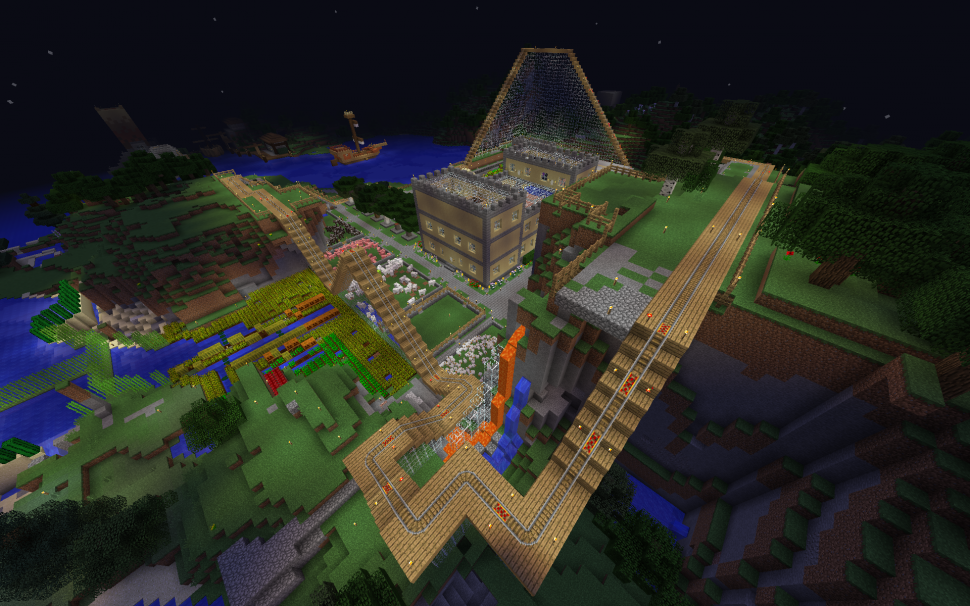
Virtual tourism is a little heavy in 2018. Sure, you’ve seen the Minecraft Eiffel Tower and beamed aboard the Minecraft USS Enterprise, but have you considered where you might wait out the end of days? Well, not you exactly, but people more important than you.
To draw attention to the escalating threat of global nuclear annihilation, the Nuclear Threat Initiative (NTI), which works to “prevent catastrophic attacks with weapons of mass destruction and disruption—nuclear, biological, radiological, chemical and cyber,” has partnered with the James Martin Center for Nonproliferation Studies to craft a virtual tour of the nuclear fallout facilities that Russian and/or American leadership will be whisked into in the event of nuclear war.
The team has really outdone itself with the Fallout-esque teaser video.
As NTI explains:
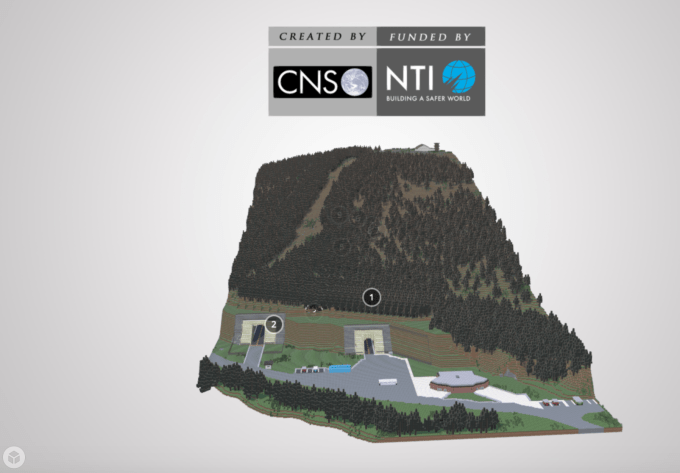
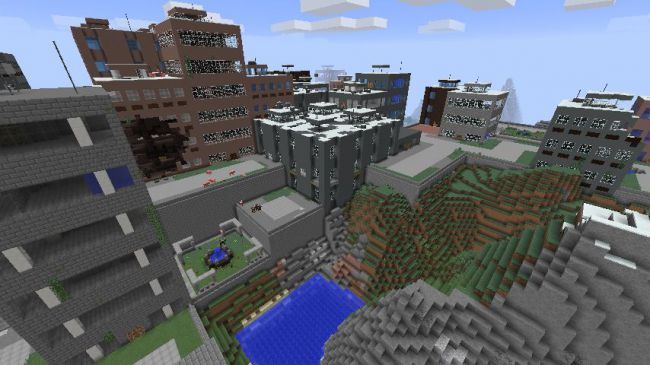
Nothing better illustrates the continuing absurdity of plans to fight a nuclear war than the massive complex of underground bunkers that the United States and Russia have built to survive and fight on even after both societies have collapsed. To help explain the scale of these facilities, we have reconstructed two, Site R in rural Pennsylvania (also known as Raven Rock) and the Kosvinsky underground command facility in Russia, roughly to scale using the popular immersive gaming platform Minecraft.
For anyone with the game, you can fire up a multiplayer instance of Minecraft, select “direct connect” and put in server address 185.38.151.31:25566 to visit Raven Rock, the underground makeshift Pentagon located near Camp David, or 185.38.151.2:25566 to tool around Kosvinsky, “a survivable command post” that serves as Russia’s equivalent. NTI cautions that it only lets zombies out on the weekends.
For anyone without Minecraft, you can take an in-browser virtual tour on NTI’s post about the project, which is also chock full of interesting nuclear bunker facts that put the existence of such underground facilities in an appropriately dark context. The tour is much clunkier outside the game, but the Minecraft experience actually looks pretty cool in that eerie we-definitely-won’t-survive-but-these-people-probably-will way.
We’ve all been very impressed by the numbers that PlayerUnknown’s Battlegrounds and Fortnite have been putting up in the past few months. PUBG is regularly pulling in three million concurrent players and more than 25 million people own it on Steam, while Epic’s action game has 40 million players, and recently passed the 2 million concurrent player barrier. But there’s a game that’s outstripping them both: Minecraft.
New head of Minecraft Helen Chiang has revealed that the game had 74 million active users in December—the most in a month since it released nearly nine years ago. In total, more than 144 million copies of the game have been sold. “We just recently set a new record in December for monthly active users, so now we’re at 74 million monthly active users—and that’s really a testament to people coming back to the game, whether it’s through the game updates or bringing in new players from across the world,” she told PopSugar.
Now, we don’t know how many of those are on PC. Minecraft is on every major console, as well as on tablets and phones, so it’s not a fair fight. But still, 74 million active players is a hell of a lot. Combining PUBG’s PC and Xbox One sales figures gets you to about 30 million. And that’s total owners, not active players (granted, Minecraft has been out for many years longer, and at the current rate PUBG is going to get there eventually).
I’ve heard a lot of people frustrated with the lack of meaningful updates to the game recently, which is a fair criticism. 2018 does look like a fairly big year for it, though, starting with a beefy ocean update coming in Spring.
Minecraft developer Mojang will join us on-stage at the PC Gamer Weekender to discuss future updates for the game, as well as offering insight into how features for the game are conceived and developed. The studio’s lead creative designer Jens Bergensten will present at 16.00 on Sunday, 18 February at the Olympia in London. Come along, and learn more about what they’ve got in store for 2018.
Minecraft, of course, just had its biggest active month ever with 74 million users. Hell, you know what it is. This is a great opportunity to go behind-the-scenes with the developer, and while you’re at the Weekender, you can check out many more speakers, games and booths. Tickets are available now from £12.99, and you can save an extra 20% with the voucher code PC-GAMER20.
Released at the end of 2014, Mojang revealed they would stop development of the game way back in June of 2015. They committed to keeping the servers running until at least July of 2016, though they’ve clearly lasted much longer than that.
As part of the announcement, Mojang also revealed that they are working to make the Scrolls server software public, allowing the community to host their own servers and continue playing online. They said they can’t guarantee this will happen, but that they have “high hopes that we’ll be able to do this in the next few weeks or months.”
As a final goodbye, a community tournament will be held on February 11. Additionally, Mojang developers will be online playing Scrolls with its players on February 9.
As technology offers students more access to the digital world, teachers have to start thinking outside the box on how to prepare their students for the future.
King High School teacher Katherine Hewett is doing just that, but using an unorthodox but futuristic method.
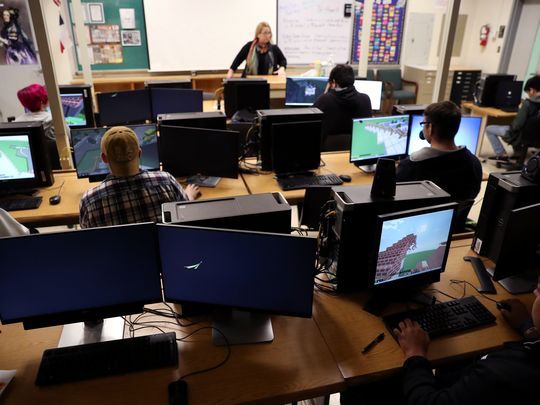
“I use the game Minecraft to teach my students about 21st century skills,” she said.
That’s right, Hewett is using video games in the classroom, and it’s not as crazy as some may think.
“About five years ago, I was having conversations with my students about video games,” said Hewett, who is a career and technical education teacher at King. “I was listening to them tell me about how video games impacted their learning and as a teacher, this was an awakening. I realized kids were receiving an alternate education when they got home.”
Hewett said she started to ask herself questions about who was teaching and mentoring these students when they entered these virtual worlds.
“I was wondering why weren’t adults, teachers, not taking more of an interest and using this is as a tool?” She said.” Why weren’t they in those worlds with them?”
That was when Hewett decided she was going to integrate to virtual reality.
Her goal? To teach the students design, coding, programming and visual media so that they are prepared for the future.
And Minecraft came on to the market, Hewett knew she had a chance to make this dream a reality.
“Here was a VR space that visually looks like Legos and had sandbox features to build, create and design 3-D worlds,” she said. “I approached the administration about it and when I suggested it to them, they were all in! I remember, when we ordered the licenses they told us we were 1 in 700 in the country that integrated the game into a class.”
Since Hewett started the course in 2013, she has had students find careers in the information technology field working for big data companies or working on virtual reality projects of their own.
Hewett said the class starts with a theme topic.
“Each class agrees on a topic where they then start researching and begin replicating the build in Minecraft,” she said. “Students collaborate and communicate to create a really large size 3-D model.”
This year’s classes have different worlds as the game is integrated into all of Hewett’s classes. Some class periods are designing fantasy worlds like Mario World and Tron whereas others are replicating real life places like Alcatraz Prison and the Winchester Mansion.
Sophomore Brendan Fuller said taking the animated course will open doors for him in the future.
“I’ve always been great with technology, but taking this course has definitely taught me a thing or two about animation,” Fuller said. “I want to use these skills one day when I become an architectural engineer. Learning how to create 3-D models now will benefit me greatly.”
Hewett said “Minecraft” has not just changed her students lives but hers as well.
The King High School teacher said as she was working on her doctorate, she focused her dissertation on her class. Now, her research on the “21st Century Classroom Gamer” has been accepted into the international journal “Games and Culture.”
“This course is everything,” she said. “I’ve learned so much with my students immersing myself into this gaming culture.”
Hewett said the animation course is a first step. She plans to take the next step with virtual reality soon.
“We don’t know what the jobs will be in the next five to 10 years,” she said. “So I’m trying to teach them all the 21st century skills they need to prepare them for jobs that don’t even exist yet.”