On the first day of Christmas, J.K. Rowling will give to you: new Harry Potter material. On the second day of Christmas, she’ll give you some more. And so on, through the 12 days leading up to Christmas Eve.
The author announced the new stories in a newsletter to Pottermore members, explaining that each new installment would be posted at 1 pm GMT (8am ET) every day beginning Dec. 12. The email promises “wonderful writing by J.K. Rowling in Moments from Half-Blood Prince, shiny gold Galleons and even a new potion or two.”
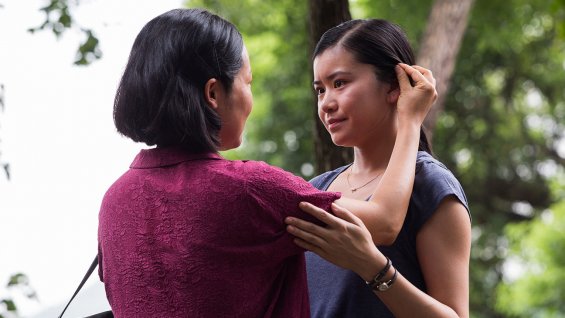
The actress, who appeared in five Harry Potter films as Cho Chang, is starring in SundanceTV’s miniseries One Child, in which she plays a British woman who was born in China and given up for adoption. When her birth mother contacts her, she learns she has a brother who was wrongfully convicted of murder — and that it’s up to her to get him out of prison.
“They are emotionally draining,” Leung tells The Hollywood Reporter of her heavy scenes. “At the same time, they are very real.”
In a chat with THR, Leung also reveals what she thinks of the upcoming Harry Potter spinoff films, why she chose One Child, and how she prepared.
What was the audition process like?
I auditioned for it way back. Three or four years ago. I fell in love with the script, but it took quite some time for it to happen.
What kind of preparation did you do?
I watched the documentary Somewhere Between, which was very helpful for the role. It’s the journey of four teenage Chinese girls who had been adopted and are living their lives in America with Caucasian parents. It was interesting to see from their perspective where they were in life.
There are a number of powerful scenes in this, like when your birth mother explains why she gave you up. What was it like shooting those scenes?
They are very emotional and emotionally draining. At the same time, they are very real because it’s not difficult to get into that frame of mind of what it would be like without a mother — to have gone through 20-something years thinking you were abandoned because your family didn’t want a girl. To discover that was the case, and that your mother is living in poverty and your dad wanted a son hurt her more than she thought.
What was the best part of this project?
Being involved in such a heartbreaking story makes you very appreciative of your own life.
Do you still get fan attention from Harry Potter?
I still get a lot of mail and contact from fans, especially on Twitter. They are so lovely and dedicated. You would think after the films are finished and the books written, it would diminish, but that is not the case. They are keeping the world alive through social media.
And they’ll make the spinoff movies.
I can’t wait to see what they’re doing with it, especially because David Yates is directing again. It’s going to be amazing, no doubt.
One Child airs Friday and Saturday at 9 p.m. on SundanceTV.
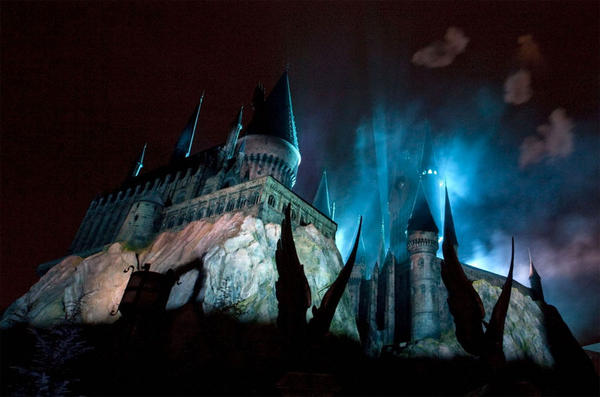
For some “Harry Potter” fans, watching the movies, reading the books, and visiting the theme park isn’t enough. They want to BE Harry Potter – to find out what it’s like to be a student at the magical school Hogwarts and truly live the life of a wizard or witch.
If you are one of those fans, The College of Wizardry is here for you.
The event is a LARP (live-action roleplaying game) in which “Potter” fans can travel to a castle in Poland and pretend to be professors, students, and other characters at the imaginary Czocha College of Witchcraft and Wizardry. According to the event’s website, it’s put together by volunteers from Denmark and Poland.
“It is a collaborative experience in the Nordic larp tradition, and is created by the players and organizers together, with everyone pitching in and helping make the magic come alive,” the website reads. “It’s essentially the same as when kids use curtains as robes and sticks as wands and run around pretending to be witches and wizards – except we’re grownups with nicer costumes and a lot of experience in designing interactive experiences for each other.”
Rewind to January last year. Here’s a thank-you letter a fellow mother shared with me, written to her husband from his godson.
“Thank you very much for my Christmas Present. I love ‘Diary of a Wimpy Kid’ books. Love Yore Loving GOD SON James.”
We both laughed. As many mothers reading this would realize, the likelihood of her husband a) sending the present himself or b) knowing that his godson liked Jeff Kinney’s series in the first place was, as she put it, on a par with her “being reincarnated as a Christmas fairy”.
Retailers know it tends to be women who are the nation’s present buyers and wrappers, mood makers and crisis averters. We distress the shop-bought mince pies and microwave the still-hard roast potatoes. We are up until midnight trying to attach angels’ wings to the nativity outfit with splitting Sellotape and a headache to match.
For while women have made huge strides in the workplace, many men have not yet found themselves needing to order the turkey, decorate the tree, or throw the neighborhood party. Mostly women just get on with it and many love doing so.
But be warned. For some, the pressure of trying to achieve perfection both at home and work is proving too much, and never more so than in December. In my case, it was trying to throw a Christmas party that tipped me into a second breakdown. In the run-up to the party, I had been trying to be all things to all people: the perfect mother, wife and friend, and to tick every box despite increasingly bad insomnia and high levels of anxiety. My to-do list was never-ending.
Tell this to a fellow mother and they understand the pressure women put themselves under. My mother calls it “death by a thousand cuts”. And there’s no denying more woman than men come forward to talk about their depression.
Figures from the mental health charity Sane show that in 2013 almost 475,000 women were referred for counseling or behavioral therapy compared with only 274,000 men.
What, then, is the answer? My own approach to Christmas is now somewhat different. We’re not holding a party. Becoming a volunteer with the education department at a local prison has helped me to find a new perspective. So too has running poetry workshops for mental health charities. I am entirely the beneficiary, given the well-known personal rewards of trying to help others.
After a family summit, we decided to streamline our present-giving this year: all the adults are getting a paperback. So there’s one trip to what is arguably the least stressful kind of shop. A friend swears by using paper plates for Christmas lunch; another by choc-ices as “you don’t even need to wash up the spoons”.
I have also tried to reassess my relations with others: research suggests women are especially vulnerable to depression given the pressure they put on themselves to maintain friendships and other relationships. Sane’s Richard Colwill reports that while families can be a source of strength and joy for some, for others they are a source of anxiety. Aim to replace “good” with “good enough”.
This is particularly true for mothers. One child recently was weeping because she hadn’t been given a solo in the forthcoming carol service. In the past, I might have spent hours telling her that I would make it better, possibly going so far as to distract her with an alternative treat. But it was good enough to sit quietly and listen. Her rage visibly dissolved as she felt heard and understood. Soon she was reminding herself that she had been lucky enough to have been a soloist a previous year. Sometimes good enough is actually better.
I’ve learned that not only can I not manage to respond to every request of the modern child, but trying to create the perfect Christmas with its ensuing stress may not have pleased my children either.
A 1998 survey of American children conducted by the Families and Work Institute found that 10 per cent of the surveyed children wanted more time with their mothers, 15.5 per cent wanted more time with their fathers, but 34 per cent said they wished their mothers were less stressed.
I’ve certainly been trying to put less pressure on myself of late. Many of the demands I imagine are just that: my own imaginings. Walking or cycling has slowed the tempo of life and automatically reduces how much I can pack into a day, while practicing mindfulness, when I pause, breathe, stretch and appreciate, gives my mind a breather – literally. Stopping to read a poem helps too, especially anything by George Herbert or Christina Rossetti at this time of year.
Such strategies won’t magically stop me getting in a flurry about Christmas presents. But I know the best present of all would be nice, calm mother on Christmas morning.
How to stay sane over Christmas: 10 top tips
1. Treat yourself like a rather nervous pet. If you feel your anxiety rising, slow your breathing, making sure your out breath is longer than your in breath.
2. Vitamin B supplements can help keep you steady and ward off low moods.
3. Despite the temptations of festive cheer over the break, go easy on the alcohol if you can.
4. Learn from geese and practice a bit of formation flying. Work together as a team to make Christmas lunch. No one says you have to eat turkey or Christmas pudding.
5. Enjoy the outdoors. Pick up a Christmas tree rather than ordering one online. It might seem time-consuming, but your spirits will feel the benefit.
6. Try to make sure that your meals remain balanced, and avoid quick festive sugar fixes. If 80 per cent of your meals are nourishing, you can relax about what you eat on sociable Christmas outings.
7. Go to a carol service. Remind yourself of what Christmas is about: sing with gusto (proven to help your mental health).
8. Edible presents are a good way to solve what to eat and what to give in one fell swoop.
9. Practice a random act of kindness, preferably to a stranger: the “one minute stand” improves your own mental health.
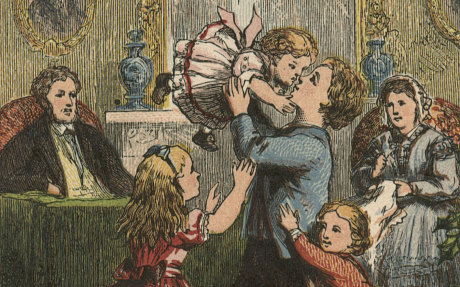
10. The perfect Victorian Christmas of united families and ruddy-cheeked children gratefully unwrapping their presents around a tree no longer exists – if it ever did. Evaluate what will make you and your family most happy and ditch any expectations of how you spend your Christmas day.
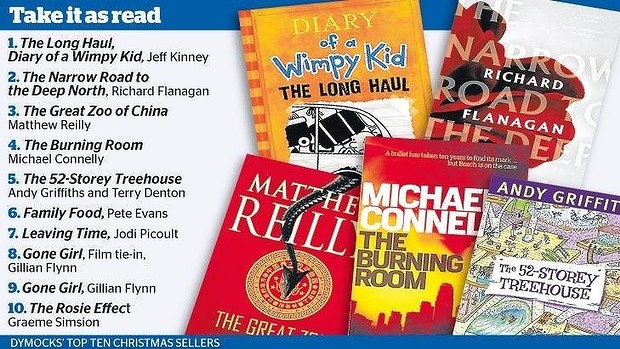
In the battle for Christmas book sales the competition has come down to two giants of tween fiction.
On one side are the homegrown anarchists, Andy Griffiths and Terry Denton, and on the other is the all-American Wimpy Kid.
This year’s contest appears to be a rerun of last year’s dash-to-the-finish when Jeff Kinney’s eighth instalment of the Wimpy Kid Series, Hard Luck, ran down the 39 Storey Treehouse and John Green’s The Fault in Our Stars.
Only a late resurgence from the Man Booker Prize winner, Richard Flanagan, and Matthew Reilly’s latest blockbuster, The Great Zoo of China, a Jurassic Park with dragons, might upset Kinney and Griffith’s quest for sales domination.
But there is no enmity between fellow travellers. Jeff Kinney, says Griffiths, is “welcome to come and play in our treehouse any time”.
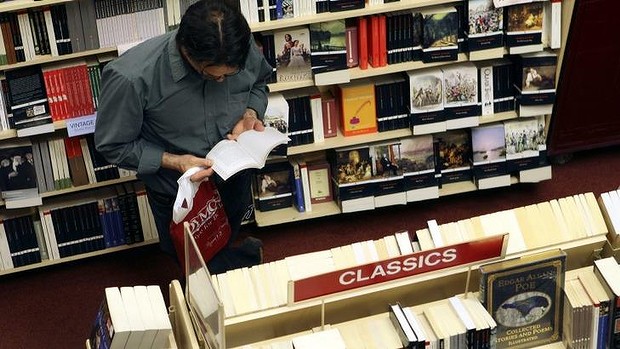
Strong growth in children’s book sales have generally marked a year of moderate growth and consolidation for independent and chain booksellers in Melbourne and Sydney – a year in which political biographies disappointed, the celebrity memoir proved a covert bestseller and online sales soared.
“The fact that children are still coveting and choosing books over all the other enticements in TV, movies and the internet really speaks to the unique power of the written word,” says Dymocks’ buying manager, Sophie Higgins. “Perhaps also the fact that parents know how important it is for children to have strong literacy skills.
“Our growth, calendar year-to-date, is well into double digits and last year was also a growth year for children’s books; it really is such a good news story.”
After initial fizz, interest in political biographies has fallen away, with the exception of Julia Gillard’s My Story. Kinokuniya made a conscious decision not to promote political biographies in its Christmas catalogue, correctly guessing interest in them would wane.
“I think people have had enough,” says Jon Page, general manager of Mosman’s Pages & Pages. “We lived once with all the media speculation and I really don’t think people are keen to relive it all in book form.”
Mark Rubbo, managing director of Melbourne’s independent book chain Readings, says the Gillard book sold well on first release but hasn’t maintained the sales intensity.
“I wildly predicted that we would sell 10,000 copies and so far we have sold over 2000 – still very good but way off 10,000.”
Celebrity biographies from the likes of Lena Dunham, John Cleese, Amy Poehler and Cary Elwes have been racing out the door, according to Kinokuniya, while short story collections or novellas from Christos Tsiolkas, Michelle de Kretser, Patrick Rothfuss, Margaret Atwood and Hilary Mantel have ben selling in place of full length fiction.
Such is the interest in Dunham’s Not That Kind of Girl,The Art of Asking by Amanda Palmer and Poehler’s Yes Please, Rubbo suggests non fiction titles by feisty women should become a new sub-genre.
The online Australian bookstore, Booktopia, expects its biggest sales ever in the run up to December 10, its Christmas order cut-off, capping off a year of strong sales across hundreds of titles, instead of the sharp peaks of previous years.
Chief buyer John Purcell predicts Big Little Lies, The Rosie Effect, The Great Zoo of China to be popular holiday reads.
Page has reordered Richard Flanagan’s The Narrow Road to the Deep North a dozen times since the author’s Man Booker prize win.
Last year Dymocks recorded some of its biggest pre-Christmas sales days. This year, says Higgins, sales are largely positive but much more variable, week to week.
At Readings, overall sales are up slightly on last year, online sales by a “huge amount”. Other booksellers Rubbo knows report similar experiences.
It’s been a strong year for Pages & Pages but the next three weeks makes or break the year. “Let the madness begin,” says Page.
Touch-screen technology could be a vital new weapon to combat low literacy levels in the key target groups of boys and disadvantaged children, according to new research published by the National Literacy Trust and Pearson.
This is the second year that the Early Years Literacy Survey has been carried out examining the use and attitudes to books and stories on touch-screen devices with children aged three to five and the influence of reading practices on young children’s vocabularly.
Its findings show the benefits of using touch-screen technology for boys, who engage with reading and educational activities for longer than with books alone.
Twice as many boys as girls look at or read stories on a touch-screen for longer than they look at or read printed stories (24 per cent versus 12 per cent) and more boys than girls use a touch screen for educational activities rather than for entertainment (36 per cent versus 28.2 per cent).
The findings also reveal that technology can be a more engaging learning tool for disadvantaged children at age three to five, than books. Twice as many young children from poorer households with a socio economic grouping of DE read stories on a touch-screen for longer than they read printed stories than children from AB households.
Furthermore, a higher number of children from DE households than AB households use technology more for educational activities than for entertainment (43.2 per cent vs 30.4 per cent).
Jonathan Douglas, director of the National Literacy Trust said: “Our second Early Years Literacy Survey with Pearson throws up very interesting evidence on the positive impact of combining technology with books on pre-school children’s vocabulary. Children’s early language and vocabulary skills lay the foundation for their future success and it is crucial that we recognise the opportunities that technology brings for engaging boys and poorer children in reading”.
Additionally, the survey highlights the increasingly significant role that technology plays in the lives of under-fives, both at home and in their pre-school educational environment.
It estimates that now more than 90 per cent of children aged three to five have access to touch-screen technology at home. Access to touch screens in early years settings has doubled since 2013 (from 22 per cent to 41.3 per cent) and nearly a third of all parents say their children read stories on both a touch screen and on paper compared to 70 per cent of parents who say that their children read books only in a typical week.
A varied reading diet could also be a route to improved vocabulary, according to the research findings. Children aged three to five have a wider vocabulary if they read stories in both print form and on a touch-screen compared to those who don’t use technology (20 per cent versus 15 per cent).
The research also explored the use of technology in early years educational settings, and found that the majority of pre-school teachers and practitioners say they want more access to touch-screen technology (60 per cent). However, practitioners feel far more confident sharing stories with children on paper rather than on a touch screen (90 per cent versus 55 per cent), and a quarter do not think technology has a place in their pre-school educational environment.
Julie McCulloch, director of policy and thought leadership at Pearson UK, added: “This research highlights the shifts in literacy learning that are enabled and driven by technology, both in the home and in more formal settings. We’ll be exploring how we can do more to support parents and practitioners to make the most of these trends to support improved outcomes for young people, in the UK and around the world.”
Pearson has announced that it will be directing its flagship social impact campaigns towards improving literacy rates over the next five years.