by Stone Marshall | Jan 21, 2015 | parent-news |
What does reading 20 minutes a night really mean?
It means that your kids are
reading out loud to you. If your kids are in Pre-school or Kindergarten, they are probably reading the
small, repetitive books like
“I went to the store. Mommy went to the store. Daddy went to the store. We all had fun!”.
Kindergarten: For this level, I would suggest reading each of those small books three times each.
– The first time you are reading to sound out the words.
– The second time you are reading for comprehension.
– The third time you are reading for fluency (to read at a faster rate.)
If you have not reached 20 minutes yet, this would be a great chance for YOU to read to your child.
For Your Older Children:
I let our son (second grade) read his chapter book to me for about 15-20 minutes. He would prefer to read it silently, but he has to read it out loud because I can listen to him.
-I can make sure that he doesn’t just skip over hard words.
-I can help him with his mistakes.
-When he is finished, I will ask him to tell me about the story (what happened, who were the characters…).
-I also make sure to read a bible story to him every night.
Hearing me read aloud is also important.
You can find the this printable chart here. 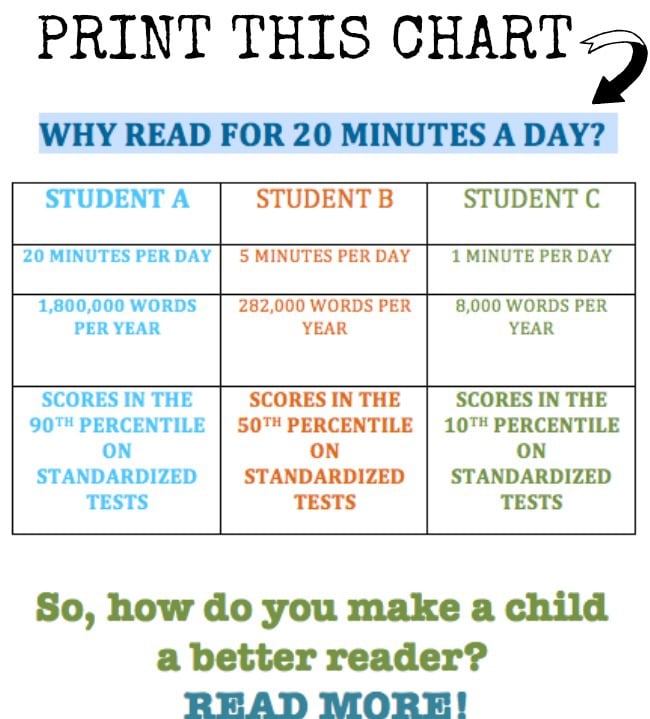
PRINT OUT THE READING CHART HERE
I know that time is tight. I know that you are busy. I know that your kids need to get to bed early. I know that they will ask you
“Mommy, will you lay with me?” at the end of the day. I also know that if you skip out on
reading nightly, your child will slowly fall behind.Give your child the best advantage and read with them- twenty minutes a night.Thank you for taking the time to invest in your child! They will
thank you… one day! Read original article here:
by Stone Marshall | Jan 21, 2015 | parent-news |

The key to learning and memory in early life is a lengthy nap, say scientists.
Trials with 216 babies up to 12 months old indicated they were unable to remember new tasks if they did not have a lengthy sleep soon afterwards.
The University of Sheffield team suggested the best time to learn may be just before sleep and emphasised the importance of reading at bedtime.
Experts said sleep may be much more important in early years than at other ages.
People spend more of their time asleep as babies than at any other point in their lives.
Yet the researchers, in Sheffield and Ruhr University Bochum, in Germany, say “strikingly little is known” about the role of sleep in the first year of life.
Learn, sleep, repeat
They taught six- to 12-month-olds three new tasks involving playing with hand puppets.
Dr Jane Herbert performing the study.
Half the babies slept within four hours of learning, while the rest either had no sleep or napped for fewer than 30 minutes.
The next day, the babies were encouraged to repeat what they had been taught.
The results, published in Proceedings of the National Academy of Sciences, showed “sleeping like a baby” was vital for learning.
On average one-and-a-half tasks could be repeated after having a substantial nap.
Yet zero tasks could be repeated if there was little sleep time.
Dr Jane Herbert, from the department of psychology at the University of Sheffield, told the BBC News website: “Those who sleep after learning learn well, those not sleeping don’t learn at all.”
She said it had been assumed that “wide-awake was best” for learning, but instead it “may be the events just before sleep that are most important”.
And that the findings showed “just how valuable” reading books with children before sleep could be.
Dr Herbert added: “Parents get loads of advice, some saying fixed sleep, some flexible, these findings suggest some flexibility would be useful, but they don’t say what parents should do.”
Sweet dreams
A study last year uncovered the mechanisms of memory in sleep. It showed how new connections between brain cells formed during sleep.
Prof Derk-Jan Dijk, a sleep scientists at the University of Surrey, said: “It may be that sleep is much more important at some ages than others, but that remains to be firmly established.”
He said babies “should definitely get enough sleep” to encourage learning, but concentrating learning just before bedtime may not be best.
“What the data show is sleeping after training is positive, it does not show that being sleepy during training is positive.”
There is also growing interest in sleep and memory at the other end of life.
The two go hand in hand in your twilight years, particularly with underlying neurodegenerative disorders such as dementia.
It is hoped that boosting sleep would “slow the rot” of memory function.
Read original article here:
by Stone Marshall | Jan 20, 2015 | Awesome Book News, parent-news |
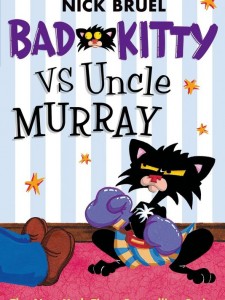
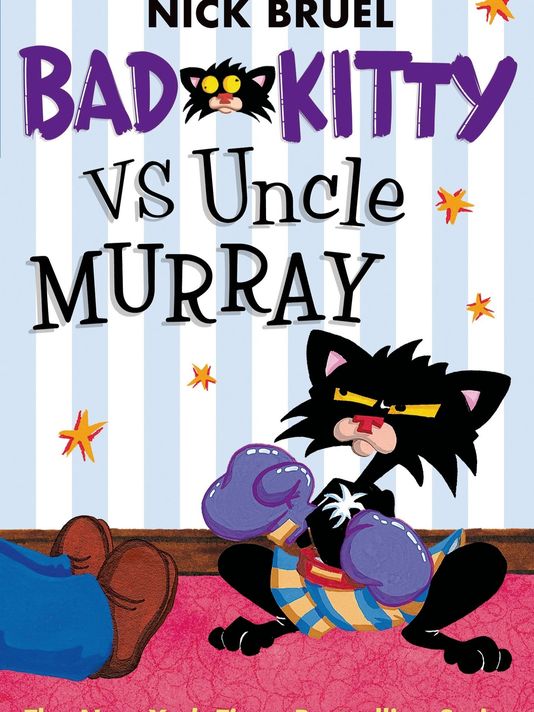
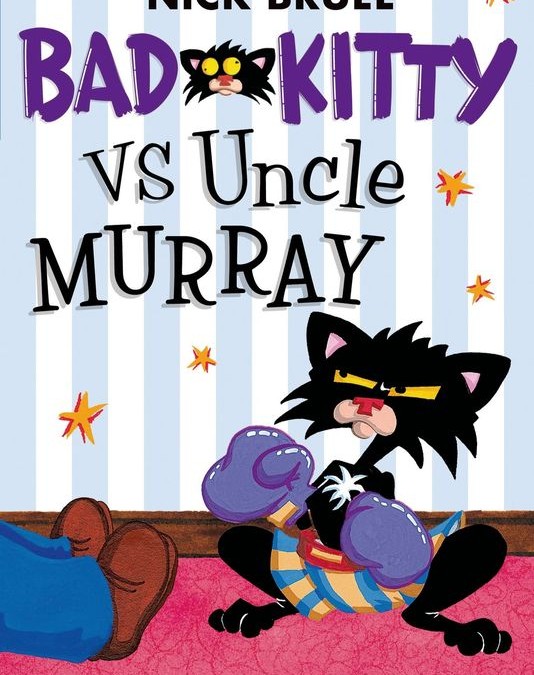
Do you like “Bad Kitty” books? Well if you do, check out “Bad Kitty Vs. Uncle Murray”! Trust me it’s great! You have to read the book to find out the rest!
This story reminds me of when my mom told me a story about her younger brother when they had baby hamsters. Her brother let them out. She found all of them in different places all over the house, just like when Uncle Murray found Bad Kitty all over the place!
When my mom and dad are doing something I blend into things and try to scare them, just like Bad kitty. Bad Kitty is just like my sister Isabel. They are both so silly. Uncle Murray is just like my dad Richard. He gets so frustrated over something that HE did! If all of the cats were humans, they would be great friends because they will always stick up for me.
I think the main idea of the story is “Don’t judge a book by its cover.” The most important part of the story is when Uncle Murray came over to their house. The funniest part of the story to me was when all of the cats started chasing Uncle Murray!
This book makes me want to read more of the series. I think the author wrote this book to make kids laugh and have fun reading. This book makes me think of my happy place.
Read original article here:
by Stone Marshall | Jan 19, 2015 | parent-news |
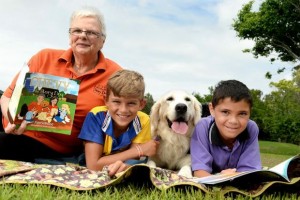
IT’S a blissful life for Pam Sellwood’s golden retrievers.
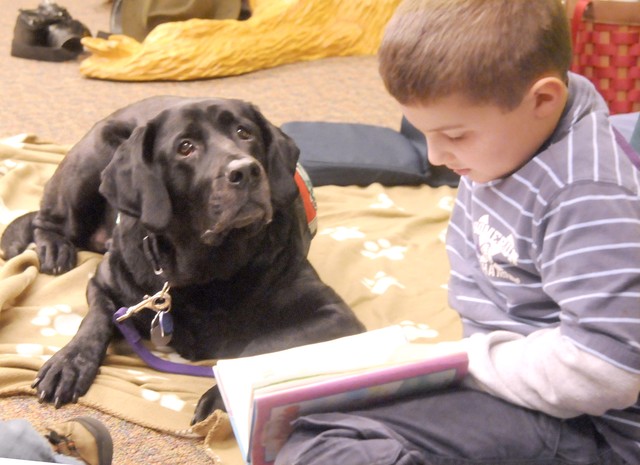
They spend their Thursdays helping children to read, and getting all the attention their hearts could desire.
Now, Ms Sellwood has published a book about her younger dog, Chevy.
Chevy the Story Dog began from many students’ questions about Chevy and his mother Marlee, Ms Sellwood said.
“Chevy has been going for 18 months but his mother has been going for three years,” Ms Sellwood said.
“The children asked so many questions about the dogs.”
On Thursdays, the dogs take a trip to Pottsville Beach Public School, then St Anthony’s in Kingscliff.
They – and Ms Sellwood – volunteer for the non-profit organisation, Story Dogs, which was established in Murwillumbah in 2009.
The program is designed to help children in Year 2 with reading difficulties gain confidence in reading.
Ms Sellwood, who has a background in dog training, said it was a great way to give back in retirement.
“The teachers are really good with the program,” she said.
“The children really improve … By the end of the year they’re really outgoing and are reading really well.
“It changes the kids.”
Ms Sellwood said the dogs enjoyed their Thursday adventures at the schools, too.
“The dogs love it,” she said.
“As soon as we put our shirts on, they get too excited, so we have to wait until we’re nearly ready.”
Ms Sellwood said it was incredibly rewarding to see the children improve with their reading after being involved with the Story Dogs program.
Read original article here:
by Stone Marshall | Jan 19, 2015 | parent-news |
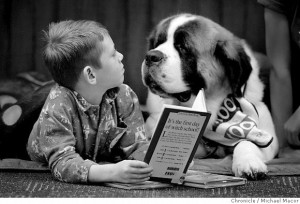
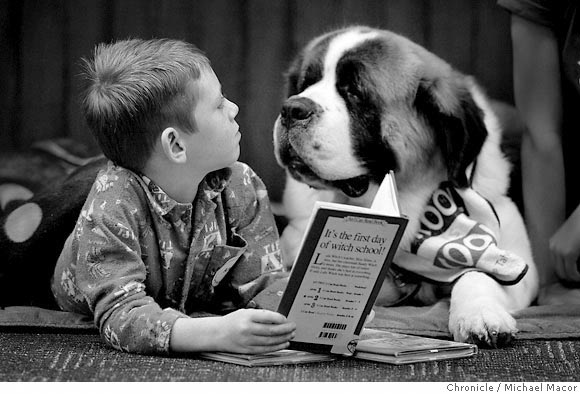
MIDDLEBORO — Tivy the cocker spaniel is a good listener: he doesn’t judge, butt in with corrections or make funny faces when you run off course. Tivy cannot possibly promise to sit still, and whether or not he enjoys a good story, we’ll never know. But Tivy listens.
Five-year-old Middleboro resident Lotti Drummond found a captive audience in Tivy and retired children’s librarian Marilyn Thayer, Tivy’s mom, Monday afternoon at the Middleboro Public Library, part of the Reading with Miss Marilyn’s Spaniels program. The three found a quiet corner and got comfortable, and as Lotti bumbled through a few tales from the “Frog and Toad” series, Tivy sat comfortably, nosing around the book and its reader, occasionally lobbying for attention. Oblivious to the misadventures of Frog and Toad, and really not all that interested in the visiting newspaper reporter/photographer, Tivy sat tight and proved an exemplary lapdog.
 As is the case wherever therapy dogs are doing their thing, the basic idea is to lighten the mood in a potentially stressful situation. For some young readers the payoff is simply adding a bit of fun to learning to read and practicing reading skills, while for others the dog provides a calming, non-judgmental audience which alleviates some of the pressure and anxiety that comes with reading aloud for a much bigger audience in the classroom.
“It can work in a number of ways,” says Thayer, who goes by Miss Marilyn at the library. “I’ve had kids that are frightened of dogs come in, and at first, Tivy stays away and we let them have their space, but very often by the end of the session they’re petting Tivy and playing with Tivy. So in that case, it’s helping them get over their fear… and maybe it’s helping them with their reading, or getting them interested in reading.”
It’s really just a way to add a little fun to reading, which is a chore for some kids. And all agree, Reading with Miss Marilyn’s Spaniels easily accomplishes that baseline goal. Any lasting, more dramatic results are all bonus.
Lotti is in her second session with the program and is reading way above the kindergarten level — she breezed through “Frog and Toad” and boasted of having completed “Green Eggs and Ham” in a previous session — and while Thayer won’t take any credit for Lotti’s proficiency, Franzi Drummond, Lotti’s mom, says the program is leaving an impression.
“It’s very beneficial,” Franzi said. “She enjoys reading in general, but having the treat of reading to Tivy is making her look forward to reading and making her practice. It takes a lot of the pressure off… no teachers, no other students listening… and it’s just fun for her. It’s a great program.”
 Tivy is a 12-year-old spaniel with an admirable show-dog resume. Included on that resume are “Certified Family Therapy Dog” and proud papa, as Tivy shares his listening duties with housemates Brazen, Tivy’s son, and Violet, a granddaughter. The dogs are well known to library patrons, and like all dogs, are motivated and influenced by treats.
At the conclusion of Monday’s session, Tivy was rewarded with double treats, as Lotti was waiting with one and her younger brother, three-year-old Chris, made good with another.
Reading with Miss Marilyn’s Spaniels is one of many cool kids’ programs available at your local library. The program is offered Monday afternoons, with 20-minute sessions available from 4 – 6:30 p.m. The current session runs through Feb. 23. Call the library 508-947-2470 to reserve a spot. As with nearly all programs at the library, Reading with Miss Marilyn’s Spaniels is offered free of charge.
Read original article here:

by Stone Marshall | Jan 18, 2015 | parent-news |
 Just a year ago, most parents chose independently which ebooks their children read. Now those decisions are split nearly evenly between parents and kids, according to a new report published today by PlayCollective and Digital Book World.
The expanded roles children are now playing as consumers of digital content present publishers with new challenges and opportunities.
While more children are now primary owners of e-reading devices, a circumstance that PlayCollective finds drives e-reading itself, ebooks must now compete for kids’ attention with a battery of other media on those very same devices.
And around age eleven, reading begins losing ground to other activities like games and apps.
Opinion is split as to how publishers should respond, but what’s seems clear is that the goal will increasingly move toward attracting children first and their parents second.
Much more, including graphs from the complete report.
To get all the ebook and digital publishing news you need every day in your inbox at 8:00 AM, sign up for the DBW Daily today!
Macmillan Enters a Changing Subscription Ebook Market (DBW)
Adding 1,000 back-list titles each to Oyster and Scribd, Macmillan wades into a subscription landscape that’s evolved dramatically over the past eight months. Scribd now claims it’s the third biggest revenue source for some publishers, even though Oyster’s catalog now boasts twice as many titles.
Why Subscription Ebooks Are Gaining Steam (Wired)
One observer wagers the main reason publishers are steadily–and even reluctantly–doing more business with ebook subscription services is the industry-wide thirst for reader data.
Related: New Routes to Reader Data
Penguin Publishing Group Reshuffles Upper Ranks (Pub Lunch)
Madeline McIntosh, president of the freshly established Penguin Publishing Group, institutes major changes in the division, merging the Dutton and Putnam imprints, accompanied by a number of top-level appointments.
What Trade Publishers Can Learn from the STM Market (DBW)
Science, technology and medicine (STM) publishers may not publish the most glamorous titles in the book business, but major players in the sector have different ways of operating than their trade counterparts, which occasionally seeds more collaboration. Here’s one industry insider’s take.
Remarkably, Little to Remark on Ebook Best-Seller List (DBW)
We’ve seen few long, multi-week runs at No. 1 ever since mega-hits like Divergent or The Fault in Our Stars swept the rankings in the middle of last year. Since then, average prices have skittered up and down, and this week’s uptick is no exception to that variability. Somewhat remarkably, though, few titles moved very far out of the positions they occupied last week.
How Will Reader Data Impact Readers? (NYRB)
Publishers may welcome the expanding opportunities to gather insights about ebook readers, but one observer points out more readers may begin to turn away from publishers and retailers that scrutinize and parse their every move.
Doubling Down on Original Content, Amazon Signs Woody Allen (NYT)
Fresh off its landmark Golden Globe win for “Transparent,” Amazon announces it’s secured Woody Allen to write and direct an original series for Prime Instant Video.
UK Publishers Collaborate on New Digital Imprint (Teleread)
Two former Quercus executives partner with the digital head of Profile Books to launch Canelo, a UK-based digital publisher focusing on ebooks, apps and web-based fiction and nonfiction.
Read original article here: