by Stone Marshall | Mar 8, 2015 | parent-news |
I’m sure anyone who went to the recent Gordon Lightfoot concert hoped to hear “Sundown” and “If You Could Read My Mind” yet again rather than a tune Gordon banged out in the past year.
And I’m pretty sure that this same anyone didn’t go to the library the next day and check out a book he’d read oodles of times.
And I’m absolutely sure that if this anyone don’t pay me back those two yards he owes me, it’s going to get Cubist ugly.
Sorry. I need to keep my personal business out of my laugh-a-second column.
So back to the column mentioned afore.
I’m just like this anyone (who apparently has the scratch for concerts but not for me and I swear, O Best Ones, I won’t mention it again). I rarely read a book more than once, but if Elton John’s “Your Song” comes on the radio, I crank it up to 11 and me and Mrs. Cool Kid head-bang in the Honda.
Why is this?
I’m no rocket surgeon, but I figure it has to do with the difference between aural and ocular synapses. That, or alchemy.
I was mulling this recently while sitting on a mule, and I had a brain typhoon. Something that could save the struggling publishing industry.
Singing books!
I’ll let the huddled masses work out the details; the tech specs; the royalties; all that. The Cool Kid is an idea man (some would say an ideal man, but I wish they wouldn’t because it makes me blush).
But I know it will work, because I tested it. Minutes ago, I asked Mrs. Cool Kid if she remembered the financial advice Polonius gave Laertes in “Hamlet.”
She looked at me like I was the one who wrecked the Edmund Fitzgerald.
Then I started singing, “Neither a lender, nor a borrower be!”
She jumped in and we belted out, “Do not forget! Stay out of debt!”
There’s an episode of “Gilligan’s Island” where the castaways set “Hamlet” to music using the album collection Mr. Howell, for some reason, brought on the three-hour cruise.
If you saw it, I’m sure you can sing this: “I ask to be! Or not to be! And that is the question that I ask of me!”
Singing books — can’t fail!
And when they catch on, the Cool Kid fully expects to wet his beak the way Johnny Sacks always did on “The Sopranos.”
Read original article here:
by Stone Marshall | Mar 7, 2015 | parent-news |
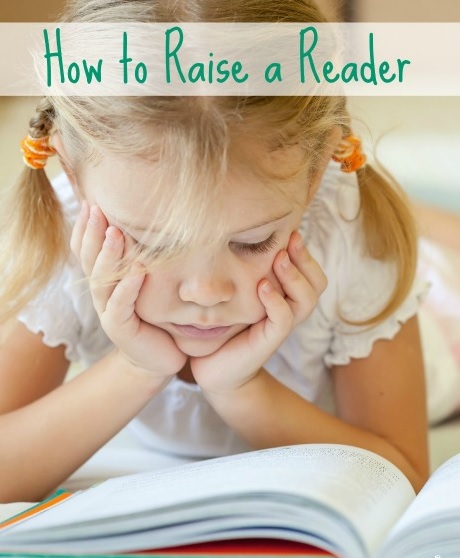
 Kids become lifelong readers for all kinds of reasons. Sometimes there’s one key book that captures a kid’s imagination and opens him or her up to the exciting world of fiction. Other times, a teacher who assigns great books in class sparks a hunger for more big ideas and fine writing. In some cases, parents influence kids’ appreciation of books by sharing their own love of literature and modeling reader behavior – always having a book to read, taking books on vacation, reading before bedtime, making regular trips to the library and bookstore, etc.
Here are some tips for nurturing a love of reading that can last a lifetime:
_Read aloud:This comes naturally to lots of new parents, but it’s important to keep it up. Kids will enjoy it longer than you think. When reading to babies, toddlers, preschoolers, and kids in early grade school, it’s wonderful to have a kid on your lap, snuggled next to you on the couch, or drifting off to sleep in bed as you enjoy picture books together. You may have to read your kid’s favorite a hundred times, but just go with it. Your kid will remember the closeness as well as the story. And try nonfiction for those who are curious about pirates, Vikings, robots, castles, history, sports, biography, animals, whatever. For second through fifth graders, read those rich and meaty books that might be missed otherwise, maybe classics like”Treasure Island”or”Alice’s Adventures in Wonderland.”
Many parents think that as soon as their kids learn to read on their own, they no longer need to be read to. But kids still love it and benefit from it as they hear the rhythm of the language, learn correct pronunciation, and get to relax and just take it all in. Kids will get the idea that there’s something worthwhile in books and that there’s something special about time spent with a parent.
_Savor the series:It’s common for kids to become book lovers for life after getting hooked on a series. And there are lots of good ones that keep kids hungry for the next installment. Some reliable prospects:”Ivy and Bean,””Judy Moody”for beginning readers;”Harry Potter,””A Series of Unfortunate Events,” and the”Percy Jackson” seriesfor middle graders; and”Hunger Games,” “Sisterhood of the Traveling Pants,” and”Twilight”(unless you think vampires are too creepy) for older kids.
_Grab onto a genre:Kids go through phases of genres they’re passionate about, fromgirl detectivestoscience fictionandfantasy. Don’t get hung up on whether it’s considered great literature (although some genre books are). Be happy that your kid is devouring books one after the other.
_Feed the favorite-author addiction:Once your kid finds a writer they love, they may want to read all of his or her books – a great excuse for a trip to the library or an opportunity for book swapping among friends and classmates. Here are some good bets for favorites. Younger kids: Dav Pilkey (“The Adventures of Captain Underpants”), Beverly Cleary (“Beezus and Ramona”). Middle grade: Kate DiCamillo (“Because of Winn-Dixie”), Neil Gaiman (“The Graveyard Book”). Tweens and teens: Judy Blume (“Are You There God, It’s Me Margaret”) and Sarah Dessen (“Just Listen”).
_Count on the Classics:Books are called classics because they continue to engage readers generation after generation. There are no guarantees, but you could try introducing your kids to books you loved as a kid and see which ones click. Some good ones to try are theDr. Seussand Narniabooks,”Charlotte’s Web,” and”The Secret Garden.”
_Find Books About the Things Your Kid Loves:If your kid adores horses, try”Black Beauty.” If he’s wild about cars, trucks and trains, try “The Big Book of Trains” or “The Rusty, Trusty Tractor.” Librarians, booksellers, and Internet searches will help you find books on any favorite topic.
– Funny Is Fine:Some parents wrestle with letting their kids read”Captain Underpants,””Diary of a Wimpy Kid,” and other edgy humor books about kids getting in trouble. Talk to your kids about the content, but keep in mind that kids like these books not because they want to imitate the characters’ actions but because they can live vicariously through their bad behavior. Humor is a great pathway to book loving.
– Comics Are OK:Graphic novels are among the hottest trends in children’s publishing, and they can get kids hooked on reading. Kids may start with”Squish”and”Babymouse”and move on to”Diary of a Wimpy Kid.”But these series can also lead to more sophisticated fare such as”Marzi”and “American Born Chinese.”
_Engage with eBooks:Kids can cuddle up with a Kindle, Nook, or iPad before naptime or bedtime. Some recent studies say more than half of U.S. kids are reading digital books at least once a week. The electronic format has proved to be especially engaging for boys and reluctant readers, and you can download or access many books on an eReader, which make it a great choice for air travel and car rides.
But note that some studies show that book apps and interactive “enhanced” eBooks, while fun, can be distracting and inhibit reading comprehension. So to promote reading skills and encourage your kid to be a frequent reader, you might want to stick with eBooks that have the look of a bound paper book. Some even have animation that mimics turning the pages.
– Make Reading a Family Value:Actions speak louder than words. Take your kids to the library once a week or once a month to get new books, make regular outings to your local bookstore, hunt for low-cost books at used bookstores or second-hand shops, and show kids that finding a good book is like a treasure hunt.
Fit reading into your family lifestyle. Set aside time for reading only – turning off the TV, computer, and cell phone. Encourage focused reading time, either for independent reading or reading aloud. Take preschoolers to story time hours at libraries and bookstores. For older kids, a parent-kid book club can be fun. Read to kids at bedtime. Provide time and space for your kids to read for pleasure in the car (if they don’t get car sick!), on vacation, after homework is done, on their own before bed. Warning: It could be habit-forming!
Read more here: http://www.thestate.com/2015/03/02/4019776_how-to-raise-a-reader.html?rh=1#storylink=cpy
by Stone Marshall | Mar 7, 2015 | parent-news |
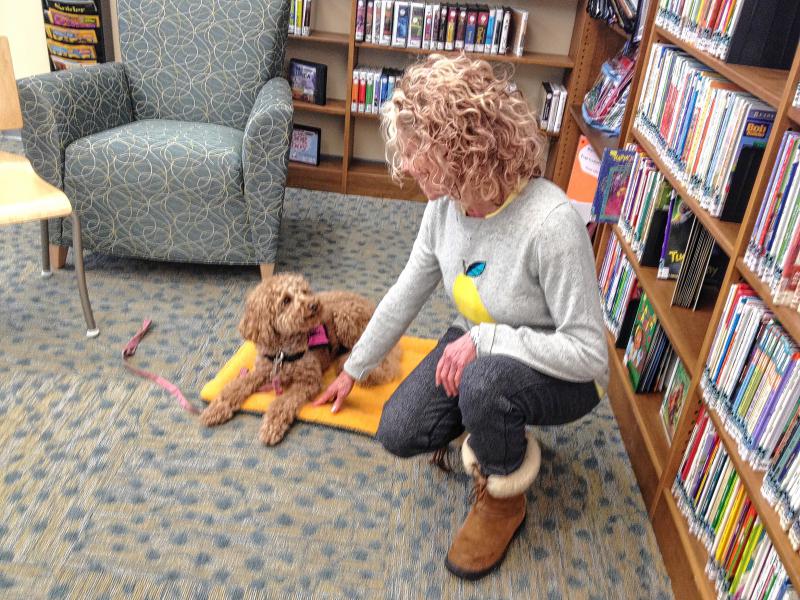
 Sunapee — Bumble Bee sits quietly on an orange mat as Amelia Salvitti, of Sunapee, reads aloud from the Dr. Seuss book Fox in Socks .
Children have been reading Dr. Seuss books for generations. What makes this scene at Abbott Library unique is who 6-year-old Amelia is reading to.
Bumble Bee, a 4 1/2 -year-old miniature Labradoodle, has been helping children build their reading skills for two years. Bumble Bee and her owner, Abby Brown, of Sunapee, work with both children and senior citizens as a certified therapy dog team.
“I’ve always volunteered and I wanted a dog, so I thought I’d combine that,” Brown said.
Brown and Bumble Bee earned a Canine Good Citizenship certification and a Therapy Dogs International certification before beginning volunteer work.
In addition to visiting children at the library once a month, the team also goes to Mount Royal Academy to read with first-graders and visit seniors at Woodcrest Village Assisted Living in New London and Summercrest Senior Living Community in Newport, where Bumble Bee p rovides comfort to residents by curling up on their laps.
At one point during their session at Abbott Library, Bumble Bee, wearing a pink vest with her name and certification displayed, stretches out to lick Amelia’s hand .
“We don’t kiss while she’s reading,” says Brown.
In response, the dog rests her paw on Amelia’s leg instead.
Therapy dogs must know how to ignore everything going on around them, Brown said. At the library, this means sounds from children and people elsewhere in the room. Bumble Bee’s attention must be on her subject, and her owner. Bumble Bee typically reads with the children for about 30 minutes.
But Bumble Bee does more than provide children with a safe place to practice reading. She helps them cope with fear, too.
Brown recalled two children who were afraid of dogs before meeting Bumble Bee.
“After one class with her, they now sit next to her and read to her,” she said.
Bumble Bee is Abbott Library’s first canine volunteer, said Mary Danko, the library’s director.
“It’s finding the right partner,” Danko said. “Abby is great to work with. She brings the right attitude and enthusiasm to it.”
Danko has seen children come out of their shells when Bumble Bee is around. Amelia, in particular, always reads to Bumble Bee during the dog’s monthly visits to the library.
“As soon as she saw Bumble Bee, she was asking for a certain book to read to her,” Danko said. “ It was great to see that motivation right away.”
Bumble Bee seems to agree. During the half-hour she spent at the library last m onth, she sat quietly as children read to her. She didn’t interrupt with barks to correct words that were pronounced incorrectly.
She simply listened.
“Whenever they’re here, I just want to go and take a peek,” Danko said. “It’s so satisfying to see the kids reading aloud.”
Read original article here:
by Stone Marshall | Mar 6, 2015 | parent-news |
Read early. Read often. Read for the rest of your life.
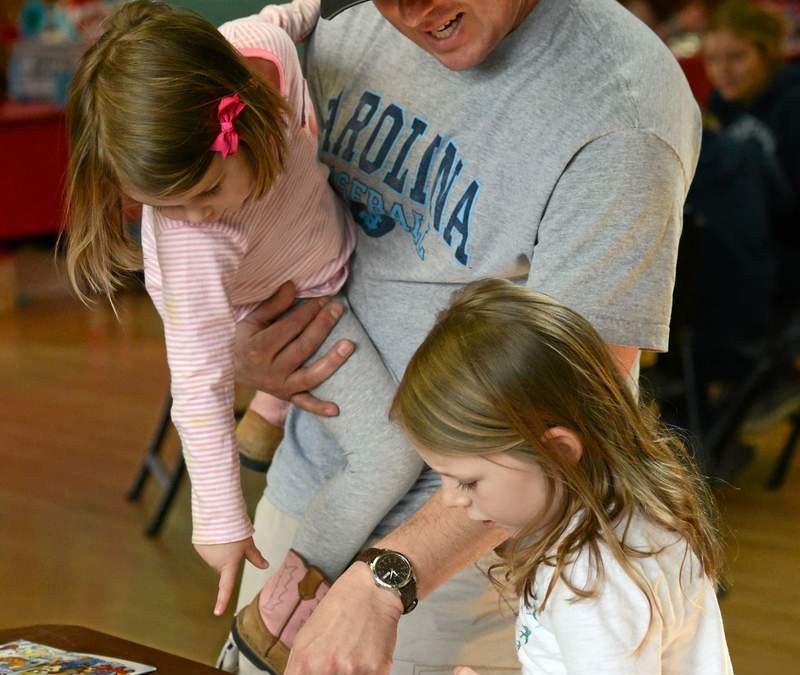
Those were some of the take-away messages for parents who brought their kids to Chico’s version of the “Read Across America” extravaganza, held Saturday.
The message for kids was that reading is fun.
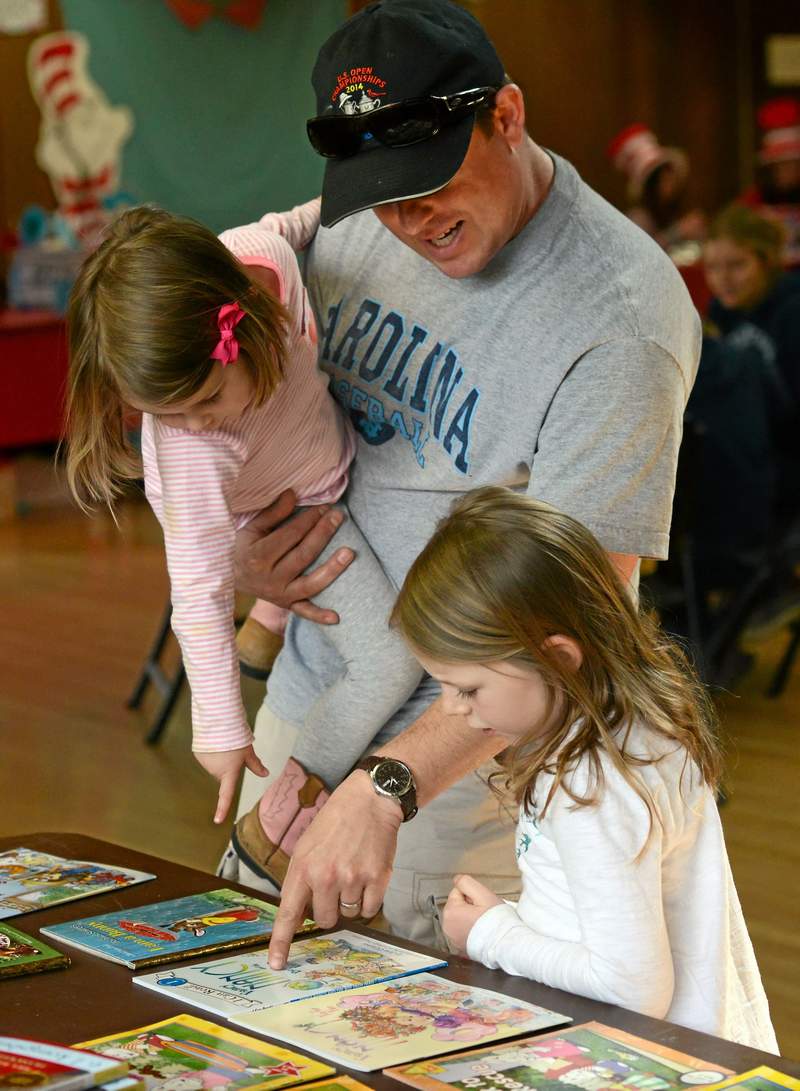
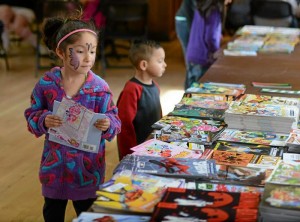
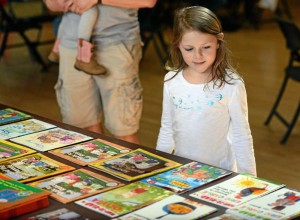
The main room at the Chico Area Recreation and Park District was busy with reading-related activities, including a “book walk.” Children walked in a circle until the music stopped. Winners could pick out a free book from the back of the room.
The event coincides with Dr. Seuss’ birthday, March 2, and posters throughout the room had memorable Seuss sayings.
“You can find magic wherever you look. Sit back and relax, all you need is a book,” one said.
Another poster declared: “The more that you read, the more things you will know. The more that you learn, the more places you’ll go.”
Syrus Copeseeley, age 6, was well on his way to writing a book of his own.
The Butte County Teachers Association and Chico Unified Teachers Association had provided bundles of blank paper where children could put down words of their own.
Syrus’ book was titled “The root that never stopped growing.”
“If I write messy I can still read it,” Syrus said, as he read the first chapter aloud.
His mom, Kate, said she loved books when she was a child and reads to her two children every day.
Research shows that children who read early and keep reading do well in school, explained Michelle Kelley, the elementary school librarian for the Chico Unified School District.
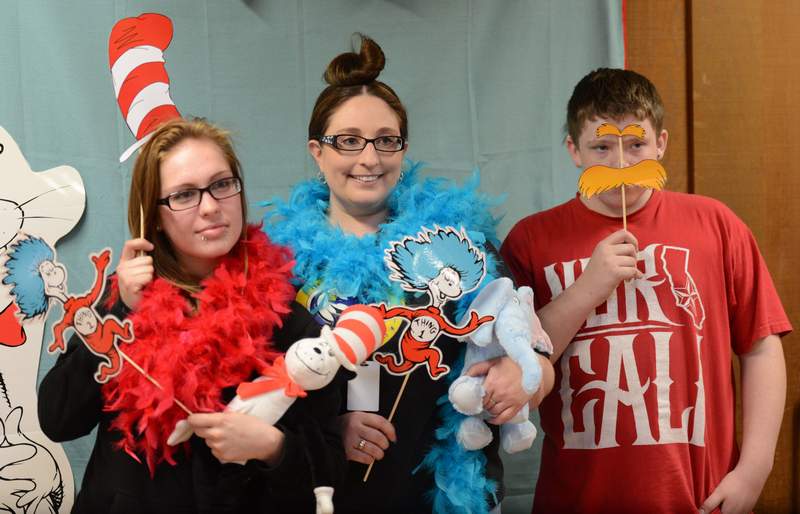
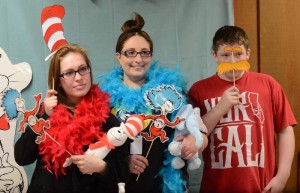
Her job for the day was to guide people to the photo booth, where people could pose while wearing Seuss-related hats and masks.
People who are readers for life never want to stop learning, she said, as her tall Cat-in-the-Hat headgear bopped back and forth.
Publishers have done a good job learning what kids love to read, providing books for all reading levels, she said.
The goal of educators is to find books that children will “devour” to give them a push toward a lifetime of reading.
Parents can help by setting aside time every day for reading, Kelley said. This might include a quiet place with a reading lamp, perhaps making reading a family activity.
Local libraries also have great programs for children, including reading rewards programs and story time. See more details at http://goo.gl/gwLJPK.
Leslie Phillips, a senior library clerk for CUSD, fully embraced the day by dressing like a Sneetch.
Attached to her head, and mostly covering her face, was an elaborately long yellow neck and a Sneetch head.
To complete her look, Phillps wore yellow pants, a yellow sweater and lemon-yellow sneakers.
The Sneetches are Dr. Seuss characters that teach that snobbery is no fun.
Phillips said her mother read to her when she was a child and she grew up to love books. It seemed natural to become a librarian, and apparently to dress like a Sneetch.
With her face barely visible through her costume, Phillips said she loves to find books she thinks a particular student will like.
“It’s exciting to watch them get excited. They’ll come back and tell me about the books they read.”
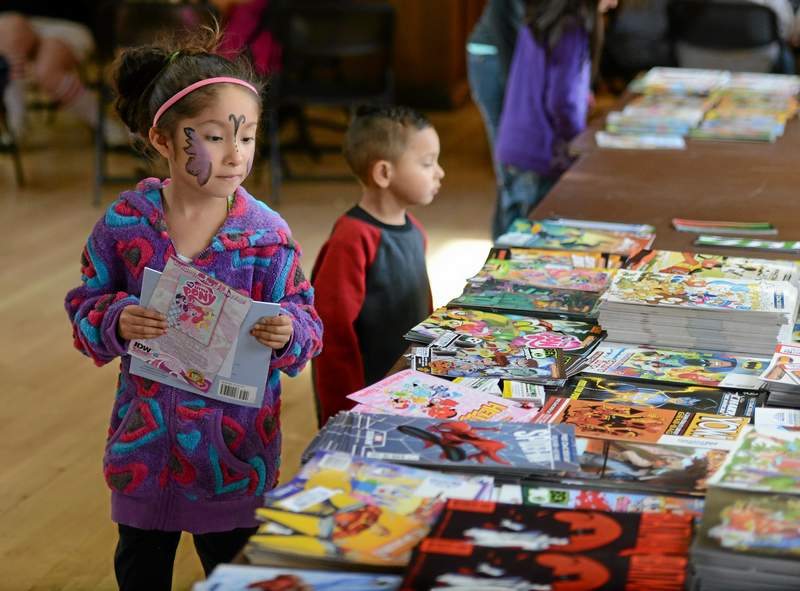
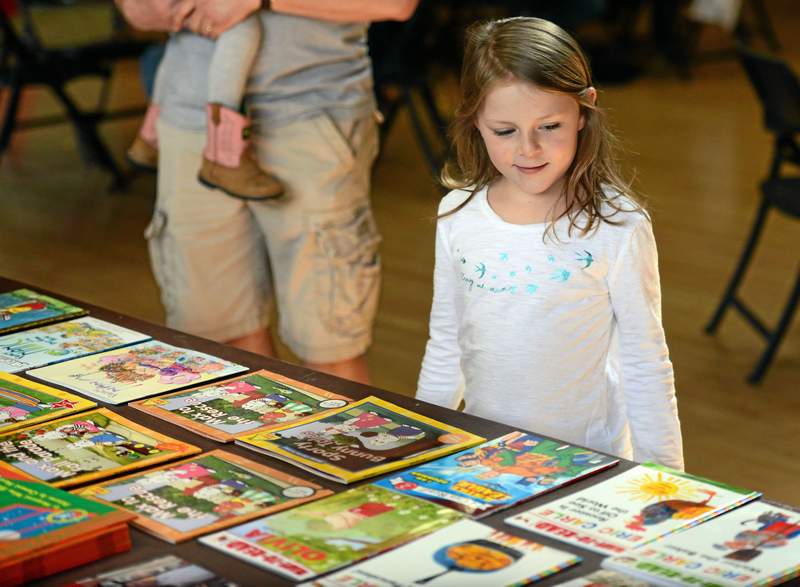
A good assortment of books were available at the back of the room, with each child allowed to choose one. Comic books were also among the mix.
Read original article here:
by Stone Marshall | Mar 6, 2015 | parent-news |
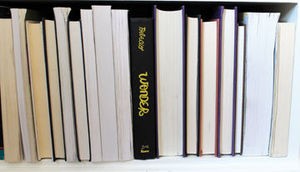 Give others more kindness than is necessary.
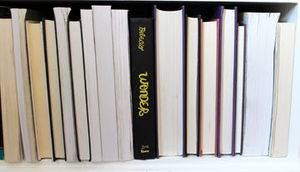
That’s the take home from R.J. Palacio’s “Wonder,” an engaging read for kids fourth grade and older and adults too, making this novel ideal for families to read together.
Main character August Pullman was born with a combination of syndromes, including a type of mandibulofacial dysostosis, a genetic mutation that affects how his face formed. According to the story, there’s a one in four million chance any baby would be born with this condition, and August declines to describe his own face because “whatever you’re thinking, it’s probably worse.”
The story covers his first year in public school, and he’s off to fifth grade at Beecher Prep, a New York middle school. He’s nervous and for good reason; he’s familiar with being called “freak,” “mutant,” “monster” and “orc.”
But on the first day a girl names Summer sits by him at lunch and finds out he’s funny, so she keeps coming back day after day. Jack, a boy the administrators asked to befriend August, does so out of obligation at first but eventually realizes August is more than a challenge to be met; he’s a boy, just like Jack. He’s funny and smart, and in spite of appearances he’s the friend Jack chooses in the end.
Not everyone is so kind, some by accident as they react involuntarily to seeing August’s face and some because they choose to be mean.
As far as readability goes, there couldn’t be a more leisurely novel to work through. The novel is just 310 pages long, but it can easily be read in a week’s worth of afternoons. Most chapters are two to five pages long, and the book is chunked into sections with different characters telling their own first-person account of the story.
That’s another endearing part of the story: Readers get to hear from several characters and become sympathetic to them. For instance, one section told by August’s sister Via examines the conflict between fiercely loving and defending her brother and desperately wanting more attention from her parents and less negative attention from others because of August. It’s an interesting perspective from a family member who’s life is impacted for good and bad by a loved one’s struggle.
Maybe the best way to read “Wonder” would be as a parent with your kids because the story has lots of anecdotes perfect for conversation starters. For instance, the antagonist, Julian, knows just what to say to get on the good side with teachers and other adults, but around peers he is arrogant and condescending, and with August he’s downright cruel. His character isn’t likeable and provides the ideal opportunity to talk about authenticity and what real popularity is.
In the end, most fellow students are rooting for August, even though they don’t want to be open about it — and it’s another chance to ask your kids what kind of friend they are: one who is unashamed to be inclusive and accepting of others, or one who cares more about the crowd than being kind.
Reading this book as a family or at the same time as one another can be a good way to open the discussion about how we treat people who are different than us — appearance wise and otherwise. Because as Palacio preaches, “Your deeds are your monuments,” and little can be as monumental in people’s lives as the genuine care of others.
Read original article here:
by Stone Marshall | Mar 4, 2015 | parent-news |
As a child, I was so desperate to read that I would painstakingly scan the ingredients list on the tomato ketchup bottle when mealtimes kept me from my books. Perhaps that’s why I’m so relaxed about mixing easily devoured trash with genuine masterpieces.
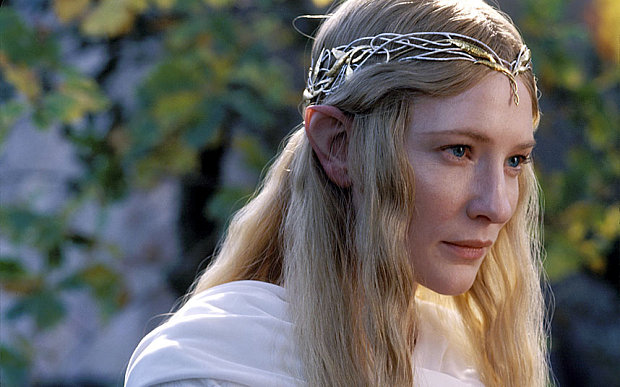
Yet even I was taken aback by last week’s furore over the annual What Kids Are Reading report, which seemed to indicate that children are now shunning classics such as J R R Tolkien’s The Lord of the Rings trilogy in favour of books by David Walliams or Jeff Kinney’s Diary of a Wimpy Kid.
To be honest, this is a debate that is as predictable as a fairy‑tale ending with the words “happily ever after”. Every generation thinks that standards are slipping – in my childhood it was Enid Blyton in the line of fire, for my sister it was the Sweet Valley High series, and today it’s The Hunger Games. All have been roundly condemned for stopping children reading good books.
And yet children keep reading. Shouldn’t we be celebrating that children’s books sales were up by 9 per cent last year – and that seven out of 10 of the best-selling books in 2014 were for children or young adults? Many of those books today have messages as sophisticated as those in classics such as To Kill a Mockingbird. I’ve been gripped by The Fault in Our Stars by John Green, Wonder by R J Palacio or Keren David’s When I Was Joe trilogy.
Plus, let’s not blind ourselves to the fact that some “classics” don’t always deserve the title. I was delighted that Tolkien, the favourite author of nerds and fantasists, has finally slipped out of the “most popular” lists. What can account for the perpetual appeal of Middle Earth? I’m fully with Hugo Dyson, one of the “Inklings” – a literary circle of Oxford dons – who had to listen to Tolkien read out early drafts of The Lord of the Rings, until one day he could bear no more and shouted out: “Oh no! Not another —-ing elf!”
Read original article here: