You know how sometimes a new iPhone model will leak because an Apple employee leaves it in the back of a taxi?
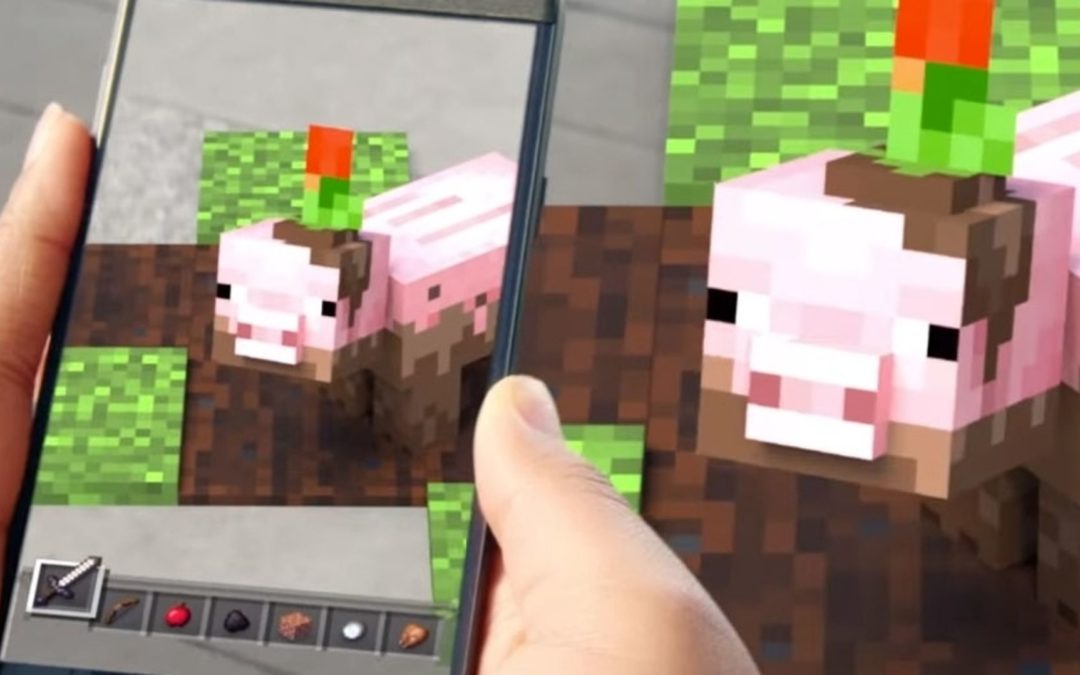
Well, that’s the excitement Microsoft wants to conjur up in this new Minecraft teaser for what looks like a new Pokémon Go-style game.
Microsoft has dabbled in bringing Minecraft to other platforms before (remember that snazzy looking HoloLens tech demo?) but this one looks a little more familiar – it’s a mobile AR game you play on your phone while out on the street.
The video below shows a preened Microsoft employee leaving their mobile on a public bench. A woman picks it up and sees the new Minecraft AR game running, and is promptly excited by the pixelised pigs and Villagers around her.
More, we’re promised, will be unveiled at Minecraft’s big 10th anniversary event on 17th May.
Microsoft has announced that its annual MineCon livestream event, which offers a look at Minecraft’s future plans, will return (in this tenth anniversary year) on 28th September. Oh, and it’s got a new name.
Back in 2017, Microsoft decided to turn Minecraft’s massive real-life MineCon event, which had been held on a somewhat annual basis around the world since 2010, into a smaller-scale digital-only affair. The change in format heralded a new name – MineCon Earth – but that’s now been swept up by the newly announced Pokemon-Go-like Minecraft mobile game. As such, this year’s MineCon livestream will be known by the highly imaginative name of MineCon Live.
The show kicks off at 5pm on 28th September in the UK (that’s 12pm EST), and will last for around 90 minutes. It will feature, says Microsoft, “juicy Minecraft news, content creators… pre and post show bits, as well as on-demand community panels.”
Microsoft also promises new information on Minecraft’s next major game update, and the opportunity for fans to vote and decide on a new biome to be added to the game – similar to a competition held during MineCon Earth 2017, in which the community was able to vote on a new mob. That later gave the world the flying Phantom (the tongue-squid was robbed).
MineCon Live can be viewed on the official website come 28th September, and it’s also scheduled to appear on “a bunch of streaming sites”, says Microsoft somewhat unhelpfully. Presumably Mixer, Twitch, and YouTube then, but don’t quote me on that.
NetEase has tripled its net income year-over-year and has sights on international expansion. Niko Partners’ Daniel Ahmad says Minecraft’s achievement in China is ‘extremely impressive.’
China, even with its restrictive licensing policies, continues to be a huge market for the global games business, worth almost $31 billion in 2018 according to Niko Partners. Online game company NetEase is certainly one of the major contributors to the region’s growth, and the firm has just reported another very solid quarter with big gains in both revenues and net income to kick off its 2019 fiscal year.
“We are pleased to begin the year with a strong quarter. Our total net revenues grew robustly by 30% and our net income more than tripled year-over-year,” said Mr. William Ding, Chief Executive Officer and Director of NetEase. “Online game services revenues continued to grow steadily with the support of a diversified portfolio and impressive performances from all of our leading titles.”
Net revenues for the first quarter came to RMB (Chinese Yuan) 18,356.2 million ($2.7 billion) while NetEase saw its net income jump to RMB 2,382.1 million ($354.9 million). The publisher cited strong performances from titles like Night Falls: Survival, Onmyoji, and Invincible, along with steady performances from its Fantasy Westward Journey and New Westward Journey Onlineseries, which also saw new expansion packs released.
One particularly impressive achievement during the quarter came from Minecraft, which NetEase began publishing in China in August 2017. In less than a year, the game racked up 100 million registered users in China, and as NetEase reported, that number now stands at 200 million users, not even two years since it launched. For a game that’s well over a decade old, that’s quite a feat, and it shows just how globally appealing Minecraft truly is.
“Minecraft’s 200 million registered user number is extremely impressive given the game has been on the market for less than two years. Only a handful of games have been able to reach 200 million users in such a time frame. [Tencent’s] Honor of Kings reached this milestone shortly after one year on the market. We note that the game was popular in China prior to official entry, which helped pave the way for demand that has contributed to the success of the licensed Chinese version,” Niko Partners’ Senior Analyst, Daniel Ahmad, commented to GameDaily.
Minecraft was launched in China before the country’s restrictive game policies were put in place. That doesn’t mean that the popular block-based title is immune to the nation’s censorship, however.
“The Chinese version of Minecraft is quite similar to the Western version, as the game content was benign anyway, in that it is aimed at younger players. The main changes generally involve the interface and localization for Chinese players. However, NetEase was recently fined RMB 50,000 by China’s National Office Against Pornographic and Illegal Publications after it was discovered that users were able to spread adult content in game through the rooms feature. The result was that NetEase deactivated the ability to rename rooms and implemented a stronger reporting policy to curb immoral content in the game,” Ahmad explained.
The fact that NetEase has been able to perform this well as the market continues to work through licensing pains actually makes the company’s first quarter even more impressive. Ahmad added that a number of other publishers “are still feeling the impact of the temporary game license approval freeze which ended in December 2018 [but NetEase] is diversifying its game development pipeline to create games in multiple genres and is working on global expansion through self developed titles and partnerships.”
NetEase CEO William Ding stressed that his company is making a concerted effort to expand beyond the MMORPG space and also into international markets. He specifically cited the “strong debuts’ of Night Falls: Survival and Cyber Hunter in Japan. Knives Out also has been popular in Japan, topping the iOS grossing chart in March and May, while Identity V reached Japan’s top 5 iOS grossing chart for the first time in April. Beyond that, NetEase is looking to launch Ancient Nocturne in Japan and Korea this year.
But will the Chinese giant’s ambitions lead it to take new steps in the West? The company opened a Western HQ back in 2015, but its business has been more about taking Western titles (such as those from Blizzard) and bringing them to China. That said, there’s more and more global thinking going into its product launches moving forward.
“NetEase has evolved significantly over the past couple of years and has shifted to a global game development approach for its new titles,” stressed Ahmad. “While previously focusing on developing games for China first, the company is now creating games with a global audience in mind with recent releases such as Cyber Hunter, a sci-fi Battle Royale game, showing that NetEase is able to develop and release games overseas prior to the China launch.
“We expect the company to grow its overseas revenue significantly over the next few years. In addition, as people look at Tencent and NetEase as the two gaming giants in China, NetEase has been able to stand out through its focus on high quality self-developed titles.”
Blockchain gaming giant Enjin is set to bring blockchain technology to the hugely popular sandbox video game Minecraft following the launch of its new Minecraft plugin.
Coin Rivet recently interviewed co-founder and CTO of Enjin Witek Radomski. During the interview, Witek revealed the exciting news for Enjin and Minecraft enthusiasts alike.
He noted: “One thing we’re working on now is actually the Minecraft launch. The Minecraft anniversary is coming up here in just a few days, and we are going to be launching a public server that uses our Enjin Coin platform.”
Anybody who owns a copy of Minecraft will be able to join the public server. Players will be able to roam around the world and complete quests – some of which will reward the player with tokenised items.
“There’s going to be some Multiverse items hidden in the world as well, so players can discover some chests and figure out how to unlock them.”
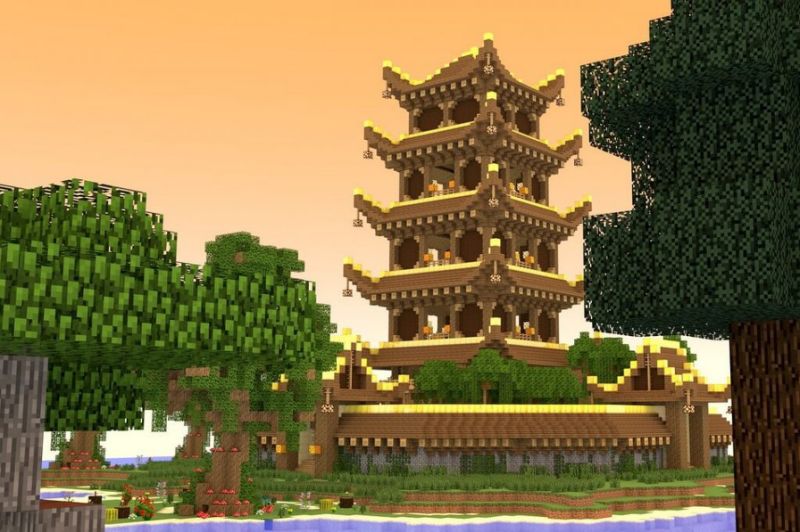
Witek went on to reveal: “We’re building out this Minecraft server with a cool little medieval world. It’s really exciting, and it’s going to be the first example of Minecraft that we’re going to put out there.”
Enjin’s Minecraft public server launch will coincide with the launch of Enjin’s Java software development kit (SDK), with the “whole thing” having been developed in Java.
The Java SDK will be released as open source soon, with the release of the Minecraft plugin set to take place a few weeks later.
“We’re going to release our Minecraft plugin to the public, and that means any Minecraft server can now integrate blockchain,” added Witek.
Interested in reading more Enjin-related stories? Discover more about the collaborative blockchain gaming Multiverse which is spearheaded by the Enjin team.
Ten years ago today, Minecraft made its debut into the world, marking a significant milestone in the history of video games. Just as we can’t imagine the gaming industry without this universally-loved title, which has now sold 176 million copies worldwide, we also can’t imagine what the video industry would look like without all those MinecraftYouTube videos.
Minecraft-related content has been a cornerstone to the game’s success, driving around 436B views to date on YouTube alone! In celebration of the game’s tenth anniversary, we looked at some of these videos to discover which creators, publishers, and brands are driving the conversation around Minecraft.
The Top Minecraft YouTube Videos of All Time
(Top 10 most-watched Minecraft YouTube videos of all time. Data via Tubular.)
Minecraft and YouTube Are the Perfect Pair for Success
While the popularity of Fortnite videos seems to have given Minecraft a run for its money, the sandbox-style building and adventure game is still the #1 game on YouTube. In 2018 alone, around 311K user-generated Minecraft YouTube videos pulled in a total of 45.1B views.
Here are some other stats we discovered about the deep connection between YouTube and Minecraft:
5M Minecraft-related videos have been uploaded to YouTube to date.
On average, these videos pulled in a 58.2K 30-day view count (V30) and a 30-day engagement rate (ER30) of 7.1x, which is seven times the normal engagement rate across YouTube!
Longer Minecraft videos attract more views: clips of 10-15 minutes pulled in the most views (123B to date), with content that’s 20 minutes or longer pacing not far behind (114B views to date).
The top five countries by views include the United States, Brazil,the United Kingdom, Russia, and Spain.
Influencers have uploaded the most Minecraft-related YouTube videos at 4.2M. Brands claim 7532K videos, while media and entertainment companies have uploaded 9806K.
YouTube + Minecraft = one of the best matches in the entire online video world. Anyone can film their gameplay of the title and upload to the platform, while YouTube benefits from all the traffic and advertising on the clips. And of course, this symbiotic relationship gives Minecraft owner Microsoft plenty of free attention on its beloved game.
The Award for the Most Minecraft Videos Goes to Influencers
When a power trend occurs in online video, influencers are some of the first to pick up on it. And Minecraft was certainly one of the first power trends in all of digital media.
As noted above, creators and influencers have uploaded the most Minecraft-related videos to date on YouTube. Among these, four out of the top ten most-watched clips were animated song parodies by popular gaming YouTuber CaptainSparklez.
The video with the most views of all time across influencers is Sparklez’s parody of Usher’s “DJ Got Us Fallin’ in Love,” which pulled in 176M views and 1.8M engagements:
The creator with the most overall views is PopularMMOs with 11.7B total views on content ranging from let’s plays, arena battles, and mod showcases. DanTDM is the second most-watched Minecraft creator to date with 8.5B views, while family-favorite stampylonghead comes in third with 5.9B views.
This data is only the tip of the iceberg. It wouldn’t be an exaggeration to say that without the support of influencers, Minecraft wouldn’t be one of the top-selling games of all time. A note to game developers, brands, and media companies alike: never underestimate the power of a fanbase and what it can do to drive interest (and sales).
Brands and Media Companies Join in on the Minecraft Fun
While influencers are clearly leading the charge in regards to Minecraft YouTube videos, brands and media companies have also contributed their fair share of content. Their 12.3K videos on YouTube have garnered an all-time total of 4.4B views.
Fittingly, the company with the most views on YouTube is the official Minecraft channel itself. At 833M total views, the channel boasts seven of the top ten most-watched videos across brands and media publishers of all time. Minecraft’s most-viewed clip is the game’s official trailer from 2011, which has 139M views (in fact, almost all of the channel’s top videos are trailers or update announcements):
Some of the other brands which showed up in our search included retailer J!NX Clothing(64.9M views), Telltale Games (79.7M views), and LEGO (241M views). All of these companies created Minecraft YouTube videos introducing their own products themed after the popular game title, and in turn, benefited from millions of views and reach.
As for media companies hopping on board the Minecraft train, we’d be remiss by not mentioning two of the top-performing channels of all time: gaming property LetsPlay and its parent company Rooster Teeth.
The former has pulled in the most media company views and engagements to date at 492M views and 7.9M engagements, while the latter claims 369M views and 5M engagements. Rooster Teeth has been making game-related content since before YouTube even existed, so it makes sense that some of the company’s most-watched videos are on its Minecraft content.
Other media companies pulling in millions of views and high engagement rates on Minecraft YouTube videos include animation and cartoon company Mineworks (294M views and 2.2M engagements), gaming media and news company IGN (59.4M views and 632K engagements), and entertainment channel Smosh Games (169M views and 2.9M engagements).
Here’s to More Minecraft in Online Video
Of course, the breadth of Minecraft’s impact in the online video world doesn’t end here. Gamers around the world upload or stream live content related to the title on other platforms like Instagram, Facebook, and Twitch on a daily basis.
But this sampling of Minecraft-themed content on YouTube alone is enough to see exactly why the game is not just so well-recognized and widely-played, but also why it has become eternally ingrained in global pop culture.
Happy tenth anniversary, Minecraft! We can’t wait to see what the next ten years hold.
As the blocky exploration game and creativity tool reaches its first decade, our games writer – and the father of someone on the autism spectrum – reflects on the impact it has had
Hidden away somewhere in my attic is an old Xbox 360 that I’ll never throw away. On its hard drive is a Minecraft save file that contains the first house my oldest son ever built in the game. He was seven and, coming from a boy on the autism spectrum with a limited vocabulary and no patience to draw and paint, his creation was a revelation. Sure, it is a monstrous carbuncle, a mess of wooden planks, cobblestone and dirt. But it is also the greatest building I ever saw.
Now Minecraft is 10. The building-and-exploring game, originally developed by one coder, Markus Persson, in his spare time, has now sold 176m copies across 21 platforms. A free-to-play version launched in China via a partnership with NetEase has been downloaded 200m times alone. Every month, 90 million people around the world play Minecraft. There are Minecraft clothes, Lego sets and spin-off games. In spring 2022, there will be a live-action Minecraft movie.
But this isn’t just a story about sales. “Minecraft is personal,” says Lydia Winters, the brand director at Mojang, the Swedish studio behind the game. “It has become part of players’ identities.” Lydia started out as a Minecraft YouTuber, making videos about the game during a tough time in her life. Her marriage had ended, she’d moved homes, she was a little bit adrift. “There is such a community feel to Minecraft. I would jump into a game with another player that I’d met online and we’d just see where the day took us. We’d hop on a server and we’d run. Every experience was unique and individual, [filled with] the limitless potential of what we could do together. It was huge for me.”
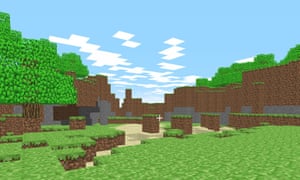
Minecraft Classic, a new version of the game that runs in browsers, based on how it looked back in 2009. Photograph: Microsoft
There are lots of ways in which the game has had a profound influence. Early on, Persson made the decision to release the game in an unfinished “alpha” state, so people could try it and give him feedback. He charged for the download but made it clear that anyone who bought it would get the finished version for free. Very quickly, thousands were playing, and the money allowed him to leave his job, set up Mojang and employ a team, while the feedback let them create a better game.
In this way, Minecraft effectively invented the “early access” model that a huge number of independent game developers have now embraced, to take some of the uncertainty out of development. Rather than working for two years on an offbeat game, then releasing it and crossing their fingers, studios will now get it out there as soon as possible, charging players to become part of a sort of extended developer community. Minecraft changed the whole structure and economic model of the games industry.
It also changed the structure of the gaming experience. You don’t win or lose in Minecraft. It presents you with a blocky world that you are free to explore. You chop down trees and make a house, you mine for materials, you can make a sword and fight zombies, but the fun – the reward structure – is all extrinsic: it’s about exploring your own creativity, making your own rules, hanging out. There were other open-ended simulation games around – The Sims, of course, but also closer influences on Persson, such as Infiniminer. But there was something about Minecraft – perhaps its quaint visuals, its mix of exploration and creativity, its cooperative multiplayer functionality – that made it special. That made it personal.
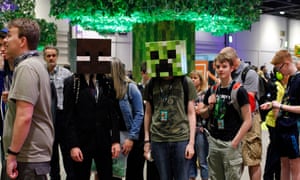
‘The experience is collaborative’ … players get together IRL at the annual Minecon event. Photograph: Katherine Anne Rose/The Observer
Minecraft also became a focus of the emerging YouTuber community. The concept of the Let’s Play video, wherein fans filmed themselves playing a game then shared it online, was in its infancy in the early 2010s, and many latched on to Minecraft as the perfect subject matter, thanks to its inherent humour, its funny, blocky creatures and its open-ended structure. YouTube gamers and presenters had a huge amount of room to express themselves and explore idiosyncratic ideas in the game. Some of the biggest YouTubers in the world, such as StampyCat, Amy Lee and DanTDM, built their millions-strong fanbases by messing about in Minecraft.Advertisement
There are other important contributions the game has made over the last decade. Early on, Persson and Mojang took a relaxed approach to their code, allowing fans to modify the graphics and rulesets and then distribute their versions across the globe. In 2015, Mojang partnered with the Hour of Code campaign designed to get children into programming, and the company created a Minecraft Hour of Code tutorial to teach fans of the game some basic elements of coding. Through Minecraft Education Edition, hundreds of schools around the world now use the game to teach everything from physics to theatre studies, proving that video games have a place in the classroom.
Most crucial for me, personally, is the social aspect. Although you can play little competitive Minecraft minigames, the main experience is collaborative. You can enter a world with a group of friends and build and explore together. For a lot of children – especially non-neurotypical children, or the shy or awkward or lonely – it has been a godsend; a way to make meaningful friendships without having to cope with or understand a lot of the intricacies of physical contact.
How valuable is this? Where do I even begin? Having written a novel in which Minecraft is a major component, I have spent the last two years talking at festivals, conferences, bookshops and libraries about autism and Minecraft and the power of video games. Whenever I speak, I end up chatting to people afterwards and, invariably, somewhere in the little queue, I’ll spot a parent standing beside a slightly shy child, and they will both look kind of worried or hesitant, not knowing quite what to say.
Minecraft Education Edition is used in the classroom to teach physics, coding … even drama. Photograph: Microsoft
But then they’ll tell me their story. Their son or daughter barely spoke, struggled at school, had no friends – and, oh god, I saw the worry of that, the worry and sorrow of it, every time in the way they spoke to me. But then their kid started playing Minecraft. Often that’s a concern at the start, because the parents aren’t always gamers, but the next thing everyone knows is that the kid has friends, they’re building Hogwarts together, they’re chatting, they’re confident. They have ideas and plans. I’ve heard it dozens of times, all over the world, from Brussels to Dubai, and it never gets old: this game changed our lives.
Sitting there nodding and smiling in agreement, I sometimes struggle to hold it together. Because in the back of my mind is that old Xbox 360 in the attic, and what lives on it, and what it means. The house my kid built when we weren’t sure he’d ever draw or paint or make anything, and the goddamn sunlight of that, the beauty of it. The relief.
So forget the sales figures, forget the revolutionary industry practices, forget the “brand extensions”. Ten years of Minecraft has been 10 years of people finding a place to be creative, expressive and social, somewhere they feel safe and welcome, and 10 years of parents like me looking on, holding themselves together, thinking, at last. At last.