Google brought virtual reality to the masses cheaply with Cardboard, a DIY headset announced at last year’s I/O conference. Now, the search giant’s building upon its 1 million VR viewers with an improved Cardboard headset that fits smartphone screens up to 6 inches. It also incorporates a new top-mounted button that replaces the finicky magnetic ring so that Cardboard works with any phone. And, in what’s probably the most consumer-friendly move Google’s made with the new and improved Cardboard, it takes just three steps to assemble. Clay Bavor, VP of Product, told I/O attendees that they’d be receiving these new DIY VR kits immediately after the keynote. And for interested VR developers, it’s important to note the Cardboard SDK now works with iOS in addition to Android.
Google Cardboard / Expeditions / Jump VR
Google also announced Jump, its new VR platform for creating and sharing content due out sometime this summer for “select creators.” It’s the company’s way of giving professional-grade VR content-creation tools to the masses so that anyone can capture and share 3D video. To do this, Google’s partnered with GoPro to build Jump’s first 3D camera rig. As Bavor explained onstage, the software works by seamlessly stitching video frames together for a border-free, depth-corrected immersive VR experience that can be easily uploaded and viewed on YouTube.
Jump also happens to be the perfect software companion for Expeditions, Google’s just-announced initiative to bring these VR experiences to educators so that “teachers [can] take their classes on field trips to anywhere.” Google didn’t reveal much about how Expeditions will work or how it’ll roll out to schools, but it’s clear from today’s announcement that Google’s taking VR very seriously.
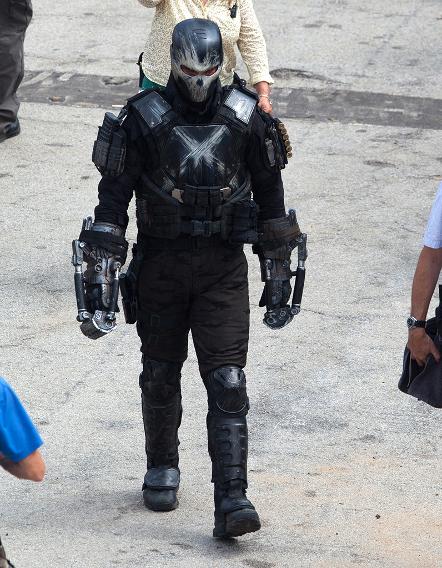
While ‘Avengers: Age of Ultron’ keeps exploding the box office, ‘Captain America: Civil War’ has commenced production. Featuring a huge cast of familiar heroes (Cap, Iron Man, Black Widow, Hawkeye, Falcon, War Machine, Bucky Barnes) and newcomers (Black Panther, Ant-Man, Vision, Scarlet Witch) entwined in a classic comic storyline, ‘Civil War’ promises to be a game-changer for the Marvel Universe. Here’s an inside peek at the making of the film, directed by Joe and Anthony Russo for a May 6, 2016 release.
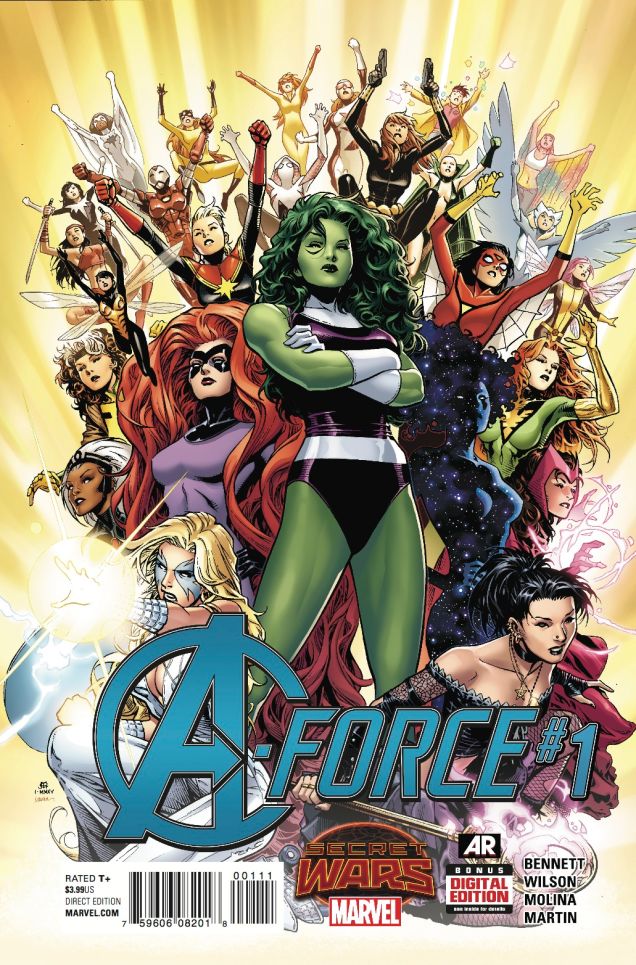
You know the drill: Worlds will live! Worlds will die! Lots of spin-offs! Marvel and DC Comics are pretty much doing the same universe-changing story in almost the same way at almost the same time. One of them is good. One of them isn’t.
Kotaku editor-in-chief Stephen Totilo and I have both been reading chunks of the major publishing crossovers from Marvel and DC. There’s been elements that we’ve liked and some that have left us cold. Overall, we both feel like Marvel’s got the better offering and elaborate as to why that is in the chat below.
(Spoilers follow. Hover over the top left of each image and click on the magnifying glass icon to expand it.)
Evan Narcisse: These days, it seems like the big two superhero publishers are always doing one big crossover after another, designed to shake things up and keep readers engaged. But what’s been different this event season is just how similar DC Comics’ just-ended Convergence and Marvel’s ongoing Secret Wars are to each other. I wondered about just closely they’d line up when they were both being hyped but now that they’re happening the resemblance is kind of uncanny.
Stephen Totilo: I figured out any easy way to spot the difference. The DC one is the one that’s bad.
Evan: Harsh but true. Convergence read like what it is: a stopgap fill-in while DC figures other, more important stuff out. It exists to cover for the company’s move out to California, for those who didn’t know.)
Stephen: One emerges from a company needed to move offices; the other from a writer (Jonathan Hickman) building a years-long story to a crescendo. Both are business moves in that all comics crossovers are designed to rope in new readers and compel existing ones to buy more books. They both trade on nostalgia, since the core concept, as you alluded to, is similar: they involve the creation of patchwork worlds full of districts that contain characters from this or that beloved classic Marvel or DC series. The thing is, I grew up reading DC. I read and loved many of DC’s older crossovers. And yet I’ve avoided much of Convergence and have disliked most of what I tried, because so much of it was drenched in DC’s dreary, uninspired approach to its own history. Whereas, I didn’t grow up reading Marvel, have no clue what Inferno is, have no soft spot for its 2099 timeline, didn’t read Infinity Gauntlet, and yet I’m trying and enjoying nearly all the Marvel Secret Wars stuff. Why? Because Marvel taps more interesting creators these days and seems to let those creators have more fun.
Evan: Yeah, the fact that DC’s higher-ups knew that Convergence was coming and somehow didn’t tease or build to it at all is pretty damning. Either you can’t get your creators to play ball or it’s just not that important as part of what you’re actually building towards.
Evan: I read almost all of the Convergence main series and tie-in books, and they largely seem like try-out or paycheck comics for their creative teams. The ones that had actual charm or worked—like the Atom, Shazam, Question, Nightwing/Oracle or Speed Force books—were anomalies.
The whole event feels even more insulting for leaning on cancelled or disavowed versions of characters that readers loved. “Here, buy comics with the Batgirls we know you liked but did away with anyway.”
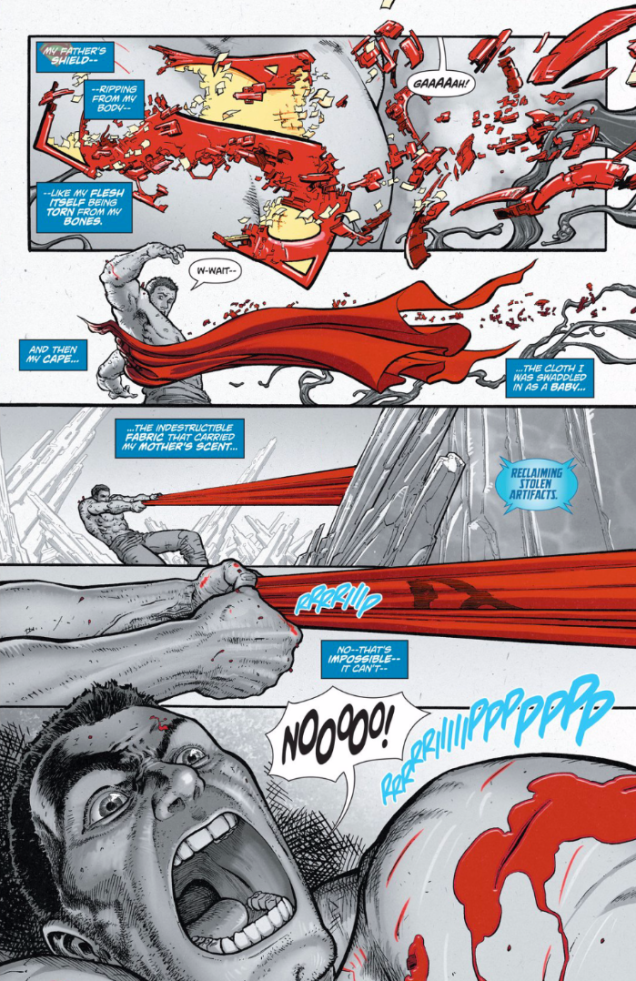
Stephen: Being an editor-in-chief, I have a soft spot for editors. Being a comics reader, though, I mostly have disdain for modern super-hero comics that seem driven by editors. DC just spent two months printing books that used a bad formula that clearly from the top-down. They published 40 or so two-issues series, each of which just HAD to feature a battles between warring factions of different prior DC storylines (post-CrisisJustice League International vs. Wildcats or whatever). Each of these just had to begin with our heroes de-powered. Each just had to include the moment when the villain behind the patchwork world restored everyone’s powers and told them to fight. You should easily be able to sell me on a new, short series about the vintage JLI or Suicide Squad or post-Crisis Superman and yet… I just HAD to not buy the second half of any of those series. DC should treat more of its creators like Grant Morrison and let them be creative. Thank goodness there are signs of that in the preview books they’re putting out in advance of their June refresh. You are more encouraged by the previews, too, right?
Evan: Yes, I am, even though part of me feels like I should know better. I’m excited by what I’ve seen so far from the Batman and Superman books. I’m not so dumb as to think these won’t be the new canonical versions of the Dark Knight or the Man of Steel but I think some interesting tensions and situations could come from the changes.
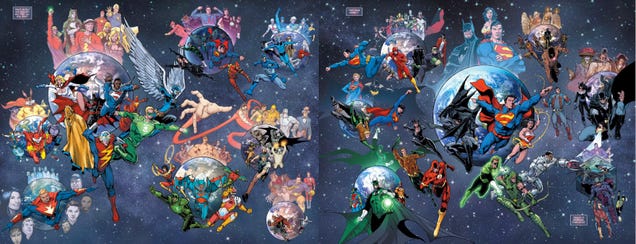
The weirdest thing about the vague way that Convergenceended—with the apparent restoration of the old multiverse, and the existence of a new one—is that it seems to be opening a back door to the kind of thing DC was moving away from. When they did the New 52 reboot four years ago, everything lived on the same block, so to speak. Now they’re letting creators sketch out different neighborhoods, it seems.
Stephen: It’s never too late to admit you did something dumb. The New 52 reboot was dumb. They half-assed it, not making it a clear reboot, rushing it to market without seeming to have a coherent sense of their new universe’s history. Post-Crisis was sloppy, too, but Post-Crisis was better-paced with them not relaunching everything all at once. The Multiverse is a good concept. It’s fun. People like alternate Earths.
As for the preview books, I’m torn on Superman. Grouchy Superman seems like, well, not Superman! But I loved the post-Crisis Superman comics so much that I can’t tell if I have enough perspective to welcome varied interpretations of the character. Robot Batman seems silly, but, sure, why not. Take a chance. I was surprised about how much I cared about the Cyborg preview book and like the idea that he’s got mysterious parts of his cyborg body that he doesn’t know about. I also liked the Justice League United book that you highlighted earlier this week, since it seems to have a crazy, eclectic cast. We Are Robin is cool, too, because, hey, we’ve had boy Robin and girl Robin, but we’ve never had every-teenager-is-Robin before. More of that, DC. Go crazy!
Stephen: On the other hand… you’re pumped for Darkseid War, right? A new potential crossover looms. Oh joy.
Evan: Lord.
Evan: I mean, it’d be naive to think that kind of continuity-riven orthodoxy will ever go away in cape comics. But I’m glad more divergent fare like Black Canary (which itself riffs on ideas seen in stuff like, say, Scott Pilgrim) gets to exist next to Darkseid War. So, while DC is expanding their multiverse, Marvel is contracting theirs. And that might be another reason that Secret Wars feels more interesting. There’s a sense of mystery about what the next version of the Marvel Universe will look like.
Stephen: And yet DC’s was the one called Convergence. So confusing!
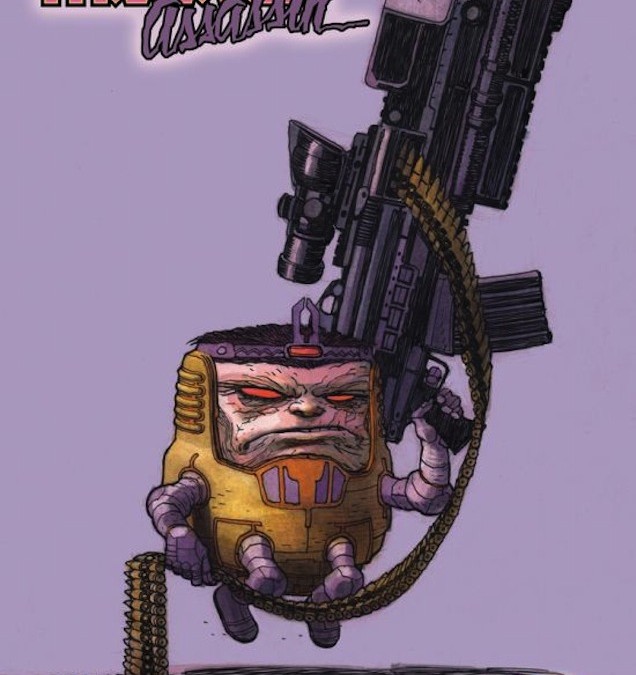
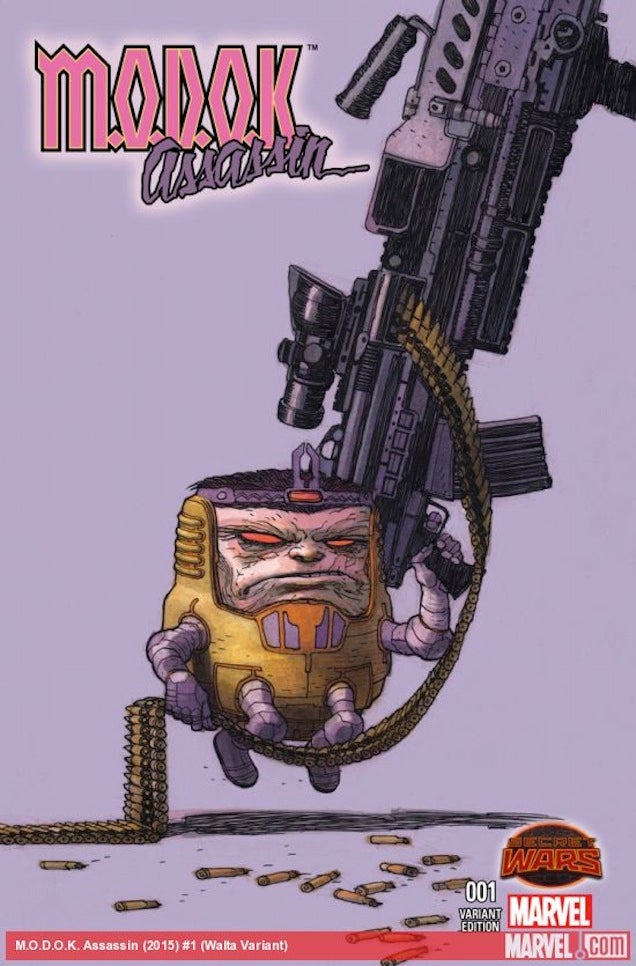
The main Secret Wars book has been good, the crossovers a mixed bag not surprisingly. My favorite of this week is…. M.O.D.O.K. Assassin! It does a good job of literally telling you where things are. He’s in a place called Killville that is between a district run by mutant-killing Sentinels and a district based on the House of M mutant crossover. The two sides cross paths in Killville until M.O.D.O.K. intervenes. M.O.D.O.K., that giant head with spindly arms and legs who is a lunatic killer is the kind of ridiculous character that DC used to embrace more. (Thank goodness they’re beginning to appreciate and reintroduce Captain Carrot again).
Stephen: Maybe it’s helpful that I have next to no history with these characters. Like, I have no idea if the new Inferno is a proper homage to classic Inferno.
Evan: They kind of don’t need to be good homages, though. Because Marvel hasn’t cut off its history in chunks the way DC has, so the collective pangs for this old stuff aren’t quite so acute. That said, I like the Old Man Logan book this week, more than I did the original Mark Millar/Steve McNiven run that it’s named after.
Stephen: Does it even connect to the old one? I’m flying blind here, Evan! Tell me what I need to know.
Evan: It does, barely. Logan is still surrogate dad to the baby Hulk that was orphaned when he killed all the mean ol’ Hulks in that alternate timeline, so it seems to be a real follow-up.
Stephen: Oh, I thought that was all new!
Evan: (My memory is foggy. I’m sure some commenter will correct me!)
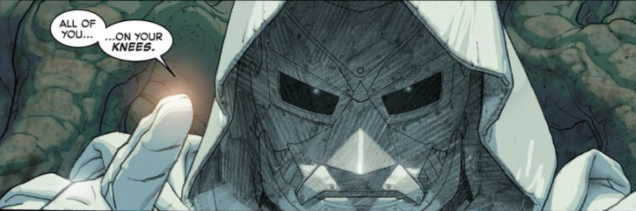
Evan: Part of what makes Secret Wars work is that it’s so different than what came before it. This whole Game-of-Thrones medieval court intrigue set-up is nothing like the Marvel Universe of a month ago. Guess Doom is a GRRM fan?
Stephen: Hey, if they want to homage the GoT show and have a controversial rape scene, too late. DC covered that in Identity Crisis.
Evan: Nova Flame-level burn, boss. Johnny Storm, remember him?
Evan: Anyway, we already know that things will go back to a semblance of the previous iteration of the Marvel Universe, with some big changes. But what we’re getting in the meantime is enthusiastic work by the company’s top talent. Like, Brian Michael Bendis wrote Old Man Logan and it doesn’t feel phoned in a la so many Convergence tie-ins. Even the work from creators who aren’t household names—like on the Planet Hulk book—doesn’t feel throwaway.
Stephen: Yeah, the books do not feel phoned in.
Evan: The same story beats aren’t being recycled, thank God.
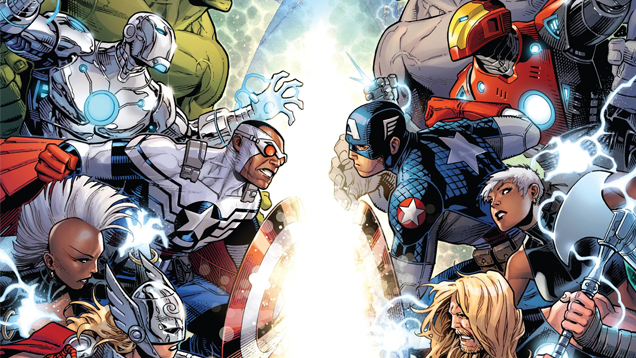
Stephen: Secret Wars 2099 was surprisingly interesting, though I’m not a Peter David guy. They’ve got a lady Captain America who doesn’t seem to know she’s Captain America when she’s not being Captain America. Weird! I’ll keep reading that.
Stephen: I am a bit annoyed, though, that this crossover interrupts a lot of what was being published and/or seemed to rush several good Marvel series to premature conclusions. I was enjoying Charles Soule’s Inhumans run. Waid’s Daredevil may be long in the tooth but now it feels like they are scrambling to wrap up. This crossover seemed to work into Hickman’s timing but not in many others’.
Evan: Agreed. The tie-ins give creators room to experiment wildly, which probably won’t be the case when this is all done. And you make a good point about non-event books. If you’re not into Secret Wars, you’re out of luck.
Stephen: Some of the non-event books seem protected. The surprisingly-good Howard the Duck and Squirrel Girl books (read the second Galactus issue, #4!) seem to have been unaffected. Dan Slott and Mike Allred’s superb run on Silver Surfer probably wasn’t going to last much longer with or without a crossover. Stepping back, though, I just have to say that I trust Marvel so much more than I do DC these days because Marvel now has several years of letting their creators do substantial distinct runs and a lot of great books to show for it. DC, which used to be the company that was more open to letting writers and artists be more expressive has felt straight-jacketed for a half-decade or more, even with the New 52. I hope they’ve finally found their inner Mister Miracle. They need it.
Evan: To me, some of those DC previews show glimmers of hope. Marvel’s teased a few revelations in a Free Comic Book Day Avengers story, but the bulk of their coming status quo changes remain mysteries. They don’t quite need the same level of hype as DC does, though. Hopefully, six months down the line, each publisher’s line-up will be filled with must-read stuff. It’d be a real Crisis if that doesn’t happen.
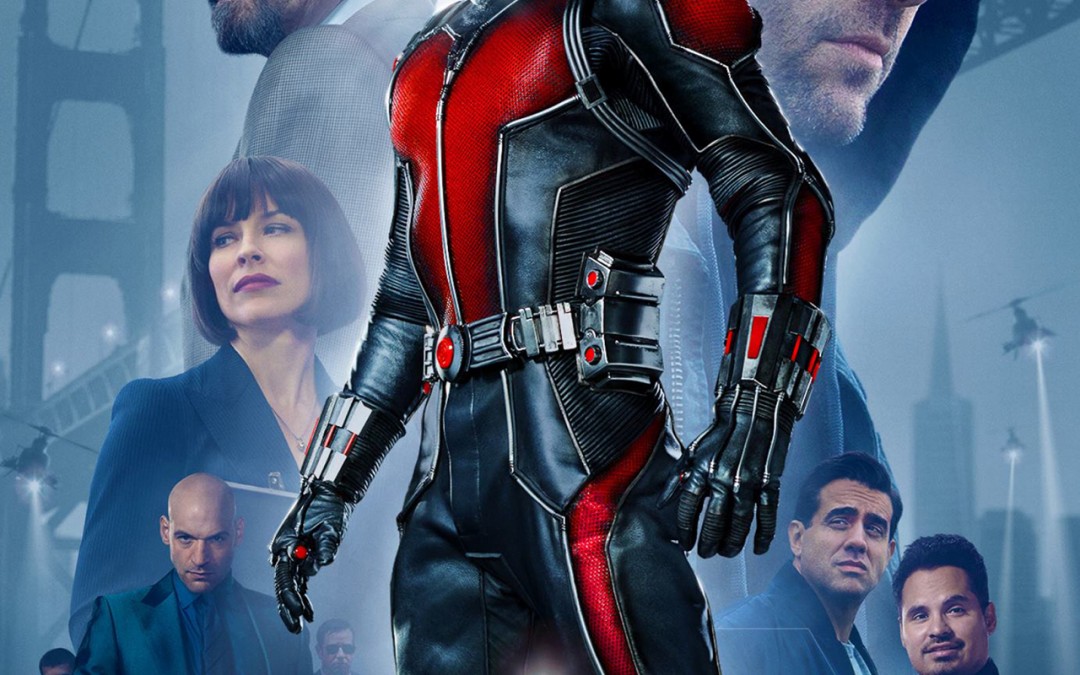
While Ant-Manwill introduce some fantastic technology to the Marvel Cinematic Universe, Marvel Studios is looking at spreading innovation in the real world with the announcement of “Marvel’s Ant-Man Micro-Tech Challenge,” a special contest designed to inspire and encourage scientifically-minded young women nationwide. Marvel has just released a new video featuring star Evangeline Lilly introducing the program. There’s even a few new bits of footage from the “Phase Three” capper itself. Check it out in the player below and find official rules for the contest underneath.
The challenge invites girls nationwide, ages 14 – 18, in grades 9-12, to design and build a DIY project using at least one readily available micro-technology component, which can enable tinkerers, makers, builders and future Imagineers to execute big ideas with a board that fits in their pocket and costs less than a video game. The projects can be utilitarian, artistic or just plain fun.
After completing a project, applicants will be asked to submit a short video demonstrating the project and explaining how it will inspire other girls to pursue interests in science, technology, engineering, or math.
The five winners will each receive: Two round-trip tickets to Southern California, including hotel accommodations, from June 28 through June 30, 2015, to be on the red carpet at the World Premiere of Marvel’s Ant-Man at the Dolby Theatre in Dolby Atmos on June 29, 2015; attend a special “The Evolution of Technology” workshop on June 30 at The Disneyland Resort where they will meet Walt Disney Imagineers who will introduce them to the broader scope of technology and how innovation is inspired during a behind-the-scenes tour of The Disneyland Resort; and receive a tour of the Walt Disney Studios in Burbank, California.
Upon completion of the challenge, a STEM-based girls program in each winner’s hometown will be selected to receive “re-create” instructions for each project. Each winner will have the opportunity to lead a workshop in building her project with the girls in the selected program in her community. By sharing their work, the winners will accomplish big things from small beginnings by inspiring other young girls to follow their interests in computing, technology, and engineering.
Entries will be accepted from May 21, 2015 through June 11, 2015. For application forms, eligibility requirements, official contest rules and more information about Marvel’s Ant-Man Micro-Tech Challenge, visit Ant-ManChallenge.com.
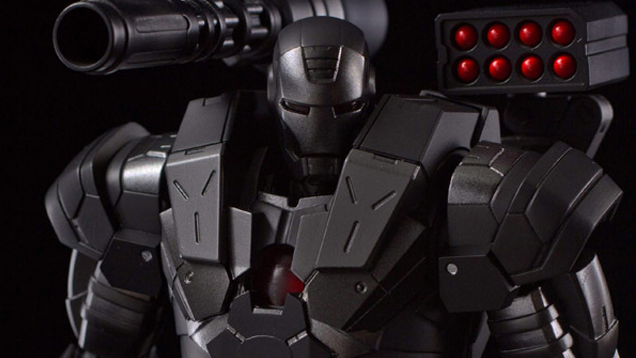
So far Sentinel’s swanky Re:Edit toys have focussed on making someprettyamazing Iron Man variants. But while their latest doesn’t fall far from the Iron Man tree, it’s a bit different: it’s an all new War Machine, one that comes packing heat and some pretty awesome armor.
Scant details have been released for the figure (which presumably comes in at around 18cm or so, like previous Re:Edits) other than a lone image:
It’s cool to see how rounded, slick and sleek Sentinel’s Iron Man figures are, and then good ol’ Rhodey is just a thick, chunky slab of walking tankiness. It’s a pretty snazzy upgrade.
There’s no release date for Re:Edit War Machine just yet, but expect more details soon. The usually hefty, nearly-$200 price tag these figures go for is also to be expected (if not more, given the size of it!).
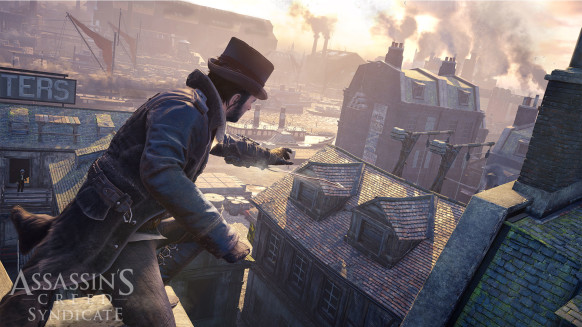
Remember Assassin’s Creed Unity‘s gimmicky tie-in app? The one you had to play to unlock collectible stuff in the main game? The cynical sense that the whole endeavor was an exploitive attempt to foist an Ubisoft-ified Internet of Things on us?
The company finally wised up in February and decoupled the app from the game with a mea culpa patch. And today, it’s gone one step further and promised that Assassin’s Creed Syndicate, the next installment set in Victorian London, will ship app-free this year.
“There will not be a companion app,” a Ubisoft rep told Eurogamer. “For Assassin’s Creed Syndicate, the team wanted to focus all their efforts on the core experience.”
Hum a bar or two of “Born Free” with me.
2014 was, as far as I’m concerned, the first bum year for the whole Assassin’s Creed franchise. Ubisoft clearly overreached, rolling out not one but two full-fledged Assassin’s Creed games, and the strain on quality control was obvious.
Rogue‘s boreal beauty didn’t offset the sense of traipsing through a desolate world with filler storytelling and boring checklists. And Unity…well, pity that busy monster, an ambitious mess of a parkour sandbox punctuated by heartbreakingly beautiful vistas, but whose chief deficiency the media mostly missed in its rush to righteously grouse about glitches: Arno, the pouty lead, was a bore, his characterization flat, his journey at best a story-of-the-week affair.
So given the whole “back to one game a year” and “no gimmicky tie-ins” thing, I’m a trifle more optimistic about Syndicate—though it may also be time to put more than a year between these games. A series that launched less than a decade ago shouldn’t be able to count more mainline releases than years.