by Stone Marshall | Jan 9, 2016 | Awesome Book News |
I’m going to be straight with you guys: I freakin’ adored Batman: Arkham Knight. Yes, the game was a massive mess on PC but for everyone else who played it on a PlayStation 4 or Xbox One, it was sublime. There’s so many moments in that game, that make it simply the best of the Arkham bunch. Sure, certain Batmobile sections may feel tacked on, but when you step back and see how much Rocksteady’s final caped crusader game got right when compared to a few missteps here and there, the good easily outshines the bad.
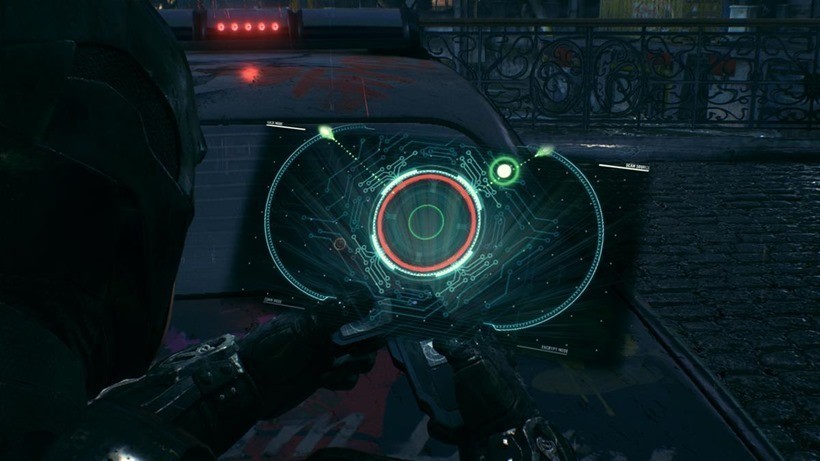
And that’s because the core game, is just so damn good. As a Dark Knight simulator, Batman: Arkham Knight was immensely satisfying. All the gadgets, moves and a Batmobile combined into one billionaire who fights the root cause of crime and poverty by shattering the teeth inside the face of anyone who dares to even illegally cross a street in his city. Perfection.
And then there’s the DLC. The season pass content of Arkham Knight is more divided than Harvey Dent’s face and personality, a mix of fan service and the lacklustre. On the more pristine side of the former district attorney, you’ve got a mix of fantastic AR challenges, races, costumes and modifiers. Good stuff then, and the kind of content I’d like to see more of.
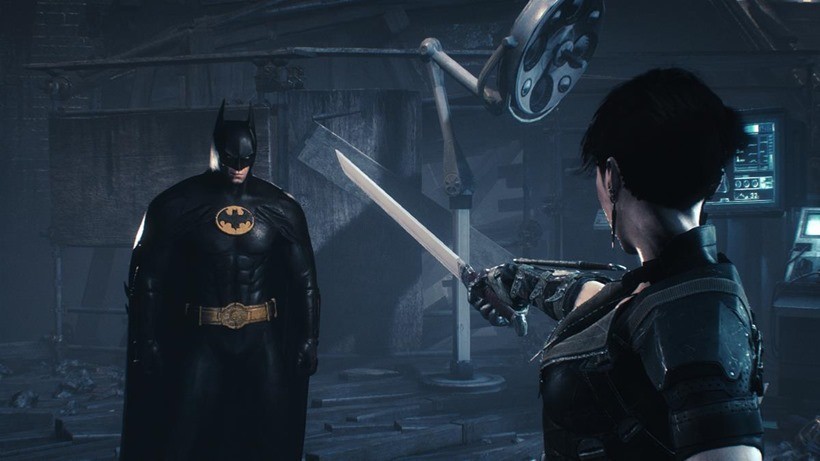
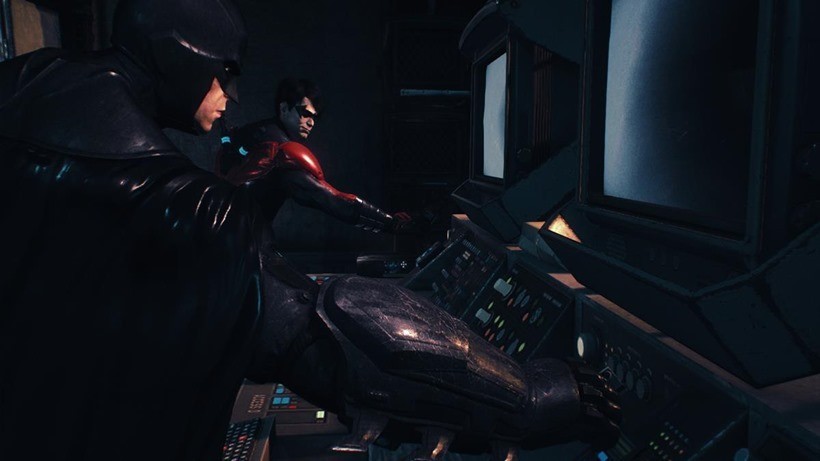
And then on the horribly burnt side of the former Batman buddy for life, you’ve got the story content. Content which is the Batman & Robin to the superb The Dark Knight of the core game. Twenty-minute episodes of middling action and returns that puts players in the boots of the rest of the Gotham City vigilantes, with only Batgirl’s single outing being worthwhile due to it having the distinct saving grace of being “not that crap”.
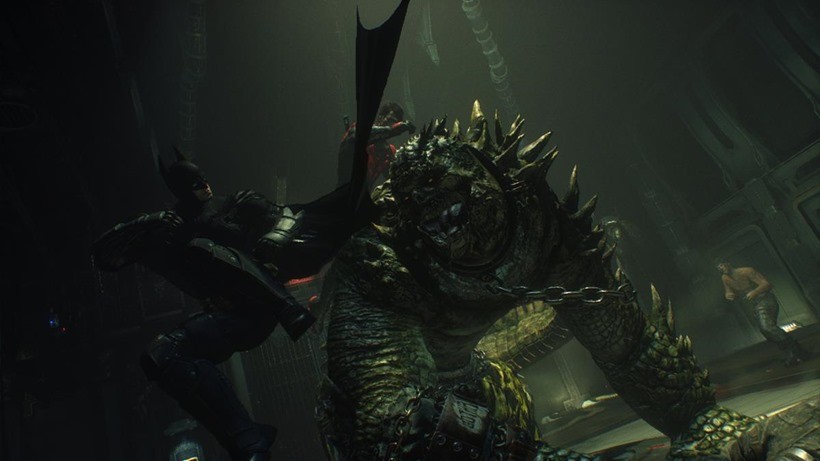
And that’s the problem with this kind of DLC. After spending several hours as the ultimate combination of man, money and machine, who the hell wants to play as Robin or the Red Hood and face bad guys with a slimmed-down arsenal of wonderful toys? That’s like EA announcing Jedi Knight 3: Jedi Hard With A Vengeance and then forcing you to play as Jar Jar Binks in the season pass DLC.
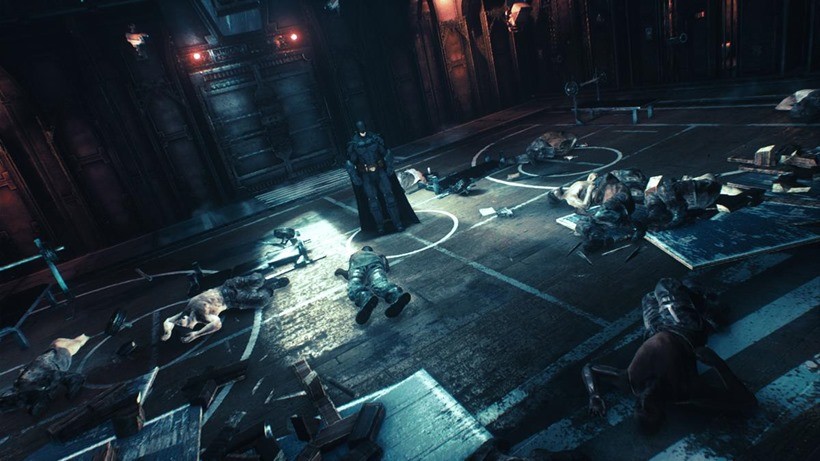
Season of infamy makes up for that however as it sends Rocksteady’s (perhaps last) Batman off with the kind of DLC content that puts the others to shame. This time you’re tackling cases as the Dark Knight once again as you uncover more of Gotham’s most wanted during the Arkham Knight and Scarecrow siege. Easy and simple.
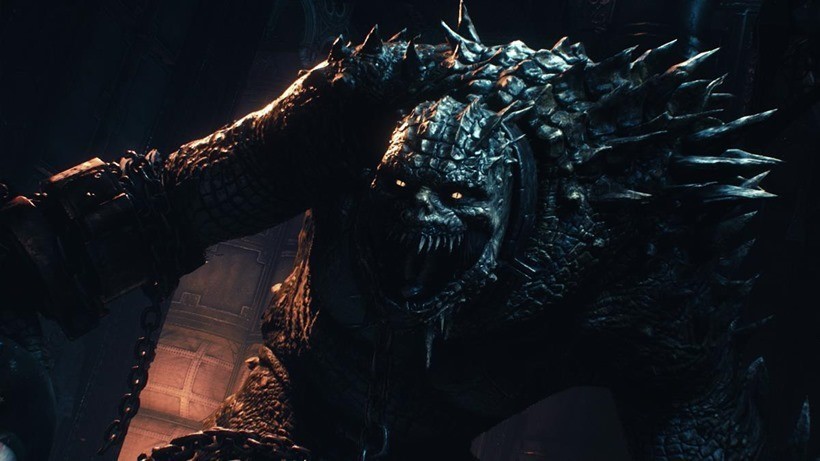
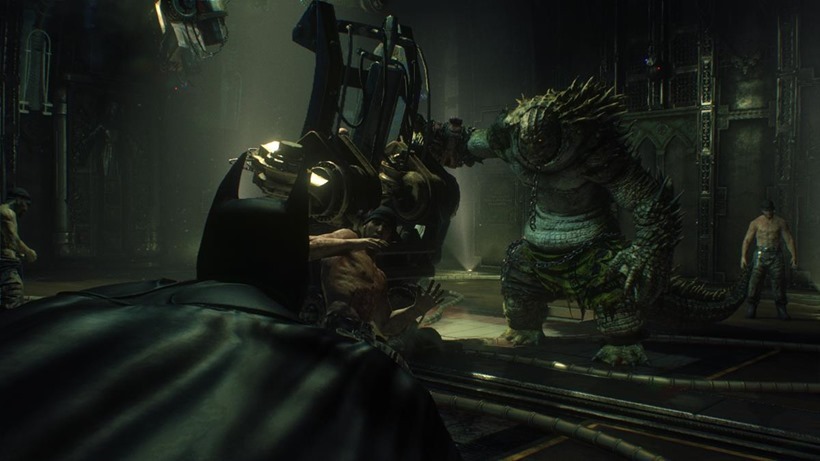
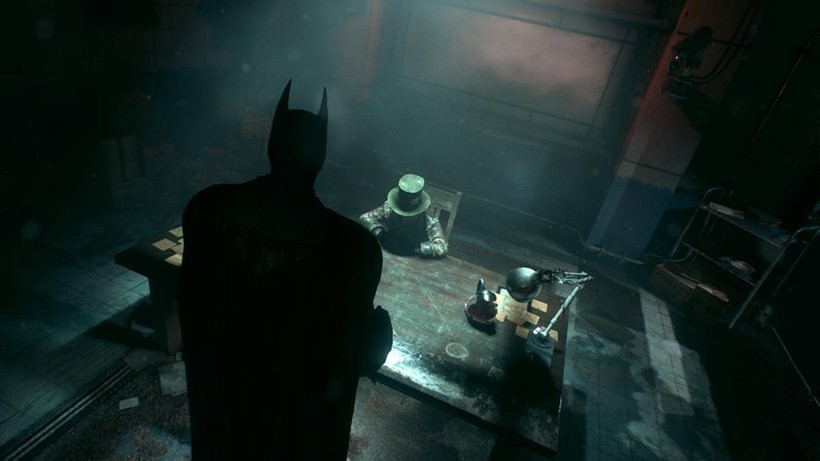
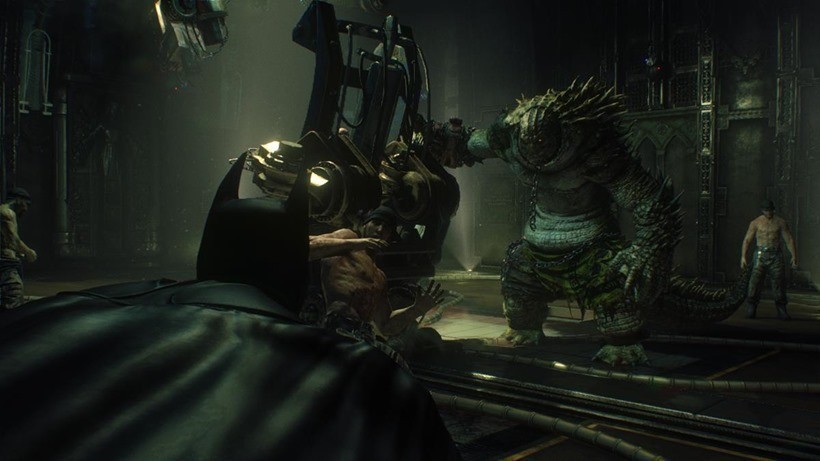
And for once, it’s not just a quick bit of fan service focused on one villain. Instead, you’ve got four Arkham regulars to deal with: Killer Croc, the Mad Hatter, Mr Freeze and Ra’s Al Ghul. It’s the combination of this quartet that plays out like a highlight reel of the best moments of the Arkham series. With the Mad hatter, you’ve got a few quick puzzles and some mind-bending combat to deal with as players find themselves battling across a gigantic storybook of Lewis Carroll inspirations.
With Killer Croc, excpect tighter exploration and more visceral combat as you make your way through the grounded Iron Heights prison airship. Ra’s Al Ghul has survived the events of Arkham City and now looks like a walking advert for the after-effects of Redbull energy drink abuse as you contend with a rebel faction of the League of Assassins.
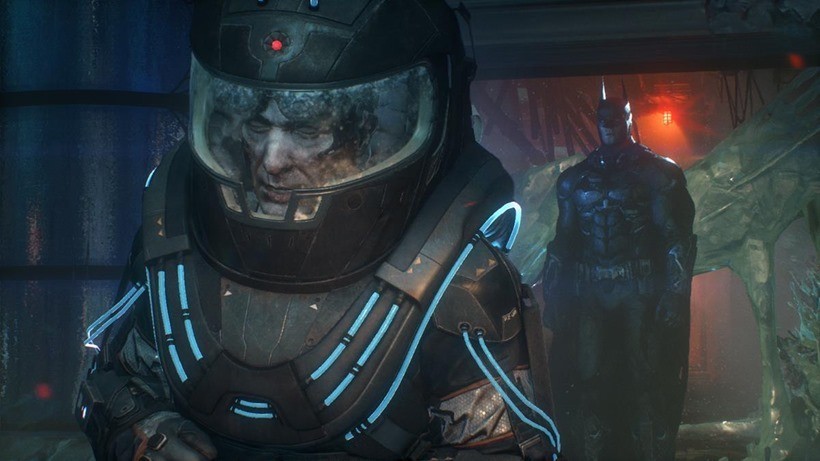
And then there’s Mr Freeze. The most tragic member of the Batman rogues gallery, Mr Freeze has always been a victim of circumstance. A frozen felon driven by the desire to cure his wife Nora Fries of some rare medical malignancy, Mr Freeze has always felt like a sad extreme of love gone wrong. And while Mr Freeze is present in his Most Wanted mission, he’s not the bad guy here. He doesn’t want to fight you for something as trivial as the soul of Gotham or petty cash. He just wants to save his wife.
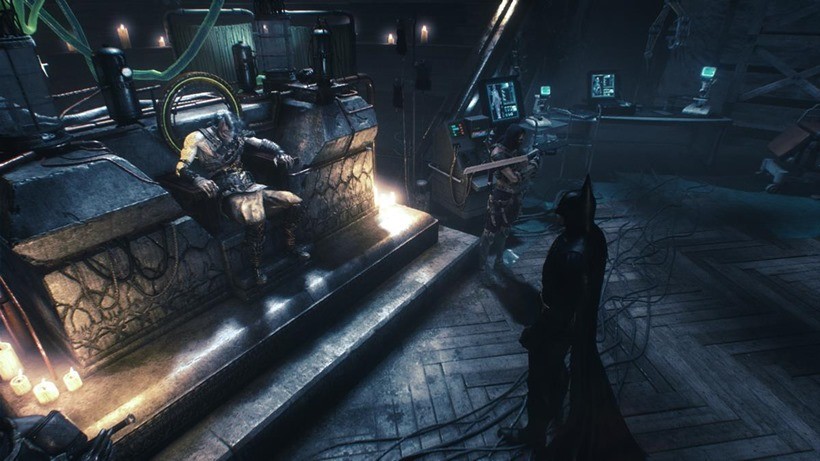
On its own, the Freeze episode isn’t much longer than any of the preceding Arkham Knight episodes that built up the DLC content for most of Arkham Knight, but it’s massively satisfying to see Batman’s cold-hearted cryogenics expert get some much-needed closure – as well as see Batman: Arkham Knight wrap up on at least one post-launch high note.
Season of Infamy is the DLC that Batman: Arkham Knight deserves.
by Stone Marshall | Jan 6, 2016 | Awesome Book News, parent-news |
A group of students were asked what they expect life to look like in ten years, and their predictions ranged from superhuman abilities to world peace.
CTV Toronto asked six Grade 4 and 5 students at Brampton’s Thorndale Public School to write a letter to their future selves, describing what they expected in 2026.
“In 2026, I will look forward to take care of my parents. I will take care of my parents because they took good care of me,” 9-year-old Dishanthan Sutharsan read from his letter.
“In 2026, I look forward to being a good student in university.”
Like Dishanthan, many of the students wrote about going off to university and finding a job.
“I would like to graduate with Masters of Management because I want to be a human resources manager,” Pari Sandhu wrote.
“In 10 years, I want to see myself in Harvard University,” Niket Bajwa read.
Though most wrote about school, the children’s letters also touched on what they hope for the world.
“I am hoping in 10 years scientists find a cure for all cancers and diseases. I also home the world is at peace and the world is a better place,” Bajwa wrote.
“When I will have lots of money I will make clothing for the poor people who don’t have clothing,” Simran Bhinder pledged.
Ganeev Singh filled his letter with questions: “Are we safe from guns? Are buildings taller? Can we fly? Is global warming still affecting the world?”
The students also wrote about current issues, like the conflict in Syria, and all wrote about the importance of peace.
Bajwa wrote, “I desire that the war will end and ISIS will be defeated.”
Atheka Jeyatharan said she hopes that “no such thing as war still exists.”
The letters were filled with hope for positive changes in their lives and the world around them.
“I can’t wait to read this letter in 10 years. I will keep my fingers crossed my wishes and goals come true. Sincerely, Atheka.”
From a cure for cancer to the ability to fly, kids make predictions for 2026
by Stone Marshall | Jan 5, 2016 | Awesome Book News, parent-news |
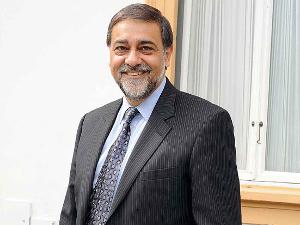
Vivek Wadhwa, an Indian American entrepreneur turned academic, has been called one of the world’s top thinkers on tech policy. Neelam Raaj spoke to the Stanford University fellow on the ongoing controversy over Facebook’s Free Basics plan
What did you think of Mark Zuckerberg’s defence of Free Basics in TOI? Were you convinced by his case for digital equality which cited the example of a farmer named Ganesh, who would be able to access weather information, commodity prices, etc?
Zuckerberg doesn’t realize that Ganesh cherishes the freedom that India gained from its British colonizers in 1947 and doesn’t want a handout from a western company. Ganesh may be poor, but he doesn’t want anyone to dictate what sites he can visit, what movies he may watch, or what applications he can download.
Zuckerberg is right about the benefits of internet access: it will enable village artisans to access global markets; farmers to learn about weather and commodity prices; and labourers and domestic help to find work through sharing-economy applications.
But here is the problem with Free Basics: the internet access on offer is not unrestricted. Facebook and the mobile carriers get to decide what websites people can visit, and Facebook becomes the centre of the internet universe. Zuckerberg compares this limited service to libraries and hospitals. But imagine a private corporation being allowed to decide which books your children could read and which videos they could watch — and to monitor everything that they did. Would you accept that?
The aggressive nature of FB’s campaign in India has surprised many. Will the fate of net neutrality here have a global impact?
This is not an Indian issue; we are fighting these battles in the US. The Federal Communications Commission enacted rules in March 2015 to require broadband providers to treat all data equally rather than provide preference to some sites. A federal appeals court is challenging these rules at the behest of the telecommunications industry.
Google has the same motivations as Facebook — to bring billions more people online. But it is pursuing a more sensible strategy: it is setting up fast and free Wi-Fi internet access points at 400 railroad stations all over India. Facebook could one-up Google by setting up access points at thousands of schools, libraries, and villages. This “no strings attached” approach would earn it gratitude — and signups — rather than resentment.
If the solution to making internet connectivity accessible to everyone isn’t Free Basics, then what is it?
The ultimate solution, unrestricted internet for everyone, is something that Facebook, Google, and others are already working on providing, via drones, balloons, and micro satellites.
With its Aquila Unmanned Aircraft and laser technologies, Facebook has demonstrated the ability to deliver data at a rate of tens of gigabytes per second to a target the size of a coin — from 10 miles away. This is ten times faster than existing land-based technologies. With interconnected drones, it will, within two or three years, most likely be able to provide internet access to the remotest regions of the world.
Google is further ahead in its efforts. Its balloons, called Loons, are essentially floating cell towers that can relay a signal to a mobile device on the ground.
And then there are low-orbit micro satellites, which Oneweb, SpaceX, and now Samsung are building. These beam internet signals by laser to ground stations.
Google is launching Loons in Indonesia and Sri Lanka. It was also supposed to launch them in India, but India’s defence, aviation, and telecom ministries raised technical and security concerns and stopped the project. When the telecom providers figure out that with unlimited, inexpensive internet access, their cell and data businesses will be decimated, they too will place obstacles in the way of these technologies.
This, therefore, is the real battle that Facebook should be fighting. If the goal is to provide everyone with internet access, Facebook and the internet-freedom groups that it is fighting should be working together to lobby for a change in government policies — for when the new space-based technologies are ready.
Which tech advance are you most excited about in 2016?
To start with, let’s look at what happened in 2015. Knowledge became globalized, with one quarter of India’s population gaining access to the internet (this is without Free Basics). And then, the medical revolution got in high gear with inexpensive medical devices that connect to smartphones and incredible breakthroughs in genomics. Just watch over the next few years as our smartphones become doctors.
Most important of all, in 2015, we reached a tipping point in clean energy, with solar and battery storage becoming affordable and practical.
By 2030, all of India will have off-the-grid clean energy and this will be cheaper than cellphone calls. India won’t need the nuclear plants that it is purchasing.
Next up, starting in 2016, we will see amazing advances in robotics, self-driving cars, artificial intelligence, internet of things, and the space race.
‘Imagine a private company deciding what your kids can read or watch’
by Stone Marshall | Jan 5, 2016 | Awesome Book News, parent-news |
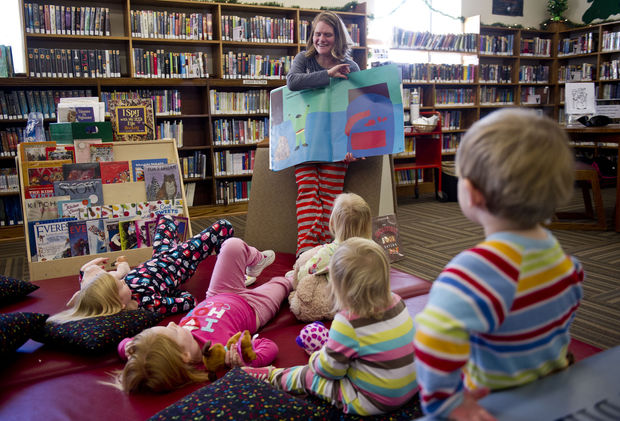
“Now it’s time for story time, story time. Now it’s time for story time, on the red mat!” Library aide and children’s programming organizer Daryl Anne Stangle sang to six kids at the Winona Public library Saturday morning, signaling the start of the story time pajama party.
The six children in attendance, all in comfy pajamas, cheered and rushed to the red mat in the youth fiction room.
On the menu today: “The Incredible Book Eating Boy,” “Snow on Snow on Snow” and “Rabbit’s Pajama Party.”
“Hey, I got that book from the library. It’s pretty silly!” said five-year-old Vera O’Shea of “The Incredible Book Eating Boy.”
Vera and her three sisters, Evie, Mimi and Nora, attend library story times often. “He eats books and that’s crazy, and I like being crazy,” Vera added.
Kids quieted down as Stangle began reading, drawn into a book whose main character literally devours books to become smarter.
“So everything he ate, he learned,” said Stangle to her attentive audience.
Stangle said she organizes Saturday programs for kids not only because she enjoys working with them, but also because she believes public libraries are a vital part of a childhood and the community.
“For me [the library]…was a place I could find answers,” Stangle said. “Kids learn that books do hold answers and worlds they can travel to in their mind. I think that’s really important.”
Vera’s seven-year-old sister Evie, who Vera describes as a “bookworm,” said her favorite part of library story time is being read to.
“I like that we got to pretend to sleep and that I got to snuggle with Piggy,” she said, clutching her stuffed toy pig to her chest. During “Rabbit’s Pajama Party” — an appropriate book for the pajama party occasion — Stangle asked her audience to act out what the characters in the book did. Rabbit gobbled a snack and so did her audience. Rabbit made an ice cream sundae and the kids pretended to put whip cream and a cherry on top.
Although Saturday programs for kids are irregular now, Stangle said she tries to do them every other month. Tuesday and Friday story times for kids occur weekly.
Saturday programs draw anywhere from five to 50 children, Stangle said, while story times during the week draw 20-30 children.
Each Saturday story time is followed by crafts or games. These activities showcase opportunities for children and parents to learn skills beyond reading at their public library, Stangle said.
“Kids learn that books do hold answers and worlds they can travel to in their mind. I think that’s really important.” Daryl Anne Stangle, library aide and children’s programming organizer
Library pajama party: story time holds “answers and worlds” for kids to explore

by Stone Marshall | Jan 4, 2016 | Awesome Book News |
Hoverboards have been getting a lot of bad press since reports started surfacing that theycatch fire without warning.
If hoverboard companies can make one that definitely doesn’t explode (though that seems like something that should be on all product manufacturers’ to-do list long before they start printing the shipping labels), they’re going to need a serious PR adjustment. Perhaps a celebrity endorsement deal could turn things around and give them a more positive image.
Should they ever decide to take that route, however, you can bet former professional boxer Mike Tyson won’t be returning their calls.
Tyson took a nasty spill on his daughter Milan’s hoverboard at his home and posted a video of the accident to his Twitter account on Tuesday. The video features Tyson taking a little spin on the self-balancing scooter in what appears to be his living room. He takes a couple of 360-degree turns and then attempts to move forward but he loses his footing and falls flat on his back with a loud thud.
Check out Tyson’s loss with gravity below in the embedded tweet.
Naturally, Tyson’s funniest home video went viral on social media and picked up over 45,000 retweets. So it was only a matter of time before some of the Internet’s more clever users came up with ways to make an already hilarious fall even more hilarious.
The most popular remake of Tyson’s great fall comes from a Vine user named Ry Ry. His video features Little Mac, the playable hero from the classic NES boxing game Mike Tyson’s Punch Out, scoring one last knockout against the champ.
The pixelated version of Tyson seems to be just as clumsy on a clumsy piece of transportation as his real-world counterpart, according to this Vine from an account for a meme-making app called Spun.
You might not know this, but Tyson is also an avid pigeon racer and lover of the urban world’s most populous avian. He has his own reality show on Animal Planet dedicated to his favorite hobby and also wrote a column in 2011 for The New York Times that explains his love for this scorned urban creature. So keep that nugget of wisdom in mind as you watch the Vine below created by Evan Zugin.
No celebrity is officially a celebrity meme until one of their videos or sound bites has been turned into some form of repetitive house music or an auto-tuned remix. This Vine by Antiski helps Tyson’s video fulfill that requirement with his blending of Tyson’s fall with the booming bass line from a song by The Black Eyed Peas.
Finally, the folks behind the YouTube channel Game Worm found a way to mix Tyson’s latest meme with one of the boxer’s other memes by mashing up the hoverboard video with footage from one of his most infamous post-bout interviews.
Tyson isn’t the only parent to take a spill on their kids’ hoverboard this holiday season. A report that aired on CNET sister site CBS This Morning Tuesday showed that hoverboard fails are trending on YouTube and Twitter, as well as throughout hospital emergency rooms. The US Product Safety Commission announced just before Christmas that it noticed a 35 percent increase in injuries caused by hoverboards.
The Sun-Sentinel newspaper, headquartered in Ft. Lauderdale, Florida, reported Wednesday that it alone found “at least 40 [hospital] visits due to hoverboards” to hospitals located in Broward, Miami-Dade and Palm Beach counties in South Florida. US Rep. Carlos Curbelo of Florida was one of those 40 names that showed up on hospital records. He posted a picture of himself with his injured arm on his Twitter account with a Tweet that read, “Confirmed – #hoverboard is for kids. My daughter got it. I ended up in #BaptistHealthSF #ER.”
I never thought I’d say this, but after seeing Tyson’s nasty fall and reading about all these accidents, I’m actually very happy jetpacks aren’t commercially available to the public yet.
Mike Tyson gets knocked out by a hoverboard, Internet counterpunches

by Stone Marshall | Jan 3, 2016 | Awesome Book News |
Destructoid’s award for Best Xbox Game of 2015 goes to…
Rise of the Tomb Raider
Before Nathan Drake, there was Lara Croft. This is important to note because recently, for a good number of years, Nathan Drake was Lara Croft. Shrewdly, developer Naughty Dog took the cinematic action baton and ran far, far away with it. The Sony subsidiary was so effective in copping from Tomb Raider that it actually made Lara feel like a relic of a bygone era, just as old as the treasure she was always chasing.
Square Enix eventually reinvented the Tomb Raider property under the tutelage of the Crystal Dynamics studio. Ironically (or maybe just fittingly), this was done by, you guessed it, copping from the Nathan Drake Uncharted formula. So, if you’re keeping score at home, the Uncharted franchise was hugely successful for being better Tomb Raider games and then Tomb Raider later took that influence to become even better versions of Uncharted games. Crazy, eh?
The parallels between the two aren’t exactly tenuous either. Just a month back, Steven was moved to write an editorial wondering if the newest Crystal Dynamics game, Rise of the Tomb Raider, is simply the best Uncharted. It probably is, because, if nothing else, it has the benefit of coming out a few years after the latest Uncharted. That’s how cyclical this relationship will likely be as long as both franchises continue to see success.
It’s enough to make you wonder why exactly Crystal Dynamics isn’t held in the same public regard as Naughty Dog. It’s certainly making games that are the same quality. The pedigree is there. That’s nowhere more evident than in November’s Rise of the Tomb Raider, the developer’s best title yet.
We’re giving Rise of the Tomb Raider some hardware as the Best Xbox One Game of 2015. In a year where so many of Xbox One’s best experiences could also be found elsewhere, Rise of the Tomb Raider is a true (timed) exclusive that helps justify owning the big black box. It’s not just good under the qualifier of “…for an Xbox game;” it’s one of 2015’s standouts, period.
It seems right to saddle Lara, an adventurer who spends so much of her time after fortune, with the treasure of an end-of-year award. And, because Uncharted 4 doesn’t come out until 2016, this is one of the few times Lara Croft and Nathan Drake won’t have to jockey for position.
[Incomplete products like Steam Early Access titles and episodic games that are not fair to assess as standalone experiences, without a full episode count, were not eligible for this year’s awards. The cutoff for entry into Destructoid’s 2015’s Game of the Year awards is December 4, 2015.]
Destructoid’s award for Best Xbox Game of 2015 goes to…
