The Indistinguishable X-Men: the narrowing range of superhero emotions
There’s more to hero life than ‘scared’ and ‘angry’
Critics agree that X-Men: Apocalypse is a troubled film. They just don’t entirely agree on the core issue. The Week says it has a villain problem. Indiewire says it has an apocalypse problem. The Hollywood Reporter says it has “severe traffic control problems.” All these things are true — it’s overcrowded, the villain is generic and forgettable, and his plan to Destroy Everything Because Reasons has turned up in far too many recent superhero films.
But none of this would entirely matter if Apocalypse’s heroes were personable, believable people who made the film’s stakes feel meaningful and specific. They certainly should be: They’re X-Men, some of the most pointedly diverse, backstory-rich heroes in the comic-book landscape. They come from different countries, cultures, and circumstances. They cover a wide variety of ages, interests, and educational levels. They should be a fractious group of distinctive individuals, struggling to come together to face a common threat.
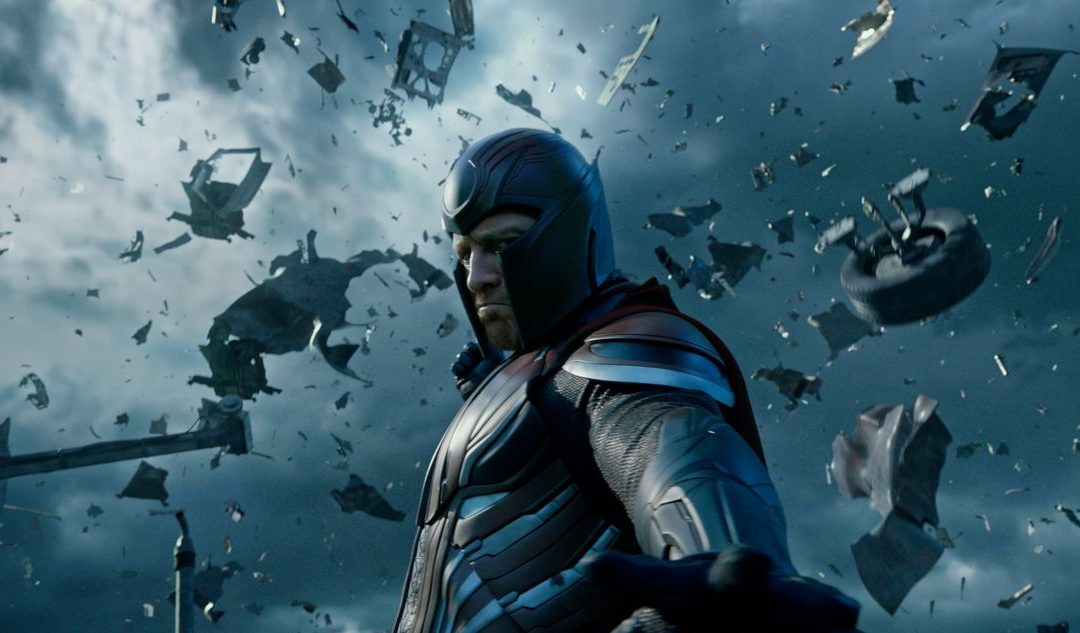
Instead, in Apocalypse, the X-Men and the villains they face are all cut from the exact same emotional cloth. They deliver dead-eyed, monotonal speeches about their traumas and their plans for the future. They stand around in poster-ready formation, glowering with their best catwalk-fierce supermodel expressions. And even when some of them are blue and one is bald and one is black and one is blindfolded, they all end up looking pretty much the same.
Lack of emotional range has been a problem in superhero movies for the past decade, and 2016 seems like a watershed year. It started with the grimmest and grittiest comic-book movie of the decade (Batman v Superman) facing off against the silliest one (Deadpool), and then Captain America: Civil War took the normally emotionally rich Marvel Cinematic Universe to a particularly dark and deadened place. Even the MCU’s most complicated heroes, developed over the course of half a dozen films, become raging, silent punch-bots by the end of Civil War. That’s a meaningful emotional tragedy within the isolated context of the film itself. But watching all these movies together, it’s easy to wonder: don’t heroes ever get to feel joy anymore? X-Men: Apocalypse
If Batman Begins really is ground zero for our heroes being replaced by grimaces, it’s possible to lay some of the blame there. Batman is defined by his barely varying rage — there’s a funny little fan-art concept about that floating around the internet in a wide variety of iterations — and Batman Begins established a particularly grave, ponderous tone. But even before that film, there was Hugh Jackman’s Wolverine in the X-movies, setting a standard for superheroes in 2000’s X-Men with his peacetime glower and his wartime snarl. Superman Returns emphasized Superman’s alienness and his remove from human feeling. Ang Lee’s Hulk marinated in the big green guy’s angst and anger without finding any of the childish glee in Hulk smashing things. Or maybe it all goes back even further, to 1994’s The Crow, and the way it turned superheroism into one long session of goth seething and brooding. Part of the appeal of MCU films like Iron Man and Guardians Of The Galaxy was that they felt like a corrective to years of hero movies that took all the fun out of heroing. They let their protagonists escape the long national funk that’s become as standard-issue for heroes as leather costumes and big explosions.
It’s certainly understandable that our cultural mandate has gravitated toward gravity. Endless thinkpieces have been written about how the current superhero-movie boom comes from America’s attempt to process the September 11th, 2001 attacks, visually and emotionally, and to simplify them into something that can be punched in the face. It took a while for movies to catch up with the grim-n-gritty trend that took over superhero comics in the 1980s, but now they seem to be trying to out-dark the comics that spawned them. So many comics-movie protagonists have taken on an edge of weary desperation, as if they’re trying to reflect the way the viewers feel about living in an age of government surveillance, endless foreign conflict, and seemingly insoluble problems.
“Don’t heroes get to feel joy anymore?”
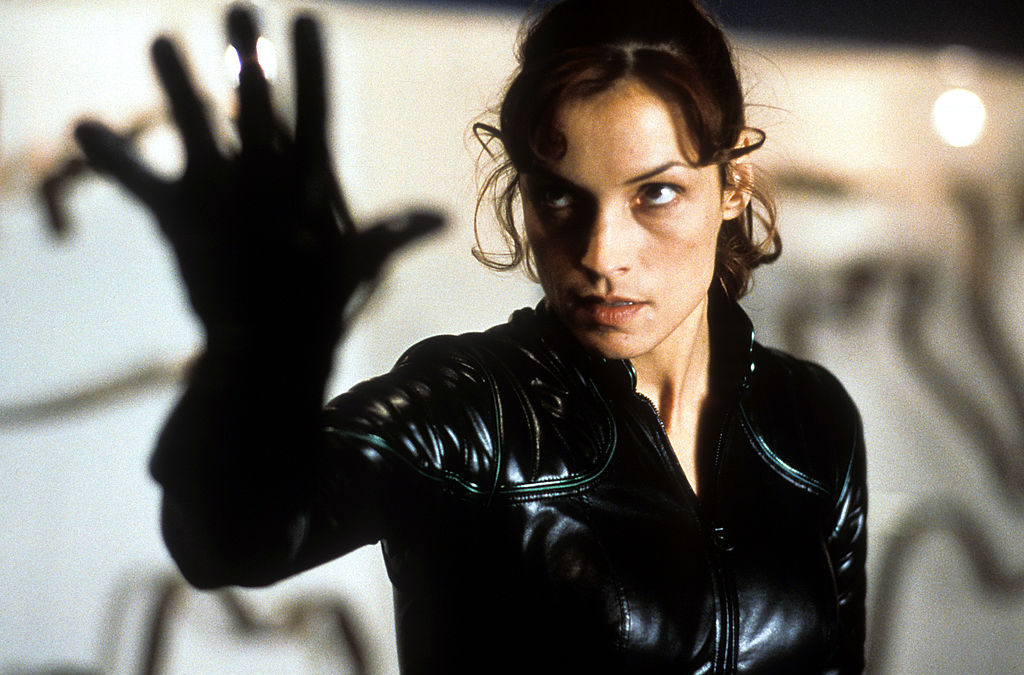
But taking a subject seriously isn’t the same thing as taking it without a hint of emotion. The problem isn’t characters defined by anger or frustration, the problem is when they don’t seem to feel anything else. In X-Men: Apocalypse, virtually everyone in the cast is emotionally shattered by traumas on-screen and off, from deaths in the family to the overall state of mutant rights. Nightcrawler, Mystique, Cyclops, Jean Grey, and Magneto all walk through the movie in various states of terror and leaden despair, carrying the weight of the world on their shoulders. Other characters,like Angel, Storm, and especially Psylocke, are so busy scowling that they barely get to talk. X-Men: Apocalypse
This is a problem for the fans. The entire point of a character like Angel / Archangel is the arc between who he was at the beginning and what he became, and when he’s a gloomy, almost wordless thug throughout the entire process, he becomes an empty special effect, without any narrative power. The homogeneity is also a problem for the storytelling: characters who start a story at an emotional dead end, already furious or numb with shock, have nowhere to go as the filmmakers attempt to ramp up the dramatic stakes. And it’s a problem for the audience. If superheroes are meant to represent our best selves, our most brave and altruistic impulses, what does it say about us if we expect our best selves to be grimly emotionless robots?
There’s a clear feeling in modern superhero films that showing too much “soft” emotion somehow weakens a character. The Batman of DC Comics is sometimes capable of laughter — remember the final page of The Killing Joke? — but the recent on-screen versions can barely crack a sardonic smirk, even in Bruce Wayne mode. Henry Cavill’s version of Superman looks perpetually pinched with some sort of deep inner strain. The X-movies have almost universally been dour, sometimes to operatic ends, and sometimes just to depressing ones. Even quip-happy, smart-ass Tony Stark loses his ability to banter by the end of Civil War, and openly sets out to kill two men in a wave of blank-faced hatred.
“Characters who start at an emotional dead end have nowhere to go”
There are so many signs that the “bigger, meaner, darker, angrier” trend isn’t actually what audiences want. Every big superhero-movie-defining callout moment from the past several years has come when the script set aside emotional deadness for a moment. Audiences seem to celebrate any hint that their heroes are human. Quicksilver glorying in his powers in his high-speed action scene in X-Men: Days Of Future Past, Star-Lord’s swaggering little dance to “Come And Get Your Love” at the beginning of Guardians Of The Galaxy, Wade and Vanessa’s lusty sex montage in Deadpool, Ant-Man thrilling to his own sudden power as a giant in Civil War, Spider-Man’s entire Civil War character — these are the moments that become fan memes and critical reference points, because they show the cracks in the heroes’ dull armor.
And that’s because heroes aren’t just escapist, and aren’t just exciting. They’re aspirational. We’re meant to identify with them, and to root for them, and to care about them. We’re meant to want to be them. But it’s hard to identify with a mirthless, expressionless chunk of granite. So many grimdark modern superheroes offer a fantasy of being tough enough to survive any trauma, not just physically, but emotionally. To people who feel battered by the world, for whatever reason, that Wolverine glare that says “I can beat whatever you can throw at me” can be inspiring and relieving. It’s a fantasy not just of competence, but of indestructibility. As we collectively continue trying to process the constant political, social, and technological changes in the world, and the feelings of frustration and helplessness that sometimes comes with them, it’s comforting to retreat to a fantasy of being able to deal with whatever comes.
But it’s also comforting to imagine being indestructible, and still getting to share in the full range of human experience — lust and love, delight and wonder, joy and amusement, and all the other things lacking in Apocalypse and so many other superhero movies. Our collective fantasies define superheroes, and we collectively fantasize about more than one thing. By shutting out so much of the range of human life, hero movies are making superhumans considerably less than human. It makes their characters duller. It turns their movies into unvarying slogs. It limits the ways in which these films can speak to us, and engage us. It’s true that too many superhero films are setting out to crowd in more action, and bigger stakes, at the expense of any kind of variety or creativity. But the small emotional apocalypse feels more disastrous than the big CGI ones. It’s important that our heroes come along to save the day. It’s just as important that they preserve their humanity in the process.
It’s the end of the world as we know it in “X-Men: Apocalypse”, starring younger versions of characters we first met in the movie “X-Men” way back in 2000.
Timeline-wise, the current run of prequels is getting close to meeting in the middle with the older films. So (with spoilers) let’s see if the events of “Apocalypse” manage to tie together with what has gone before — or has the new flick messed up the continuity?
As a reminder, here’s the chronology:
1962: “X-Men: First Class” (2011)
1972: “X-Men: Days of Future Past” (2014)
1983: “X-Men: Apocalypse” (2016)
The not too distant future: “X-Men” (2000)
The not too distant future: “X2” (2003)
The not too distant future: “X-Men: The Last Stand” (2006)
If there are discrepancies between new and old films, it could be explained away by the new timeline created in the time-traveling “Days of Future Past”, but I hate it when they do that — I’m looking at you, J.J. Abrams and your “Star Trek” reboot. So leaving aside any timey-wimey nonsense, do the films still tie together?
The answer is yes…and no.
Yes…
In “Apocalypse”, some of the young X-Men encounter Wolverine and free him from the Weapon X project where he has been turned into a living weapon. Hang on — I thought, as I was watching — don’t they meet for the first time in “X-Men”?
The X-Men met Wolverine for the first time in 2000 — or so it seemed.
20th Century-Fox/Getty Images
It seemed that way at the time, but watching “X-Men” again, there’s actually some ambiguity. In the 2000 movie, Wolverine, who has no memory of his past, is introduced to Jean Grey and Cyclops apparently for the first time. But they never actually ask him his name or seek any information from him. Wolverine doesn’t remember them — “What do they call you? Wheels?” — but they never show any sign that they don’t know him. At the time we assumed this was because Professor Xavier and Jean could read his mind, but it could easily be because they had already crossed paths years before.
Then in “X2”, a conversation between Magneto and Professor Xavier implies that both of them know more about Wolverine’s past than they’re telling him. That matches up with “Apocalypse” too.
Also in “X2”, Stryker meets Wolverine for the first time in what he says is about “15 years”. Given that “X-Men” was set in the “not too distant future”, “X2” is probably more like 20-25 years after Wolverine escaped Stryker’s Weapon X project in 1983. Eh, close enough — Stryker may have got his dates wrong in the heat of the moment, or, more likely, this reference will retroactively make sense if the two encounter each other in the next X-Men movie, which will be set in the ’90s.
Maybe we’ll also see Stryker’s son Jason in that forthcoming film. Incidentally, the actor playing Jason in “X2”, Michael Reid MacKay, was 50 years old at the time, which definitely doesn’t fit the timeline — leading us into the ways that the films contradict each other.
…and no
According to “Apocalypse”, Jean, Cyclops and Mystique have been to Alkali Lake, the home of the Weapon X project. That seems to contradict “X2”, in which they don’t recognise the location of the base.
More significantly, in “Apocalypse”, the mutant Nightcrawler fights alongside Jean Grey, Cyclops and Mystique. That directly contradicts “X2”, in which the X-Men very differently meet Nightcrawler for the first time.
Jean Grey and Nightcrawler hang out in “Apocalypse”, contradicting “X2”.
Alan Markfield
There’s no ambiguity, as there is with Wolverine: Storm and Cyclops straight-out ask Nightcrawler his name, and Nightcrawler asks them about the school, with no recognition on either side.
And finally…
So what about “X-Men: The Last Stand”? The third “X-Men” movie, released in 2006, shows Xavier and Magneto as friends, meeting a young Jean Grey just 20 years ago, which is way off the chronology established in more recent films. It also features a winged mutant and a man called Trask, but technically they could be different people than the winged mutant in “Apocalypse” and the character Bolivar Trask played by Peter Dinklage in “Days of Future Past”.
Still, we can probably go ahead and forget about “The Last Stand” anyway, since “Days of Future Past” seems to write it off — and “Apocalypse” makes director Brian Singer’s feelings about the third film pretty clear…
It looks like 2016 is set to be the year that movies based on comic books really embrace costume accuracy. The amazingly accurate outfit featured in Deadpool set the standard, and both Black Panther and Spider-Man’s duds in Captain America: Civil War look fantastic. But as excited as these comic-accurate looks have fans feeling, there are lots of page-to-screen adaptations that are just wrong. Sometimes ignoring characters’ original designs is a pretty smart decision, while other times it’s hard not to be bummed about the changes filmmakers make for the sake of “realism.” Watch our video above to see some of the most off-kilter attempts to put super-suits on the big screen from the past, present, and future. And don’t forget to subscribe to our YouTube channel for more sweet, sweet vids. Wolverine
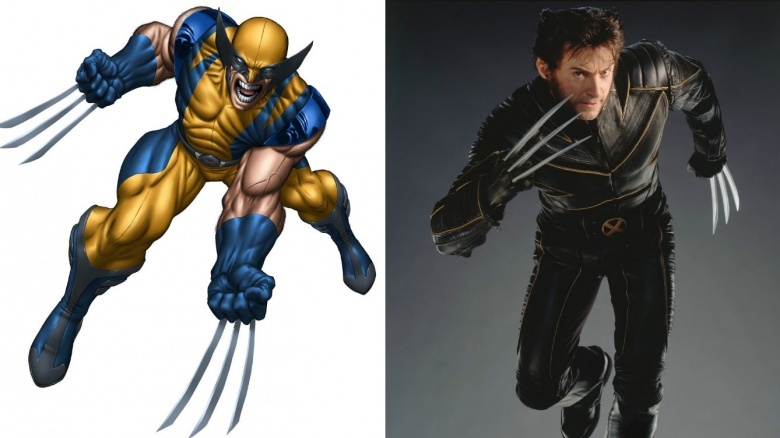
Back when Hugh Jackman first took the role of Wolverine in 2000’s X-Men, it was impressive enough that he managed to accurately capture the essence of everyone’s favorite clawed psychopath. It didn’t much matter that, at 6’2″, Jackman stands a full 11 inches taller than his diminutive comic book counterpart. But despite the fact that fans have loved the movie version of Wolverine for over a decade, he’s still never appeared on-screen in his comic-accurate costume. C’mon, can’t we even get the mask on his face? Just once? Vibe
We can’t really blame the producers of the CW’s The Flash for not going so comic book accurate with this one. For one thing, Cisco Ramon, aka Vibe, is still discovering his powers on the show, and hasn’t gone out to fight crime as a full-on superhero. Moreover, until a recent redesign, Vibe’s comic book suit was pretty embarrassing, with its red handkerchief and V-neck collar that goes all the way down. Still, if the show keeps looking to score points for comic book accuracy, we have to point out that it’s missed this one—even when it makes the smart choice by actually avoiding said accuracy. Hawkeye
This is another instance where the filmmakers behind Hawkeye’s big screen look made the right move—by moving away from the comics. Sure, Hawkeye’s all-purple archery suit looks cool on the page, it’d be hard not to make it look ridiculous at the movie theater. Superman
Lots of Superman haters have pointed to his costume as something in need of “fixing.” With the yellow belt that holds nothing up, the red underpants on the outside, and the simple blue spandex, it’s definitely a simple outfit, and one that hasn’t changed much over the past century. But Christopher Reeve managed to make it look awesome in 1978’s Superman, and all three of the sequels. That was proof enough that Superman’s costume wasn’t actually broken at all. Yet, for some reason, Zack Snyder insisted on making Superman’s belt even weirder—and cover him in fish-scales?—for 2013’s Man of Steel. Bring the underpants back, man. Deadpool
Much ink has been spilled about how badly X-Men Origins: Wolverine’s producers screwed up Deadpool: they take him out of his iconic costume, sew his mouth shut, and give him all the mutant powers they could stuff into one person. The good news, of course, is that it paved the way for 2016’s Deadpool, which has broken new ground for faithful comic book adaptations (and for creative use of a unicorn doll in an R-rated movie). Punisher
While it’s not going to win any awards for being clever, the Punisher’s costume is pretty memorable for exactly one reason: it has a gigantic white skull on it. So when the Dolph Lundgren-starring Punisher movie came out in 1989, what’s the one thing the filmmakers decided to omit from the character’s look? The gigantic white skull. Mystique
As we’ve discussed, the producers of 2000’s X-Men made some important choices to ensure that their team of mutants would look realistic on film. That meant cutting brightly-colored superhero costumes in favor of black leather. Whether or not that was a more believable costume choice is debatable. But there’s no question that director Bryan Singer’s move to change the look of Mystique is one of the more baffling adaptations in superhero movie history. For some reason, Singer insisted that the villain be covered in lizard scales and walk around naked all day long, despite there being no such corresponding look in the comics. Stranger still, the scales have stuck around from movie to movie and actress to actress, even though it looks truly bizarre and has no real reason to still be, like, a thing.
If you’ve murdered someone or have a treasure hidden somewhere, the last person you probably want to tell is Vin Diesel. The actor just can’t seem to keep many secrets to himself, especially when it comes to future projects that he may be doing at Marvel Studios.
For the past year, Diesel has been doing a littlemore than teasing that in addition to his voice role as Groot in Guardians of the Galaxy, he might have something to do with the forthcoming film The Inhumans. The project was recently rumored to be in danger of getting axed, but that doesn’t seem to be the case, especially if we continue to believe Diesel’s pretty obvious hints.
Speaking with io9, after revealing who will be directing xXx 3, Diesel said that there is still the opportunity to do something more with Marvel Studios. And while he didn’t mention a specific title or character name, he did seem to back up certain rumors about which character he might play:
I can totally be something [else] with Marvel. I think playing [Groot] only makes Marvel that much more excited and me having my experience with Marvel, seeing how great they were, makes me more excited.
We’ve heard a lot of talk about Marvel wanting to have me play a character that doesn’t have my voice. So my voice is used for Groot and my presence is used for the other character.
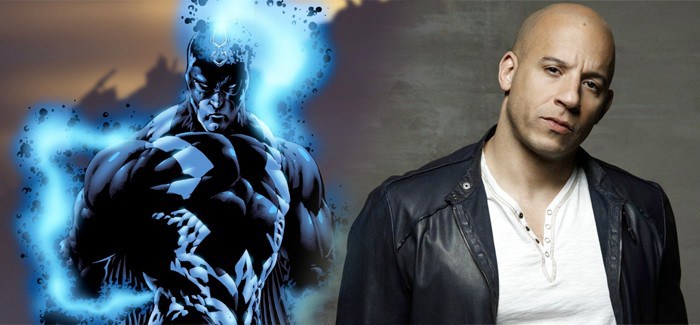
You may remember that we’ve heard rumblings that Diesel could be playing Black Bolt (aka Blackagar Boltagon), the leader of the Inhumans. Diesel hasn’t mentioned this character specifically, but his mention of using only his presence for this other character makes sense for Black Bolt. The character has a voice that unleashes immense destructive power when he speaks, making him a mostly silent leader of the pseudo-mutants.
However, at this point we’re unsure as to when The Inhumans will get off the ground. The film is still set for release on July 12th, 2019. But just as Marvel recently messed with the release dates forBlack Panther and Captain Marvel while adding Ant-Man and The Wasp, the sequel to this past summer’s Phase Two title, there’s a chance The Inhumans could get delayed at some point. Whenever the project gets in front of cameras, though, seeing Vin Diesel in Inhumans seems like a forgone conclusion.
Again, the rumors that The Inhumans was going to be canceled due to a clash between the film and television side of Marvel Studios, specifically with regards to Agents of S.H.I.E.L.D., have been grossly exaggerated. There are actually some rules in place that leave certain elements of the Inhumans mythology off-limits to the TV series, so everything should work out in the end. Stay tuned for anymore updates.
Oh what a difference 18 months makes. A year ago last fall, Spider-Man fans were facing an entire universe of Spidey movies they didn’t particularly want: A third Amazing Spider-Man about the continuing and not-particularly-exciting adventures of Andrew Garfield’s Peter Parker, plus spinoff movies for Venom and the Sinister Six. Things got so bad for Spider-Man that when ludicrous rumors began circulating that Sony was considering an Aunt May movie, the studio had to publicly dismiss that talk as “silly” with “no validity whatsoever” because after the Amazing Spider-Man 2 trainwreck, no idea, no matter how obviously terrible, seemed implausible.
A year and a half later, everything has changed. The Amazing franchise is dead and gone, the spinoffs are in limbo, and a revamped Spider-Man has emerged. Sony will continue to release his solo films (the first, Spider-Man: Homecoming, opens in theaters next summer) but this new hero, played by Tom Holland, is officially back in the Marvel Cinematic Universe, starting with a small but terrific role in this week’s Captain America: Civil War.
This new Spidey hasn’t had much screen time yet, but he’s got a real shot at being the greatest movie Spider-Man of all time. In some ways (like the seven below) he already is.
1. He’s looks (and acts!) like a teenager.
Tobey Maguire was 27 when Spider-Man hit theaters in 2002; Andrew Garfield was a few months shy of 30 in 2013 as The Amazing Spider-Man made its premiere. I know he’s called Spider-Man, but c’mon; that was ridiculous. Maguire and Garfield were and are great actors, but high school kids? Peter Parker’s supposed to be a science genius. Both Maguire and Garfield’s Peters look like they were left back. A lot.
As great as the previous iterations of Spider-Man were at times, both were afflicted with what could be called “Beverly Hills, 90210 disease” — an acute affliction of the facial area that make pop culture adolescents appear much more physically mature than they should. New Spider-Man Tom Holland is just 19, and he looks a decade younger than either of his predecessors. Even better, his Peter doesn’t act like a cool, calm, and collected superhero; he’s a dork with incredible powers. With his high and reedy voice Holland is the first movie Spidey who can pass for a legitimately awkward pubescent kid, nailing one of the most appealing (but least explored, at least onscreen) parts of the character.
2. No origin story.
Hey did you know that Spider-Man’s uncle was killed by a burglar and he could have stopped him but didn’t and on that day he learned that with great power comes great responsibility?
Yes of course you did because everyone in the universe knows this.
It’s one thing to retell the origin of Ant-Man or Doctor Strange, characters whose histories and backstories might not be that well known by the public at large (or which are getting tweaked slightly for the silver screen). It’s another thing to tell the origin of Spider-Man, one of the most iconic fictional characters of the last century. In 2016, after two different franchises with two different origins, there’s just no need for another spider bite and robbery gone wrong and tearful vow to avenge injustice.
Where so many comic book movies keep wasting time rehashing the same origin stories (*fakecoughBatmanvSupermanfakecough*), Captain America: Civil War tells you all you need to know about this new Spidey with a few simple lines and then gets down to what we really want to see, which is the new Web-Head in action. Speaking of which…
3. Better action.
Sam Raimi’s Spider-Man deserves a huge amount of credit for creating a visual language for the Friendly Neighborhood Wall-Crawler; translating the imagery of comics to the big screen in a way that has remained basically unchanged to this day. Still, for all his innovation, Raimi never quite delivered an unforgettable super-powered brawl. His Spidey’s best moments were always when he was swinging around Manhattan, dodging debris, and rescuing women as they fell from great heights, not so much going toe-to-toe with the bad guys.
Spider-Man’s role in Captain America: Civil War is a modest one, but this Spidey has already given us the coolest fight scene of the character’s movie career. Part of that is the context; Holland has the benefit of taking part in an enormous Avengers battle royal, giving him tons of different heroes to interact and fight with. That said, if directors Anthony and Joe Russo and their stunt and effects teams hadn’t found inventive ways to use Spider-Man’s powers, no one would care if he fought the entire contents of The Official Handbook of the Marvel Universe. The TV spot below gives you a tiny taste of this new Spider-Man in action, and leads us right into our next point.
4. He’s the funniest Spider-Man to date.
Tobey Maguire and Andrew Garfield’s Peter Parkers were very different men, but they shared a similarly muted sense of humor. Maguire excelled at Peter’s melodramatic side; he was always most comfortable digging into the ups and downs of his love life and career, and the struggle to carry the full emotional burden of his decisions. But Maguire struggled with the character’s sillier side. His wisecracks and quips as Spidey — a staple of the hero’s comic-book adventures since his earliest days — often felt forced. His Spider-Man was weirdly silent an action; this battle with Doctor Octopus from Spider-Man 2 is about as jokey as he got, and he delivers just two mildly amusing lines during this four-minute fight.
Garfield had his own issues with the character’s wisecracks. When he tried it, he mostly came across like a smug jerk.
Garfield did fare a little better in Amazing Spider-Man 2. His one-liners during the opening bank heist and car chase were as close as cinematic Spidey came to the lighthearted joke machine of the comics — at least until Civil War’s Spider-Man, which is far and away the funniest screen Spidey to date, and the one to best use the character’s humor the way the comics do, as a defense mechanism a shy and nervous kid deploys to cope with his anxiety during overwhelming situations. Spider-Man doesn’t run his mouth because he’s cool or arrogant; he does it because he’s a scared 15-year-old in insane situations. Holland’s the first guy to capture that, and to find a way to make Spidey’s motormouth both annoying and endearing in equal measure.
5. The best Spider-Man costume to date.
Spider-Man’s costume has often been a strength of the various Sony franchises. Maguire’s uniform from the first Spider-Man (designed by James Acheson) was probably the best superhero costume to that time, and while the first Amazing Spider-Man’s red-and-blues were sort of a mess, the second film was probably the most realistic version of Spidey’s outfit in any of these movies.
Still, of all the Spider-Men onscreen in the last 15 years, Captain America: Civil War’s is the best dressed of the bunch. He’s also got the best explanation for a dweeby teenager winding up in a suave and high-tech one-piece jumpsuit (which I won’t spoil). Holland’s Spider-suit combines the best of Steve Ditko and John Romita’s Wall-Crawler with great 2016 design touches.
Best of all: Eyes that change sizes.
There’s a justification for those narrowing eyes in the film and that’s cool, but it’s ultimately more of a clever means to a crucial end: A Spider-Man who’s even more expressive in battle than ever before.
6. A new and different Aunt May.
There will always be a special place in my heart for Rosemary Harris, who was perfect as the maternal Aunt May in Sam Raimi’s movies. It would be tough to improve on her version of the character, so why try? Better to do something new and different with May Parker.
Sally Field could have done that, but by her own admission she didn’t enjoy playing the part and didn’t put a great deal of thought into her performance. Instead, it’s Marisa Tomei who got to reinvigorate the role of Aunt May. Rather than the frail, overly protective, and naive woman who’s been typical of Aunt May for half a century, Tomei’s May is young, hip, and energetic. The fact that Tony Stark couldn’t stop hitting on her in their brief scene together suggests all kinds of potential for dramatic tension between this May and Peter. Tomei’s presence provides something that’s all-too-rare in superhero movies: A sense of unpredictability.
7. He’s a part of the Marvel Cinematic Universe.
Last but certainly not least, Marvel’s is the superior Spider-Man because he’s finally back where he belongs, shoulder to shoulder with the other giants of the MCU. Spider-Man is a rich enough character to carry a movie on his own, and he’s fine in a vacuum, but he’s even better in a group setting because his inexperience and youth play well off older, more mature heroes who can play straight men to his nonstop barrage of punchlines.
Sony spent most of Amazing Spider-Man 2 trying to cobble together a cinematic universe for the character to live in, when a perfectly good one — the one where Spidey always belonged — already existed. This really is a perfect homecoming. Here’s hoping this new and improved Spider-Man sticks around for a good long while.
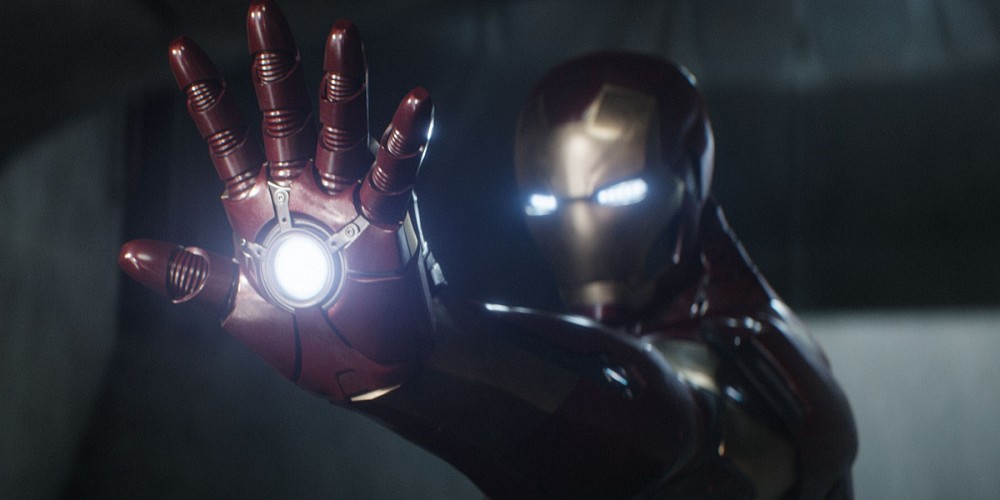
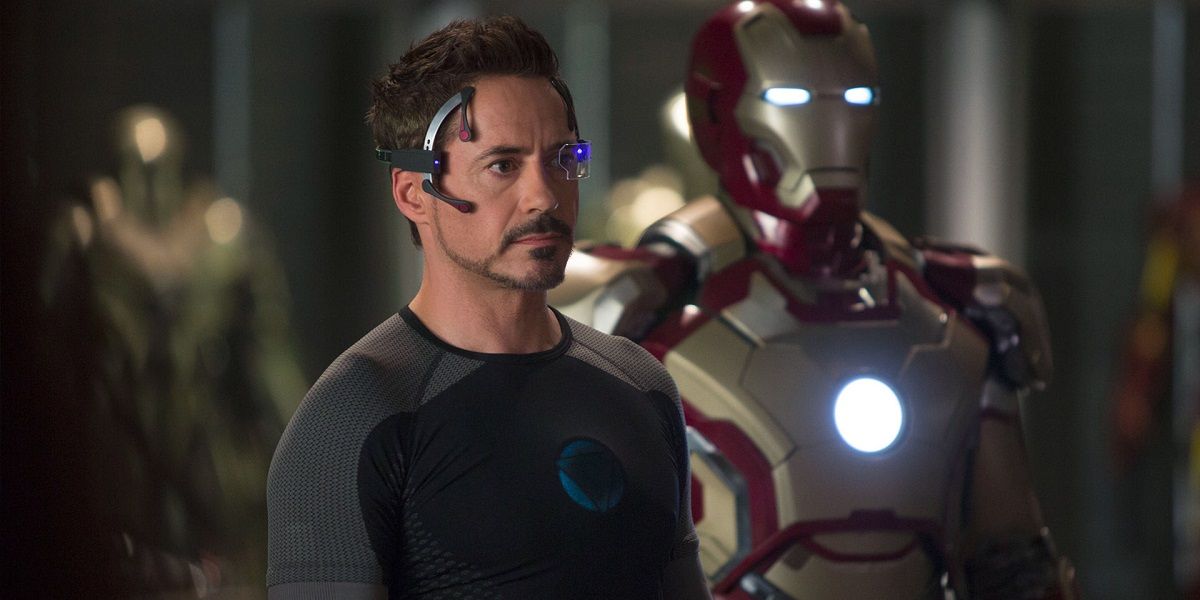
Iron Man is without a doubt one of Marvel’s most recognizable heroes. Ask anyone around the world who Iron Man is and they’ll tell you: he’s a man that’s covered in iron. He’s also a billionaire, genius, playboy, philanthropist, and one of the most bankable superheroes in cinematic history. But that’s not all he is.
Despite Iron Man’s claim to fame being that he’s just a regular human whose various suits help him accomplish superhuman feats, as it turns out, Iron Man is more than just the sum of his suits. Throughout different comic book, television, and film storylines since Iron Man’s 1968 debut, he’s accumulated a whole host of powers that most people aren’t aware of. Sure, everyone knows the basics – like his flight and weapons capabilities – but we’re diving into the powers that you don’t think about when you think about Iron Man.
To satisfy your curiosity of what makes Iron Man so badass in the recently released Captain America: Civil War, here’s 12 Superpowers You Didn’t Know Iron Man Has.
Genius-Level Intellect
With the equivalent of a small country’s weapons arsenal packed into a suit that he flies around inside of, it’s easy to forget that Iron Man isn’t just a high-tech killing machine — he’s actually the genius who invented the high-tech killing machine. Well, technically Tony Stark invented it, but they’re one in the same, which is why we’re considering one of Iron Man’s most overlooked powers his genius-level intellect.
There are a lot of smart people in the Marvel Universe. Between Reed Richards, Hank Pym, and Bruce Banner, you’d be forgiven for thinking that Stark is just some cocky engineer who knows his weapons. But perhaps one of Tony’s – and thus Iron Man’s – greatest strengths is his superior intelligence. Often considered one of the greatest minds in the world of Marvel, Stark graduated from MIT at 17 and quickly made a name for himself; and then later he made a name for himself as Iron Man, the smartest superhero on the face of the Earth.
He Can Store His Suit Inside His Body
In case you’re thinking that if you took Iron Man’s suit away he’d no longer be Iron Man, think again. Unlike Batman, Iron Man’s powers have been upgraded over the years and the result is a superhero that can never be separated from his costume — because it’s hiding inside of him. And while Iron Man has had a collection of suits over the years that all have different capabilities, it’s the suit that’s a part of Iron Man (and Tony Stark) that truly makes him a superhero.
Starting with Iron Man’s Extremis Armor and evolving into the Bleeding Edge Armor, Tony Stark was able to create a suit that meshed with his mind and body. Controlled with his thoughts and implanted directly into his nervous system via nanotechnology, Iron Man’s suit can be stored inside of his bones, able to be deployed whenever the situation presents itself. Not only is this power able to give Iron Man the element of surprise when an attacker thinks they have the advantage on him, but it also takes Iron Man more in line with the rest of the Marvel Universe heroes; seemingly-regular people that can unleash their powers at any time, no matter what they happen to be wearing.
Access to the World’s Communications Systems
If you’re Iron Man it would be pretty essential to hear what the world is saying about you and who may or may not be chasing after you if you’re enjoying a Sunday flight in your suit. It therefore makes sense that Shellhead would have the ability to tap into the communications systems of the world and use the information he obtains to his advantage. But that seems like a pretty straightforward power that we’d all assume Iron Man has, so what makes it so intriguing?
Iron Man’s ability to access the world’s communications systems is actually more complex than it seems, and the casual Iron Man fan would have no idea just what he can do with this power. Thanks to Tony’s merging with his Iron Man armor after the events of Extremis, he’s actually able to talk – and listen – to machines all around the world, without his suit. This is because Tony’s brain developed a technopathic bond with the world’s machinery, and as a result he can tap into any system that he wants and have his way with it. It’s just another under the radar power that makes life as Iron Man a lot easier.
Super-Human Healing
Iron Man’s gotten a lot of upgrades since his comic book debut, and he’s far from the frail alcoholic that had to become Iron Man in order to prevent the shrapnel in his body from killing him. In fact, Iron Man took a page from others in the Marvel Universe – specifically Wolverine and Deadpool – and gained the ability of super-human healing somewhere on his journey from forgotten comic book hero to multi-billion dollar movie icon.
Taking a page from his suit – which has been developed to patch and repair itself if damaged – Tony Stark is harder to take down than one might think. With a super-human ability to heal, Stark’s body can produce entire new organs if it needs to in order to keep itself alive. While he might not survive a gunshot to the head like Wolverine, Iron Man can still take some serious damage before calling it a day, inside and out of his suit.
Super-Human Response Time
When Iron Man got the Extremis armor, his suit’s operating system was hardwired right into his body’s nervous system. And while a lesser hero might use that nervous system OS to play solitaire with their mind all day, Iron Man quickly realized that this direct link to his brain granted him a super-human response time that he never had with his old suit; and he used his powers to fight evil, obviously.
Essentially a cyborg, Iron Man’s response time is instant, as all he has to do is think something and it will occur. Just like moving an arm or taking a step, Stark’s synapses fire a command to his suit and the command is immediately carried out, shaving precious nanoseconds off of life-or-death situations. This power essentially matches Iron Man up with the likes of Spider-Man’s spider-sense or the skills Cap got from the Super Soldier Serum, and thus it puts him on a level playing field with the more “traditional” superheroes that everyone knows about.
Physical Combat Skills Even Without His Suit
Not many people would think that a wealthy businessman who became a weaponized superhero out of necessity would be a great fighter outside of his suit, but those are the kind of people that Tony Stark would love to prove wrong. Unable to use his suit for a period of time in the comics, Stark was unwilling to sit on the sidelines and be just another powerless guy, so he turned to Captain America for help.
It was at this point that Cap started Stark on a relentless training regimen that would prepare him to be a great fighter, even when he’s not hiding behind the red and gold armor. Stark took to his combat training and eventually became a physically intimidating presence, learning how to give and take punches along the lines of the best fighters in the world.
Radar Avoidance
As far as Iron Man’s powers go, radar avoidance isn’t the sexiest or most compelling. When you’re a nearly indestructible human weapon, not a lot of people are going to pay attention to the little things that make your powers useful. But that’s exactly why not too many people know about Iron Man’s ability to avoid any form of radar, which actually turns out to be one of the most useful powers that Iron Man has at his disposal.
When you’re flying into hostile territory or trying to take out any number of various Earth-destroying threats with the Avengers, you’re generally not going to want to draw attention to yourself. So when Captain America, Black Widow, Hawkeye, Thor, or The Hulk come smashing into your backyard, you’re going to notice; but that’s not the case with Iron Man. Having devised a genius cloaking system to avoid radar and other detection methods in his suit, Iron Man essentially has invisibility on his side — right up until he yells a sarcastic insult at the villain he’s fighting and gives himself away.
Ability to Project Hologram Decoys
This is one of Iron Man’s powers that we’d love to see more of in the Marvel Cinematic Universe: his ability to project hologram decoys in the battlefield. While the MCU has shown phones and S.H.I.E.L.D. computers utilizing holograms for all kinds of nonsense, we’ve yet to see an awesome on-screen representations of what may be Iron Man’s most underrated power.
Iron Man has used his suit’s ability to project holograms in the past by projecting a copy of himself, out of the armor, in order to fool enemies and bait them into attacking him. He’s also projected multiple Iron Men in order to fool weapons and attacking forces, as well as chameleon-type blending capabilities that essentially make him invisible to everyone. Considering that so much of Iron Man’s powers are offensive-based firepower, it’s cool to see a defensive ability that really showcases the high-tech nature and intelligence behind his armor.
He Can Be Powered by External Energy Sources
Your phone might die after a few hours of playing Candy Crush, but a high-powered suit that can make its user fly around and launch rockets can apparently never run out of battery; which has to be one of the coolest things about Iron Man — he’s always on. Although there’s been a fair share of power-failures and energy draining attacks on Iron Man in the MCU, in the comics, Iron Man is actually able to power his suit indefinitely using external energy sources.
Not only does using external energy for power save Iron Man a ton on his electricity bill, but it also means that he can take the energy from incoming attacks and energy discharges such as explosion and absorb them for power (we glimpsed this in his brief brawl with Thor in the first Avengers outing). One of the coolest elements of this power is the fact that enemies trying to wear down Iron Man don’t know that by shooting at him or trying to blow him up, all they’re actually doing is making him stronger.
Indomitable Will
You wouldn’t think one of pop culture’s most famous alcoholics would have indomitable will, but just like any legendary superhero, Iron Man has a stronger willpower than just about anyone on the face of the planet. Like Captain America and many in the DC Universe, trying to change Iron Man’s mind would be a futile effort, and giving up is an option that would never cross his mind.
Though indomitable will may be the most inevitable superpower on the checklist – right up there with “having a costume” – it’s essential to who Iron Man, and Tony Stark, is; that he has immense willpower and mental strength. Having recovered from alcoholism after one of the most iconic storylines in comic book history – “Demon in a Bottle” – Stark learned to emerge from challenges stronger than ever and never quit until he wins. It’s something so ingrained in Iron Man that you wouldn’t think twice about it, but it’s also one of his most useful powers.
Able to Predict the Future
If ignorance is bliss, then maybe being a genius is what makes Iron Man such a snarky asshole. Known by all in the Marvel Universe as a “futurist,” Stark is so intelligent that his mind works differently from everyone else. He can see the future by means of foreshadowing events before they happen based on reason and logic. There’s no mysticism involved here, just a good old-fashioned superpower based on brains.
Hawkeye called Iron Man out on this in Civil War, explaining that Stark must have known what was coming considering that he’s a futurist. It was an emotionally important moment, especially considering the tie-in to the Civil War comic book storyline. In the comics, Iron Man predicted the events of Civil War before they happened, thus proving that he isn’t some two-cent fortune teller at a carnival — he’s one of the only people in the Marvel Universe that can see ten steps ahead and plan how to react as a result.
He Has a “Freeze-Beam,” Among Other Things
In case Iron Man ever gets tired of blasting people with his repulsor rays, his central chest weapon is also capable of other feats that rarely get seen. Among the most interesting is his ability to generate a beam of ultra-freon, which would immediately freeze an opposing enemy and stop them in their tracks.
Along with Iron Man’s Freeze-Beam, he’s able to generate sonic blasts, create magnetic fields, and produce an electromagnetic pulse than can wipe out the power of anything nearby. All of these abilities are part of what is arguably Iron Man’s greatest power: his ability to change suits and weapons depending on his needs. At the end of the day, Iron Man is a great superhero because he doesn’t have a limited amount of tricks that he must rely on time after time. Thanks to his genius intellect and the other powers he’s accumulated since he became Iron Man, he can keep bringing new abilities to the table in order to surprise enemies — and delight fans.
—
Which power were you most surprised to learn that Iron Man has? Are there any we missed? Let us know in the comments!