HUDSON — Children in the Hudson Intermediate School were facing a daunting prospect: a whole week without teacher’s dirty looks. How to prepare them for this deprivation?
The school has nothing if not a collective, wildly creative imagination, and to ease their children into nine days of domestic isolation, the powers-that-be devised the M.C. Smith Read-A-Thon.
The event was organized by literacy teacher Lisa Dolan and fifth-grade teacher Lynn Clark, organizing genii of the first order: Not only did the Read-A-Thon get kids off on the right foot for vacation, it also raised $6,000 for the book festival.
“We always have a Read-A-Thon the last day before vacation,” said Principal Mark Brenneman. “It’s the 100th day of the school year.” After an inspiring assembly, the kids read books all day long.
Focusing on literacy the day before the break, Brenneman believes, “increases the chances they’ll read over the coming week.”
Of course, there are kids who stare out the window or twiddle their thumbs? Not a chance, according to Brenneman.
“The kids love it,” he said. “If you put high-interest texts in front of kids, they’re going to read it and enjoy it. I incessantly read sports books.” Now the kids read “Stella Bats” books, or “Happily Ever After” books, he said.
“The kids love them. The authors come here, and they treat them like rock stars. It’s a testament to the hard work of our staff to get the kids to raise their literacy,” Brenneman said.
The Read-A-Thon also has a more concrete, quickly achievable goal.
“It’s our fundraiser for the book festival,” he said. “The kids have pledge sheets, and people pledge for them to read all day. The money raised supports the book festival.”
The Hudson Children’s Book Festival, created and developed by Dolan and other HCSD staff, is the largest such festival in New York state. It gets no tax support, so it depends on donations and fundraising.
So where did all the books the kids read Friday come from?
One student, Malachi, brought in the biggest book in his class, a book of Grimm’s fairy tales, and he said he’d be reading that all day. His favorite is “Hansel and Gretel.”
But for those who didn’t bring in a book or two, “we have the books,” Brenneman said. There are lots in the classrooms, and Dolan’s classroom has books as far as the eye can see.
“Fifty kids a day come down to Lisa’s room (for books),” he said. “We’re constantly getting new books, new authors.”
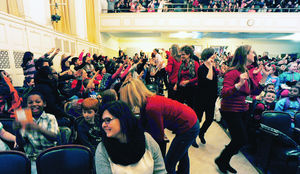
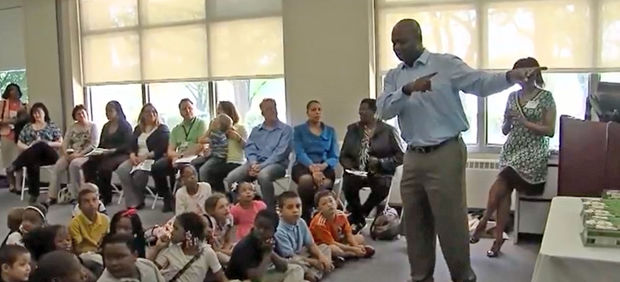
The Read-A-Thon began with the kickoff assembly in the auditorium.
After a welcome by Brenneman, fifth-grade teacher Edgar Acevedo sang “America the Beautiful” accompanied by Americorps’ Alec Butterfield on vocal percussion.
Next, music teacher Gerard Cordato played a jazzy number on the keyboard, followed by the jazz band itself — trombones, trumpets, saxes, clarinets, flutes, snare and bass drums and a djembe.
The band was followed by Americorps’ Laura Engelman, who executed faster-than-the-eye-can-see jump-roping feats; Brenneman was heard to confide in some front-row students that he could have done as well, had he not worn the wrong shoes.
The athletic wonders continued as physical education teacher Karrie Cox’ gymnastics club did astounding feats, walking on their hands, flips, splits, cartwheels, backflips and on beyond the poor vocabulary of the unitiated.
Cox stayed on for the next event, a hip-hop dance with fellow teachers Tani Quinion, Stephanie Curry and Lena Alessi. Each wore one of the letters of the word “READ” on her T-shirt. The number also included inventive solos by students pulled in from the audience.
The finale was a wide-ranging beat-box number by Butterfield that ended with the words, “I want you all to read many books / This is going to be a wonderful Friday / Read books all day.”
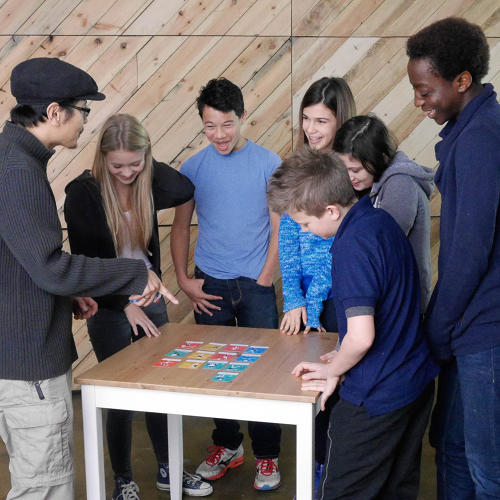
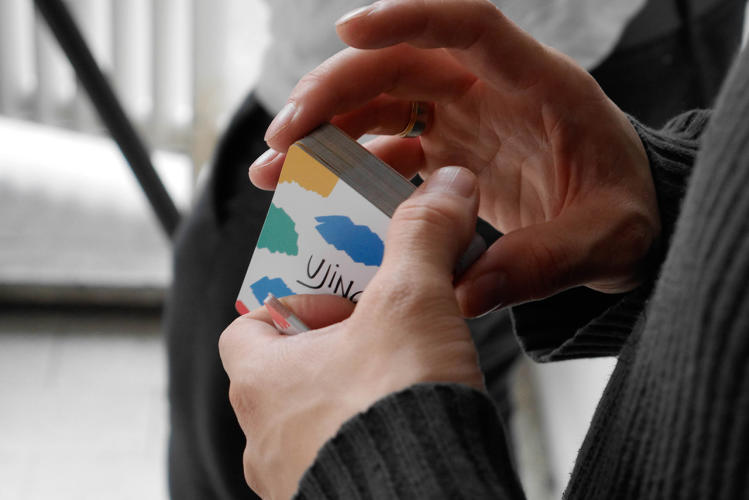
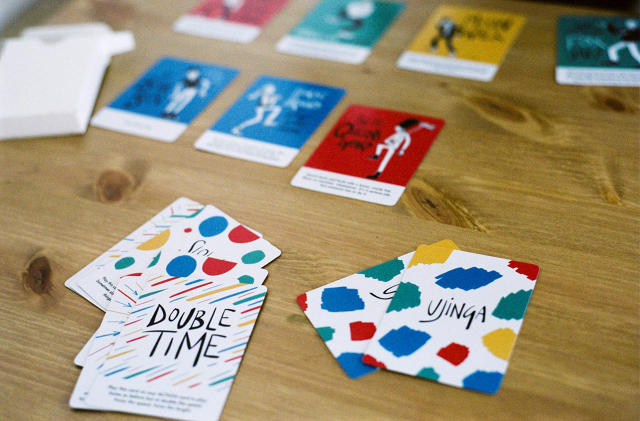
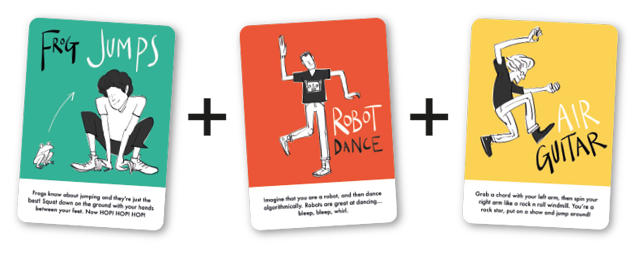
Childhood obesity rates have more than doubled in the past 30 years, no small thanks to increasing numbers of sedentary hours spent watching television or playing video games. Ujinga, a new card game designed by researchers at a top London hospital in collaboration with the Royal College of Art, aims to get kids moving. Whimsically illustrated by artist Tom Jennings, the 56 cards are printed with actions, like “zombie walk,” “robot dance,” “frog jumps,” and “Gangnam style,” which kids have to perform in order to score points in the “Survival of the Silliest.”
While the illustrations on the cards are cute, it’s hard to believe they can rival MarioKart. What will make kids want to jump around while playing an analog card game instead of, say, an Xbox or a Playstation 4, the very games that keep kids on their butts in the first place?
“Our research when designing this game led to two main insights: kids love to be silly, and they love to tell other people what to do,” Ifung Lu, a designer at the HELIX Centre, says. HELIX is an innovation team based within London’s St. Mary’s Hospital, and it was jointly founded by the Royal College of Art and Imperial College. Ujinga gives kids an opportunity to be as bossy and as ridiculous as possible, behaviors often discouraged in classroom settings. “One little girl we tested the game on told us, ‘I love making my friends do stupid things,’” Lu says. For a 5-year-old, the opportunity to boss around 8-year-olds for an hour might be more appealing than watching TV.
The gameplay is simple: each kid, starting with the youngest, takes a turn being the ringmaster. They draw five action cards and three descriptor cards (i.e., slow motion, double time), and combine them into ridiculous physical comedy routines. The ringmaster tells the other kids what to do based on the cards—for example, frog jumps plus air guitar plus robot dance, all in double time. (Wild cards let players come up with their own activity.) The ring master then rates her friends’ performances, choosing the funniest, the silliest, the fastest, and gives each one cards as rewards. Kids try to one-up another. Then, they move on to the next ringmaster. When the deck runs out, the player with the most reward cards wins. The cards are illustrated in primary colors, with pen-and-ink sketches of characters dancing/hopping/spinning. The style is reminiscent of a children’s picture book.
“Moving is no longer exercise, it’s play,” Lu says. “Kids love the social element of the game.” The team didn’t conduct research on whether playing the game directly affects weight loss. “We don’t want the game to be branded a game for ‘fat kids’—rather, it’s about getting all kids more active,” Lu says.
Ujinga is currently raising funds on Kickstarter, but since the designers’ goal is to get as many kids active as possible, they’re also making the cards free to download and print on their website. “You don’t have to be rich to play this game,” Lu says. “It’s introducing kids to the idea of open-sourcing: they’re co-creating the game, improvising movements.”
Ujinga is currently available for purchase on Kickstarter for $15.
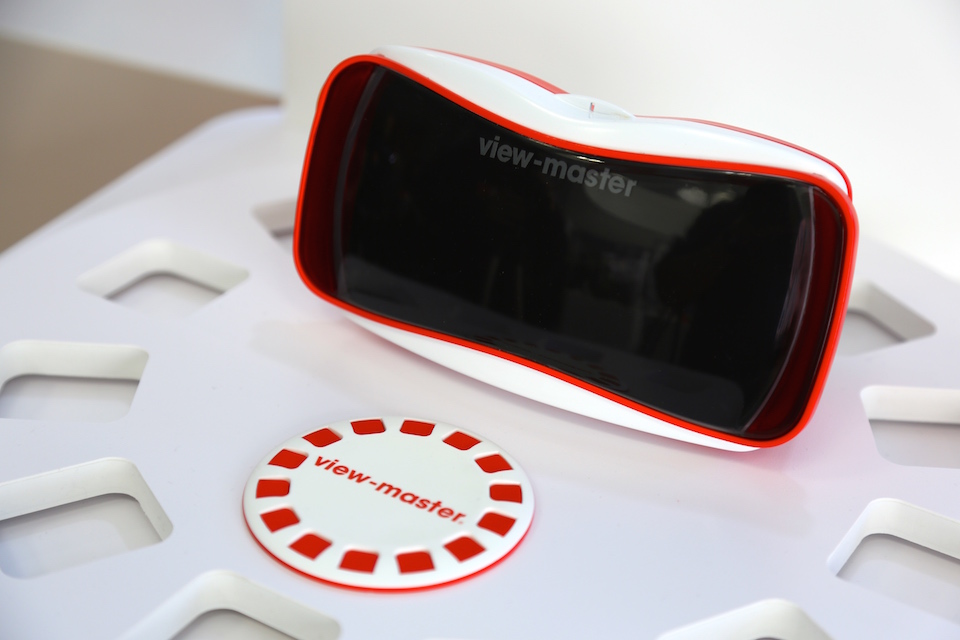
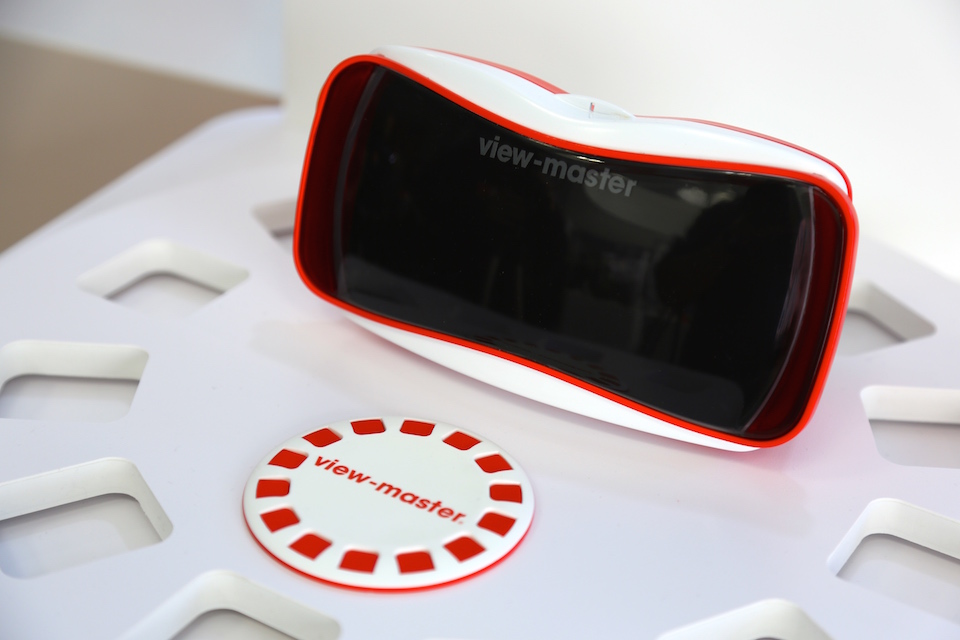
I may not be the best candidate for a virtual reality demo. My glasses always get in the way, and even straight 3D tends to make me dizzy. None-the-less, I had to try the new View-Master. Well, the new View-Master app, at least. Sadly, the plastic viewer itself is still very early in the production cycle, so there wasn’t a version ready to accept a phone and do a proper demo. But I was able to slot a Nexus into a Google Cardboard set up (stamped with a red View-Master logo) and get an idea of the experience Mattel is planning for October.
Mattel and Google’s View-Master hands-on
Basically it’s Street View in VR. That may seem a little simplistic, but it’s accurate. After you fire up the app and hold the viewer to your face you’ll be looking at the world through your smartphone camera. In the middle of your field of view you’ll see a little white dot. This is your cursor. If you have an “experience reel” you place it on the table in front of you, and putting the dot over the reel will pop up icons that let you choose different experiences or locations. Pull down on the shutter slider and you’re transported to a virtual world.
My first stop was San Francisco and I wouldn’t be shocked to learn if Mattel simply used Google’s Street View imagery. I was dropped on a corner not far from Fisherman’s Wharf; A green street car was frozen in the intersection. As I looked around, the scenery whizzing by in a 360-degree blur, I noticed an icon floating in the air that looked quite a bit like a View-Master reel. I looked at, pulled down on the shutter, and up popped a text box giving me some historical details on the bay area landmark. If I turned a little bit further, there was a second icon with some compass like markings. When I selected that I was transported a few blocks to the Wharf proper where there were other contextual icons that told me about the delicious Dungeness crab I could be enjoying if I was actually there, as opposed to New York City where the temperature is a balmy seven degrees (that’s Fahrenheit, not Celsius, by the way).
My second destination, the moon, was a little less impressive. The 3D rendering was simplistic, the textures flat and low-res. But it was interesting to be able to look at a spot and pull up an image of Neil Armstrong as he first set foot on the moon.
Since you’re holding the viewer to your face your hands and the imagery are stationary, it’s not nearly as immersive as an Oculus Rift, but it’s certainly fun. It gets pretty close to recreating the experience of looking through a View-Master, and I’m sure kids will be impressed by their ability to simply look at a landmark and learn about it. I, on the other hand, suffered the same fate I always do when I have to remove my glasses to strap on a VR headset — two minutes in and I was too dizzy to stand still. At least I have until October to get some new contacts.
HARRISBURG — Floyd Stokes grew up in rural Mississippi and found out early on that learning to read was going to be an important part of his life as he got older.
“I was surrounded by a lot of people who couldn’t read,” Stokes said. “I saw the struggles.”
He says reading is the foundation of a quality education. He has read to more that 150,000 kids in the past 10 years, and his message is always the same.
“You can’t function in society if you can’t read. Some people are able to hide it, but the truth is you are better off with an education than without,” he said.
Stokes brought the 500 Men Reading effort to the region. He says it started out with 100 volunteers, but continued to grow.
He said as more men signed up over the years, it forced him to approach more school districts because he was running out of space. He approached the non-profit American Literacy Corporation to continue his work helping kids learn to read. He visited students in 25 states in 2014.
Stokes said nearly three out of 10 children of color in fourth grade in Pennsylvania are reading below level. He says getting an early start can help turn the tide.
“We focus on the younger kids to give them the love of reading, so that when they are learning to read, they are enjoying the process of reading and they are enjoying books,” he said.
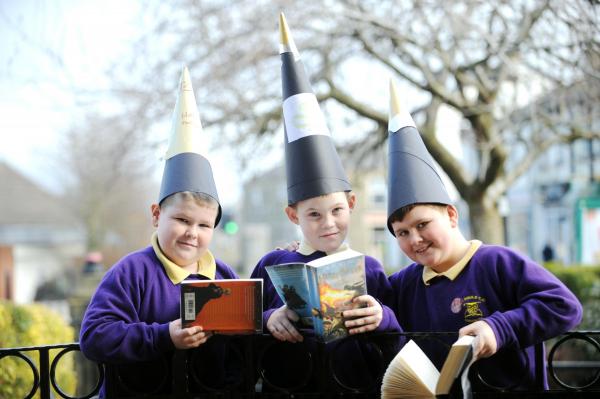
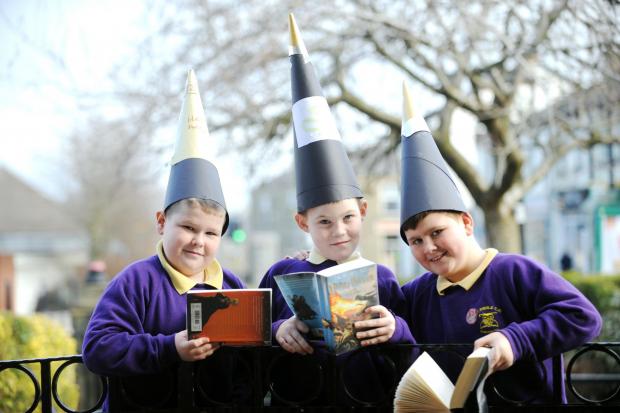
Jake Singleton, 10, Tom Young, 10, and Leo Lee, 11
YOUNGSTERS were treated to a spellbinding morning in Oswaldtwistle as part of the first ever national Harry Potter Day.
Budding wizards and witches from St Paul’s CE Primary School took part in the event at the town’s library in Union Road.
The Year 6 children took part in a specially organised treasure hunt as well as being given the chance to design and make their own magical hat.
Members of the library’s reading group read extracts from the series’ first book, Harry Potter and the Philosopher’s Stone, to the 17-strong audience.
The morning was finished off with a Harry Potter-themed quiz before the pupils headed back for afternoon lessons.
Abdul Kaeratkar, the library’s manager, said: “It was a fantastic event, all the children had a great time.
“They had fun making their own hats and there were some very creative designs and finished products. It was the first Harry Potter-themed event we have done and it was a real success.
“We will definitely hold it again next year bigger and better, and maybe get another school to attend so that more children can enjoy the experience.
“I think that the event has inspired those who did not already read to do just that and we also had a few of them who were not already members to join the library as well which was great.”