Book publishing and physics don’t seem to have much in common at first glance. I’ve written several books, but the first time I achieved commercial success was because I had applied lessons learned in my work as an optical engineer at GE Global Research to the publishing process.
When I embarked on this project, I hoped it would be a teaching opportunity for my son about setting goals, trying something hard, and taking a risk. I set a goal of not getting pessimistic about finding an agent until I had received 100 rejections. My son and I joke about how I crushed that goal – I received over 150 rejections before I stopped trying to get an agent.
Rather than quitting when I found that no agent would talk to me, I chose to self-publish my book. Initially I saw very poor sales, in fact depressingly poor sales, and realized that the challenge of publishing a book is more than having a good idea and being able to write well.
Where’s Waldo
I discovered I was missing the “secret formula” in the book publishing business, that is, how do you get noticed when there are 4 million books on Amazon. My book was like Waldo from the popular picture books, hidden among millions of look-alikes while striving to be noticed. I knew that if it could be found, my book would be successful: I chose to write a story about Minecraft and the audience was desperate for any fiction in this space. In fact, when I self-published my first book in 2013, there were only three other fiction books about Minecraft available on Amazon. Two of them were by young kids and only 20 pages long. While the third book did sell some copies, it was not marketed well to the target audience.
Before I wrote my book, I did market analysis and studied the demographics. I looked at other books in my market demographic (kids ages 7 – 13) and tried to identify what made the successful books really successful and what made the mediocre book really average, and then I extended these learnings to the book that I wanted to write. I treated this like a typical GE project and did my homework. As a result, when kids started to read my book, it seemed to resonate with them because it was similar to books that were already out in the marketplace. Once word of mouth started to get going, coupled with the marketing I was doing online, things exploded and the book reached No. 30 on Amazon’s top 100. As of the first week of February 2015, it had climbed to No. 9 on the New York Times Bestseller’s list for children’s series.
Marketing my book to its intended audience is not unlike the way researchers at GE Global Research have to differentiate themselves so that their skills will be in demand and they will always be able to get research funding. That means having a product that everyone will want that allows you to stand out among all the rest. Once that marketing is done within GRC, then it needs to be done within the GE businesses so that people who control funds will listen to you and take your calls.
The 24-year-old star was keen for everyone to see exactly what Matthew Lewis looks like nowadays – and it’s worlds away from his Harry Potter character Neville Longbottom.
Matthew, 25, is all grown up now and according to many Twitter users, he has blossomed into a rather handsome young man.
Emma posted a photo of him dressed as a soldier in new BBC3 show Bluestone 42, and was full of praise for her former co-star.
“He looks very serious here but is hilarious in #Bluestone42. Watch @Mattdavelewis on @BBCthree Monday@10pm. So Good!!” she wrote alongside the picture.
Emma sent her female fans into a frenzy when she tweeted this grown up photo of the actor
Emma was immediately inundated with replies, mainly from females, who couldn’t believe how different the actor looked as an adult.
Matthew began trending on the social network site as plenty of women gushed over his good looks.
“Who’d have ever thought Neville Longbottom would get fitter than Harry Potter??!!” one user posted, while another wrote: “Still not over how well Neville Longbottom blossomed.”
Emma is clearly very fond of the actor – who starred alongside her and Daniel Radcliffe in all of the Harry Potter films.
Matthew plays Corporal Gordon “Towerblock” House in Bluestone 42, which is a comedy drama series about a British bomb disposal detachment in Afghanistan during Operation Herrick.
Matthew has certainly grown up since his days of playing Neville Longbottom
During an interview on ITV’s Lorraine last week, Matthew revealed that he tries to see his Harry Potter co-stars as often as he can.
“We try and play a bit of cricket in summer together, in August time, we do it for charity. It’s Gryffindor versus Slytherin, I was on Gryffindor obviously, I think we’re winning like 3-1 or 4-1, we usually win,” he said.
Matthew went on to admit he and the rest of the cast developed very close friendships while making the movies based on J.K. Rowling’s book series.
“I got the role at ten, we started filming when I was 11 and at the last premiere I was 21, so it was about ten years of my life,” he explained.
“I’ve been so fortunate being involved in a project like that. I was a huge fan of the books and then to work with the acting talent on those movies was a real privilege for me.”
CALEDONIA – Liberty Elementary School students met some elves, frogs and a storytelling spider Tuesday at Literacy Night — all in the form of storybook characters.
Local authors and agencies filled the school, even after a snow day, for a night dedicated to encouraging families to read together.
Students also picked up free books donated by the United Way and the Let’s Read 20 initiative. Iron Man, Spiderman, Phineas and Ferb, Minnie Mouse and other well-known faces adorned the covers.
Mike Ring, director of the initiative, encouraged every parent to read for at least 20 minutes a day to their children.
He said 36.7 percent of 3- and 4-year-olds in the county are in preschool — under the state and national average. He said reading at home and getting kids into school are two ways parents can make them “lifelong learners.”
“Folks wait until their kids are in schools,” he said. “It can’t wait.”
This was just one of many events Ring and his team are attending this year in Marion County. He said Let’s Read 20 has already given away over 33,000 books at various events in 2015.
“It’s not just about books; it’s about creating community partnerships,” he said.
Lynn Bailey, a reading tutor and president of the PTO, said she always makes time to read to her kids.
“I will stop the world if they say, ‘Mom, can you read this to me?’” she said.
Bailey said some students she tutors think reading is boring. Part of Literacy Night, she said, was helping kids realize reading can be fun.
“You need to take the schoolwork aspect out of it,” she said.
Before Literacy Night, students worked on stories with an “Into the Woods” theme; author Shary Williamson chose the best story from each grade level.
The Waldo-based Bender & Bender team and author Janet Sedlacek of Cardington also shared ways to make storytelling fun.
Research shows students who read 20 minutes each day have a better vocabulary and score higher on national testing.
Okay so everyone always thinks that Harry Potter should have done this and that before his story concluded. Many thought that the ending wasn’t amazing. But what if he had never been a wizard to begin with?
If I had saw this ending, after all the adventures, happy times, and bad times I experienced with Harry, I think I would’ve cried. So remember, it could have been worse!
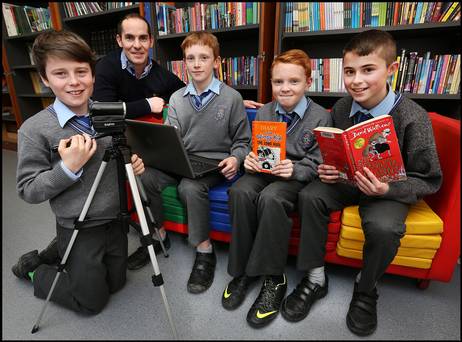
It is an innovative way to encourage children to read. Irish primary schoolchildren are becoming book-show presenters and are posting reviews of their favorite novels online.
At the website of the FÍS book club (FÍSbookclub.ie), there are videos from schools across the country where children discuss books from the Hunger Games to Diary of a Wimpy Kid.
One of the children, Matthew, talks to camera in glowing terms about the Hunger Games, telling viewers about how two characters fight each other to the death.
In sixth class at Star of the Sea Boys School in Dublin, the pupils are keen to make their videos.
Teacher Kevin Munnelly says: “It is a great way to motivate children to read. The lads find it fascinating.
“Some of them might be nervous initially, but then they become much more comfortable in front of the camera. They learn so much from presenting their videos”
The teacher asks the pupils what they want to read, and he often orders the books from the local library.
“I usually give them two or three weeks to read the book. I give them some questions to answer and they record their video.
“They talk about characters in the book and what excited them without giving away too much of the story.”
The book club is part of the Films in School (FÍS) initiative, managed by the Institute of Art Design and Technology (IADT) in Dun Laoghaire and the Department of Education’s Technology in Education service.
Ryan Tubridy recently launched the online book club at Lexicon, the new Dun Laoghaire library.
Brianog Brady Dawson, a learning support teacher at Holy Trinity School in Leopardstown, Co Dublin, says the book club has had a positive effect.
“Kids love to talk and share their recommendations and this marries their love of technology with an interest in books.”
The recording of the videos is now a simple process. Typically they can be recorded on a laptop, an iPod touch, or a smartphone.
Some children present their reviews straight to camera, but Brianog Brady Dawson also tries different approaches.
“I might have one of the children interviewing another, or two children just having a conversation about a book.”
“This not only develops a love of reading, it also encourages co-operation. They have to plan what they are going to present to camera.
“They reflect on what they have read and it improves communication skills.”
The FÍS book club is one of a number of initiatives supporting the national literacy strategy.
Grammarians who wring their hands and allege falling standards of literacy in the age of the internet will have to think again. Test scores for reading among Irish primary school pupils are actually improving.
For years there have been fears that the dominance of digital technology was damaging literacy, but the latest research shows that standards are rising.
Recent research by the Educational Research Centre in Dublin shows that performance in reading is significantly higher than in 2009.
There has been a drop from 35pc to 22pc in the proportion of children in second class whose reading is at the lowest level, and an increase from 35pc to 45pc in high performers.
Eemer Eivers, from the Educational Research Centre, says there’s been a greater concentration on literacy and numeracy in schools in recent years.
She says the use of technology by children is not having a damaging effect on literacy.
“If you are reading online, you are still reading, and these skills are transferable,” says Ms Eivers.