ST. JOSEPH – “That’s the best bedtime of the month, the day they get their Imagination Library book.”
Jessica Johnson clearly remembers the comment.
It’s from a parent whose child was enrolled in the Dolly Parton’s Imagination Library program.
The program distributes age-appropriate books to kids from birth to age 5 to promote literacy, and it will distribute its 1 millionth book this month.
Johnson is the marketing and communications manager for United Way of Central Minnesota, which has made Imagination Library one of its best-known programs. The local program — the 13th-largest in the world — is in its 10th year.
Dolly Parton even recorded a congratulatory message to participants, organizers and donors.
On Thursday, organizers traveled to St. Joseph to celebrate the milestone, following a book from post office to a waiting family.
St. Joseph Postmaster Tony Terwey is also the father of four kids, ages 3 through 8, who participated in the program.
He said the program is important because it fosters a love of reading and stories in kids, something he witnessed firsthand.
“It’s fun to see the excitement,” he said about kids receiving their packages.
Terwey estimates the St. Joseph post office sees close to 200 book packages a month.
“It’s far more reaching than someone just making a donation to the United Way,” he said. “It makes a greater impact than is known.”
The program is free for any child and doesn’t have any income requirements. Each child can be signed up individually.
If enrolled at birth, a child will get 60 books by the time they enter kindergarten — from “The Little Engine That Could” to “Look Out Kindergarten Here I Come.”
“If we can get kids inspired to read, and they learn to love to read, they’re better off in school, better prepared for kindergarten,” Johnson said. United Way hopes that sets up kids to be successful later in life.
Story continues below.
The books arrive in the mail, addressed to the child, something that gives the child pride of ownership.
And the books have reading tips for parents, which encourage literacy, comprehension and creativity.
Imagination Library selects the books, which can sometimes get a family outside its comfort zone. A child might receive a book the family wouldn’t have bought for the child and ends up loving it.
•Since the program began in February 2005, more than 28,000 local children have received free books. That’s equal to the populations of Sartell and Sauk Rapids combined.
•United Way of Central Minnesota is the 13th largest of 1,400Imagination Library affiliates across the United States, Canada, United Kingdom and Australia.
•The program currently costs our local United Way more than $200,000 per year, or about $30 per child enrolled. It’s funded by individual donations, grants, foundations, corporate sponsorships and special event fundraising.
•A recent study from local Imagination Library parents said 94 percent of parents noted their children asked to be read to more because of the program.
•83 percent of local Imagination Library parents agreed they read more to their children because of the program.
•66 percent of age-eligible children are enrolled in the program locally.
•The total number of children enrolled in 2014 was 10,475, or enough for 140 full-size school buses.
•85 percent of brain development happens before age 3.
•If enrolled at birth, a child receives 60 free books.
•At 1 million, the program has mailed more books than the Great River Regional Library’s 32 locations have in circulation.
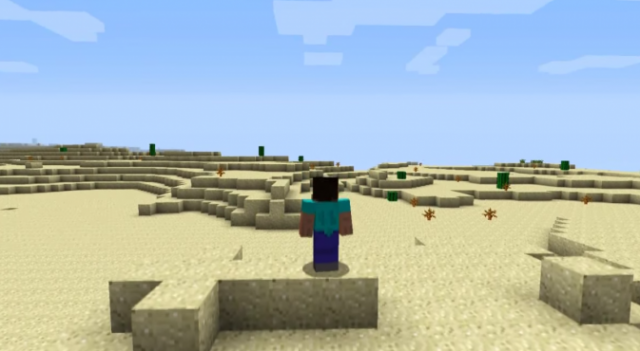
It turns out that for the past two years, you could crash a Minecraft server pretty easily. A security researcher published the exploit Thursday and said he first discovered it in version 1.6.2 back in July 2013, which is almost two years ago. He claims Mojang ignored him and did nothing to fix the problem, despite his repeated attempts at following standard protocol and contacting the company in private.
“This vulnerability exists on almost all previous and current minecraft versions as of 1.8.3; the packets used as attack vectors are the 0x08: Block Placement Packet and 0x10: Creative Inventory Action,” Ammar Askar wrote. The exploit takes advantage of the way a Minecraft server decompresses and parses data, and causes it to generate “several million Java objects including ArrayLists,” running out of memory and pegging CPU load in the process.
“The fix for this vulnerability isn’t exactly that hard, [as] the client should never really send a data structure as complex as NBT of arbitrary size and if it must, some form of recursion and size limits should be implemented. These were the fixes that I recommended to Mojang 2 years ago.” Askar posted a proof of concept of the exploit to GitHub that he says has been tested with Python 2.7. Askar has since updated his blog post twice after finally making contact with Mojang. What he says essentially confirms that the company either didn’t test a claimed fix against his proof of concept, or lied about having one in the first place.
Today, it looks like Mojang has responded (at least indirectly) to the post with a patch. The company announced today that it is releasing version 1.8.4: “This release fixes a few reported security issues, in addition to some other minor bug fixes & performance tweaks.”
The release notes make no direct mention of the exploit Askar wrote about, and comments are closed on the post. But notably, two of the fixes listed are Bug MC-79079, “Malicious clients can force a server to freeze,” and Bug MC-79612, “Malicious clients can force a server to go out memory [sic]:”
At the time of this writing, Askar has yet to update his blog post a third time acknowledging the patch and/or commenting on whether it fixes the exploit.
Back in September, Microsoft announced it was buying Mojang for $2.5 billion, with company founder Notch moving on something new. The game is available on all major platforms, including PC, Mac, PS3, PS4, Xbox 360, Xbox One, iOS, Android, Windows Phone, and Amazon Kindle Fire.
However, with the current focus on tests and scores even at pre-K, kindergarten and first-grade levels, the tendency is to care more about ability than enjoyment.
The truth is, for most part, they are coupled together.
As former classroom teachers, we recognize how reading for pleasure builds not only reading skills but also leads to personal development. Our research has only confirmed this belief.
Children are not reading for pleasure
We know a large number of kids are unable to reach the basic proficiency level in reading.
Pressures of testing have not helped. Instead, they have taken the joy out of reading.
Over the last 13 years, there has been an increase in the number of states that have enacted legislation on retention (or holding back a year) policies for students who do not meet literacy standards, with 32 states and Washington DC now requiring reading tests in elementary school.
Such pressures haven’t quite helped improve learning. In fact, parents report high anxiety and nervousness levels in their children as a result of testing. These pressures have an impact on teaching as well.
Teachers have been found to teach to the tests, foregoing development of reading comprehension and more holistic reading habits.
Reading for pleasure could actually make a difference. Evidence suggests that kids who are highly engaged with books perform better on school measures, because they learn to enjoy reading.
Make reading a fun, social activity
So, how could we get our kids to enjoy reading?
Here are some ideas based on our survey of reading research on how to get started with young children, new readers and even experienced but disengaged readers.
Making reading a social activity can also help engage young readers. So read with other family members, such as older siblings.
Young readers also enjoy reading the same stories over and over, and referring to characters during the day helps to build connections and literate lives.
For new or disengaged readers, a good place to start is by reading to them at least as much as they read to you.
When they are reading to you, remember that reading aloud at home should be about pleasure rather than accuracy; don’t correct more than a couple of words as they read.
You may also want to make space for them to tell you stories from the pictures; that is an important reading skill too.
Like with young readers, read favorite books over and over again. Repeated readings help readers recognize words quickly and automatically.
Find urgent reasons for reading, like signs, recipes, or directions for putting a toy together.
Remember, all books are good books, even if they don’t seem sophisticated. Kids will get bored and move on eventually.
Work towards reading for pleasure
When children are not reading as might be expected for their grade, it can be really hard on their confidence and identities as readers. It might also lead to concern amongst parents about their child.
In a society that is increasingly being built on an idea-driven economy, at least paying attention and working towards enjoyment and pleasure of reading – not just the ability to read – may help in other areas of social and school life.
So, make reading about enjoyment, not about the technicalities of testing.
One day, you’ll need to speak to children about the birds and bees. We list a few good books that might help out.
Scarborough Mirror
As a parent it seems there will come a day when your little one will ask the question: where do babies come from? Naturally, when the stork answer will no longer pacify your curious youngster it may be time to turn to a few resources to further your child’s education.
1. It’s Not the Stork!: A Book About Girls, Boys, Babies, Bodies, Families and Friends by Robie H. Harris, illustrated by Michael Emberley
2. Mommy Laid an Egg: Or, Where Do Babies Come from? by Babette Cole
3. The Boys Body Book: Everything You Need to Know for Growing Up YOU by Kelli Dunham and Steve Björkman
4. Who Has What?: All About Girls’ Bodies and Boys’ Bodies (Let’s Talk about You and Me) by Robie H. Harris and Nadine Bernard Westcott
5. Amazing You!: Getting Smart About Your Private Parts by Gail Saltz and Lynne Avril Cravath
6. It’s Perfectly Normal: Changing Bodies, Growing Up, Sex, and Sexual Health (The Family Library) by Robie H. Harris and Michael Emberley
7. What’s the Big Secret?: Talking about Sex with Girls and Boys by Laurie Krasny Brown (Author), Marc Brown (Illustrator)
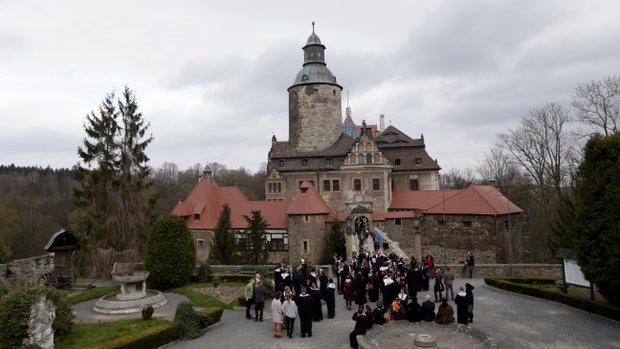
In this picture taken on Thursday, April 16, 2015, participants gather to receive instructions prior to their Harry Potter inspired role playing game at the Czocha Castle, in Sucha, southwestern Poland. Some 140 enthusiasts coming from 50 countries and places as far-away as the United States will live the life of students and professors at the College of Wizardry for four days at the 13th century castle. (AP Photo/Petr David Josek) The Associated Press
In this picture taken on Thursday, April 16, 2015, Elge Larsson, playing headmaster Arrok Trantiforus sits in a library prior to the Harry Potter inspired role playing game at the Czocha Castle, in Sucha, southwestern Poland. Some 140 enthusiasts coming from 50 countries and places as far-away as the United States will live the life of students and professors at the College of Wizardry for four days at the 13th century castle. (AP Photo/Petr David Josek)The Associated PressIn this picture taken on Thursday, April 16, 2015, participants walk through the castle prior to their Harry Potter inspired role playing game at the Czocha Castle, in Sucha, southwestern Poland. Some 140 enthusiasts coming from 50 countries and places as far-away as the United States will live the life of students and professors at the College of Wizardry for four days at the 13th century castle. (AP Photo/Petr David Josek)The Associated PressIn this picture taken on Thursday, April 16, 2015, participants are welcomed prior to their Harry Potter inspired role playing game at the Czocha Castle, in Sucha, southwestern Poland. Some 140 enthusiasts coming from 50 countries and places as far-away as the United States will live the life of students and professors at the College of Wizardry for four days at the 13th century castle. (AP Photo/Petr David Josek)The Associated PressIn this picture taken on Thursday, April 16, 2015, participants prepare for their Harry Potter inspired role playing game at the Czocha Castle, in Sucha, southwestern Poland. Some 140 enthusiasts coming from 50 countries and places as far-away as the United States will live the life of students and professors at the College of Wizardry for four days at the 13th century castle. (AP Photo/Petr David Josek)The Associated PressIn this picture taken on Thursday, April 16, 2015, Elge Larsson, playing the headmaster Arrok Trantiforus, left, talks to Dominik Dembinsky, right, to the start of their Harry Potter inspired role playing game at the Czocha Castle, in Sucha, southwestern Poland. Some 140 enthusiasts coming from 50 countries and places as far-away as the United States will live the life of students and professors at the College of Wizardry for four days at the 13th century castle. (AP Photo/Petr David Josek)The Associated PressIn this picture taken on Thursday, April 16, 2015, participants gather to receive instructions prior to their Harry Potter inspired role playing game at the Czocha Castle, in Sucha, southwestern Poland. Some 140 enthusiasts coming from 50 countries and places as far-away as the United States will live the life of students and professors at the College of Wizardry for four days at the 13th century castle. (AP Photo/Petr David Josek)The Associated PressIn this picture taken on Thursday, April 16, 2015, participants listen to instructions prior to their Harry Potter inspired role playing game at the Czocha Castle, in Sucha, southwestern Poland. Some 140 enthusiasts coming from 50 countries and places as far-away as the United States will live the life of students and professors at the College of Wizardry for four days at the 13th century castle. (AP Photo/Petr David Josek)The Associated PressIn this picture taken on Thursday, April 16, 2015, a participant listens to instructions prior to their Harry Potter inspired role playing game at the Czocha Castle, in Sucha, southwestern Poland. Some 140 enthusiasts coming from 50 countries and places as far-away as the United States will live the life of students and professors at the College of Wizardry for four days at the 13th century castle. (AP Photo/Petr David Josek)The Associated PressIn this picture taken on Thursday, April 16, 2015, participants walk across a bridge prior to their Harry Potter inspired role playing game at the Czocha Castle, in Sucha, southwestern Poland. Some 140 enthusiasts coming from 50 countries and places as far-away as the United States will live the life of students and professors at the College of Wizardry for four days at the 13th century castle. (AP Photo/Petr David Josek)The Associated PressIn this picture taken on Thursday, April 16, 2015, participants gather to receive instructions prior to their Harry Potter inspired role playing game at the Czocha Castle, in Sucha, southwestern Poland. Some 140 enthusiasts coming from 50 countries and places as far-away as the United States will live the life of students and professors at the College of Wizardry for four days at the 13th century castle. (AP Photo/Petr David Josek)The Associated Press
SUCHA, Poland (AP) — At a 13th-century castle in Poland, wizards and witches are sneaking through the halls and stone staircases of the College of Wizardry that opened this weekend for Harry Potter’s devotees.
In their magic cloaks and wielding wands, some 140 wizardry fans from Europe and the U.S. are studying witchcraft and potions in the live action role-playing game at the Hogwarts-like Czocha Castle in southwestern Poland.
From Thursday to Sunday, participants will live an academic life similar to that of the students and professors of Hogwarts, enacting an original scenario inspired by J.K. Rowlings’ saga about the young wizard.
However, the game — the third such one held here since November — does not follow the book’s characters or story line, and organizers stress it is not connected to the Potter franchise.
“I always wanted to be able to create living worlds, like book writers do or film actors,” said Dominik Dembinski of Polish group Liveform, which organized the event along with Denmark’s Rollespilsakademiet, which translates as Role Playing Academy. He added that he wanted the participants to “have some influence over it.”
“You want to be a part of this feeling” in this “simulation of a world,” he said.
Ahead of the game, the castle’s dining halls were hung with colorful banners, the tables laid with white cloths for collective meals. Secret passage ways were opened, leading to classrooms, laboratories and to other mysterious places. The participants were practicing their roles, mixing “potions” and testing their wands.
“My strategy is to put the independence of (the) college before anything else, “said Elge Larsson of Norway, as he was getting into his role of Headmaster Arrok Trantiforus. “I am afraid we will have some interference from the Polish Ministry of Magic. I will fight them nail and tooth.”
All made their way beneath archways and into the courtyard, where they received game instructions from tactics of combat to safety.
“When the character starts living in the flesh … and you have no idea where you are coming or where you are ending up, nothing beats it,” Larsson said.
Similar games inspired by the British TV series “Downton Abbey” and the legend of Robin Hood are planned this year.