Igniting a passion for technology is the goal of Connected Camps’ online summer camps in coding, game design, architecture, engineering, and survival mode in Minecraft.
The weeklong virtual camps, priced from $69 to $99, commence June 26. There are 30 online camps to choose from, including girls-only options.
“We offer the fun hands-on projects, and cool counselors that you get at a tech camp, but in an online format that is much more affordable and accessible,” said Mimi Ito, Connected Camps co-founder. “We give kids a STEM learning experience at a tenth of the cost of the more traditional summer camps. The online format also means that kids can keep in touch with their new friends and counselors and keep working on projects even after the one-week camps. And, we run a free, moderated Minecraft server that kids can connect to year-round to continue their learning.”
It can be hard for parents to find tech camps that are affordable, work with their kids’ busy schedules and tap into a passion for all things Minecraft, added Katie Salen, Connected Camps co-founder.
“The best way for kids to develop tech skills and interests is through fun and challenging projects with peers and mentors they feel connected with. We run camps that meet kids where they are, catering to interests in games, exploration, and design, as well as girls-only camps.” Salen said. “Connected Camps draws on over a decade of research on STEM learning and online education.”
Campers, ages 8-13, can connect from the convenience of home, and learn in small groups from expert counselors who are passionate about topics like coding, game design, and creative building. Campers learn by doing, creating projects like race courses, cities, automated machines, mazes, and more. All campers receive a personal certificate of completion from their counselor, and can continue learning on the free Kid Club server with counselor-led building and survival challenges, mini games, and clubs for various interests.
“We think of Minecraft as more than just a game,” said Tara Tiger Brown, Connected Camps co-founder. “To us, it is a flexible, design-friendly environment that not only lets the imaginations of kids run wild, but also teaches them about problem solving, programming, and getting along with others.”
Those who purchase one camp are offered a 20% discount on all other camps. In addition, Connected Camps will be giving away a free Piper computer kit — a computer that kids assemble themselves and runs the Raspberry Pi Edition of Minecraft Story — to one lucky camper, who registers by March 19 this year.
To register for camps, enter the giveaway, or for more information, visit connectedcamps.com.
About Connected Camps Connected Camps is a benefit corporation providing connected learning experiences that foster creativity, problem solving, collaboration and interest-driven learning. Its mission is to build a global online community where kids build, code, play, and learn from one another. Tapping the power of youth tech experts to teach and mentor, Connected Camps has served thousands of kids through its online and community-based programs. Connected Camps is a member of the Connected Learning Alliance, which supports the expansion and influence of a network of educators, experts and youth-serving organizations mobilizing new technology in the service of equity, access and opportunity for all young people.
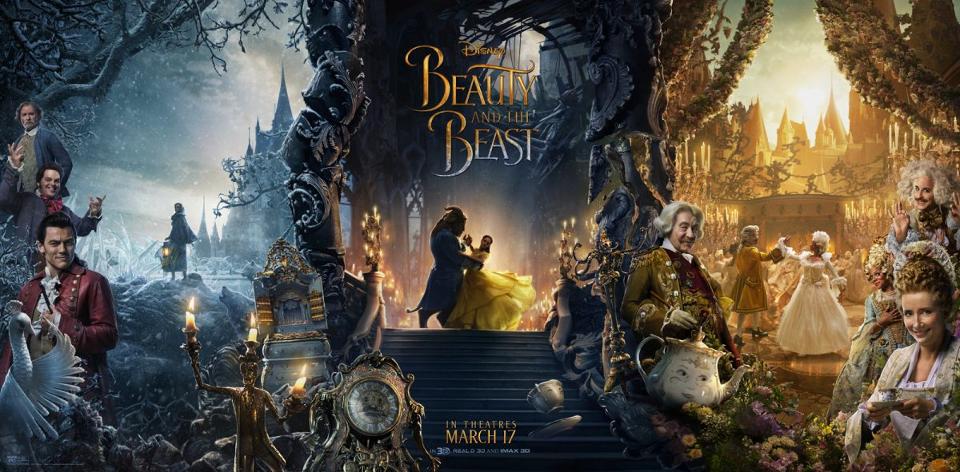
Josh Gad, who plays LeFou in Disney’s new live-action Beauty and the Beast, is speaking out about the controversy surrounding the movie’s groundbreaking gay moment.
News of the gay character has caused a stir in recent days: In the new movie, LeFou has a crush on his pal, the handsome, self-absorbed villain Gaston (Fast & Furious star Luke Evans) — and LeFou has what Gad calls a “subtle but incredibly effective” scene during the film’s finale that hints at a happily ever after. Gad tells PEOPLE that the moment in the movie teaches an important lesson central to the theme of the film: “Never judging a book by its cover.”
“What I would say is that this film is one of inclusiveness,” the 36-year-old says. “It’s one that has something to offer everyone.”
“There is so much fear out there of that which we don’t understand that which we don’t know,” Gad tells PEOPLE.
“And you have a character in Gaston who uses his charm offensive to whip other people into a frenzy to go and attack somebody they’ve never met. Somebody that’s different. Somebody that only represents a danger because [Gaston] says that he represents a danger.”
He adds: “I think that that theme is as relevant today as it was when Beauty and the Beast was first written 300 years ago. So that’s what I hope people take from it.”
Evans weighed in on the controversy at the film’s premiere, saying, “It’s about unity, it’s about never judging a book by its cover.”
“But digging a little deeper and understanding to not be fearful of things you don’t know or people who look a little different to you.”
He added, “Fear is not a good thing to fuel, and Gaston is responsible for that. But he fails — he fails miserably, and everybody finds love. Everyone!”
We’ve all heard the one about the deer with no eyes, but what do you call a deer with no soul? In The Walking Dead‘s latest episode, ‘Say Yes’, Rick Grimes had his back against a fairground ride, surrounded by zombies, and to escape the situation, he decided to shoot a nearby deer as a fresh-meat distraction. Only problem was, that deer looked like it had wandered straight out of Minecraft.
The glossy cervid in question was at the nadir of uncanny valley. It didn’t catch the light in the right way; it didn’t cast a realistic shadow, it didn’t fit cleanly into the 3D space it was meant to be occupying. It looked about as convincing as Donkey in Shrek. The result is totally jarring, especially considering there was a real-life deer in the second season of The Walking Dead. By comparison, this seventh season seems to be having weird budgeting issues – a lot of money seems to have been spent on making the zombies look as awesome as possible; deer, not so much.
Twitter’s reaction was strong, and there were many pisstakes. Pisstakes like this one:
The Disney “live-action” remakes, of which the new “Beauty and the Beast” is but one in an assembly line, are starting to resemble an iPhone software update. Click a button and that old cartoon interface changes Belle into Emma Watson, the Beast into Dan Stevens and maybe fixes a few bugs in the system.
“Beauty and the Beast,” that “tale as old as time” (or, to pinpoint it, 1740, when the French fairy tale was published), could certainly use a few tweaks. It is, after all, a fable about finding beauty within that ends, curiously, with the once superficial prince falling for a beautiful woman he’s kidnapped, whose name literally means beauty. If you’d like to untangle those ironies, please, be our guest.
Director Bill Condon’s film _ let’s call it “Beauty and the Beast 2.0” _ often feels in search of a purpose beyond the all-but-certain dollar signs. Much of the live-action/digital effects makeover is less lifelike than the Oscar-winning 1991 animated film: It’s gained a dimension but lost a pulse. The merely fine acting and the lavish production design (the sumptuous sets nearly swallow the performers whole) dutifully strive to make this a worthy enterprise.
Opposites attract, of course. And this “Beauty and the Beast” is equal parts dispiriting and enchanting: overflowing in handsome craft, but missing a spirit inside. Howard Ashman and Alan Menken’s songs still have their infectious kick, but most of the big musical moments feel more like very good covers of the originals. (There are also three less-memorable new songs by Menken and Tim Rice.)
And yet “Beauty and the Beast” finds its own verve _ or, to quote Lumiere, “reason d’etre” _ late. Condon (the “Dreamgirls” director who, having helmed much of the “Twilight” saga, knows a thing or two about young love and monsters), working from a script by Stephen Chbosky and Evan Spiliotopoulos, has taken many of the old tale’s more cringe-worthy gender roles and mixed them up in the movie’s bright swirling medley.
Belle’s bookishness is more pronounced, thanks partly to the ‘Harry Potter’ credentials of Watson. Her performance is a little minor key, still, but Watson lends Belle an intelligence and agency that she has lacked. She’s less of a Stockholm syndrome Victim and more deserving of young girls’ admiration. And the Beast, a pile of horns, makeup and effects on top of the former ‘Downton Abbey’ star Stevens, is more haunted and melancholy.
But as the film nears its celebratory coda, a buoyant pluralism bursts forth. Characters _ large parts and small _ are freed from their prescribed roles in a glorious dance, shortly after Mrs. Potts (Emma Thompson), Cogsworth (Ian McKellen), Lumiere (Ewan McGregor) and the rest come to life. (Be sure to shake your living room and see which British star tumbles out of the furniture.) Here is where that already much discussed “gay moment,” as Condon has called it, arrives. It comes and goes in a flash
Josh Gad, the MVP of many a Disney movie, plays LeFou, the doting sidekick of the caddish Gaston (Luke Evans), the dopey pursuer of Belle’s hand. LeFou spends much of the movie hinting at his affection for his lecherous friend, but LeFou, too, earns a chance for redemption toward the end. That’s all it is _ an easy to miss suggestion that LeFou might find another love. And yet this slightest wink of homosexuality has drawn the ire of some who, it’s worth noting, raised no concerns over a romance between an imprisoned girl and a beast or, for that matter, a candelabra and a feather duster.
In fact, “Beauty and the Beast” would be better if it dared more such moments and went further with them. Nevertheless, the uproar suggests even this must count as progress. Perhaps we’ll be ready for a truly up-to-date ‘Beauty and the Beast 3.0’ in another few decades.
Yes, Disney has already given us live-action versions of animated films like Alice in Wonderland, Cinderella, Sleeping Beauty and The Jungle Book in recent years — and lest we forget, this isn’t a brand-new idea (101 Dalmatians!) — but in a way, Beauty and the Beast feels like the riskiest of them all so far, as far as potential backlash is concerned. Though now 26 years old, Beauty and the Beast is still much more recent than those other animated classics, and many can clearly remember growing up during the film’s initial release and explosion in popularity. Simply put, it has more of a “This movie is mine” feel among some fans, who could be quite upset if this new version isn’t handled well.
Fortunately, it’s handled very well indeed. Screenwriters Stephen Chbosky and Evan Spiliotopoulos and director Bill Condon have done a commendable job of taking the 1991 animated movie and delivering what fans want, while also offering enough tweaks to not feel like a note for note copy offering nothing new.
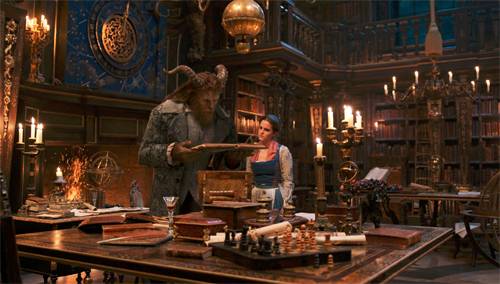
Let’s be clear though, you know exactly what to expect from the storyline here, in all the most meaningful ways. The Beast (Dan Stevens) is a vain, casually cruel prince punished by a curse that has transformed him into a monster, and Belle (Emma Watson) is the book-loving local girl looking for more than her small village can provide. And so begins some imprisonment, unexpected bonding moments, and a love story for the ages!
As a huge fan of the animated film, I felt a tremendous sense of relief simply watching the opening number, “Belle,” performed. Once you get past the “Hey, it’s Emma Watson dressed up like Belle!” aspect, it’s easy to simply sit back and enjoy a well executed, lively version of a great song, and realize this is a film made with a lot of love and care for the source material.
Beauty and the Beast is expertly cast, beginning with the title characters. Watson brings her innate intelligent, thoughtful nature to Belle (being typecast as a voracious reader isn’t the worst thing), while Stevens — balancing the tricky nature of a mo-cap, CG-enhanced performance — brings the right bitter, yet still soulful feel to the Beast. Though it should be said that while no fault of Stevens, but rather some questionable wig and costume choices, the character is amusingly goofier looking as the long-haired prince than as the Beast… but some would say that the same goes in the animated version.
Also integral to this story, of course, are the staff in the Beast’s castle, who have all been transformed into household items by the curse. It’s impossible to imagine Disney’s Beauty and the Beast without Lumiere, Cogsworth or Mrs. Potts, and with top notch digital effects and the voices of excellent actors like Ewan McGregor, Ian McKellan and Emma Thompson playing them, these characters vividly come to life, as do Madame de Garderobe (Audra McDonald), Chip (Nathan Mack), Plumette (Gugu Mbatha-Raw) and the newly-created Maestro Cadenza (Stanley Tucci), a composer transformed into a harpsichord.
The cast also includes Kevin Kline, giving a sweet, sympathetic performance as Belle’s father, Maurice – and while it’s easy to be amused by a character with what is basically an American accent (Kline sounds like he is slightly tweaking his usual accent) being the father to a girl with a British accent, while both of them are supposed to be French, just remember folks, this is musical featuring a singing candelabra. It can survive the additional heightened reality of varied accents.
Last but not least are Luke Evans and Josh Gad as Gaston and LeFou, who in many ways are the scene stealers in Beauty and the Beast. Thanks to Book of Mormon and Frozen, Gad is a proven commodity when it comes to musical-comedy and gives a wonderfully energetic performance here. Evans in the meantime is a big surprise, showing off much more wit than his work in films like The Hobbit trilogy, Fast & Furious 6 or Dracula Untold hinted at.
There’s been a lot of press recently about the decision to make LeFou gay in this version, and give him an obvious crush on Gaston – though it should be noted it’s more of a small subplot/character thread, on par with Lumiere and Plumette being in love, than a major part of the film. It’s a tweak that blends well with the established material/character and beyond that, LeFou does have a more notable arc than in the animated version, where he was simply Gaston’s toady.
There are other expansions and alterations from the animated film here as well, including learning more about both Belle and the Beast’s parents and how it helped shape who these two kindred spirits are. While the story’s fantastical elements can never make it feel truly “realistic,” these touches certainly help to ground and flesh out the characters in some key areas.
As for the musical numbers, they are by and large great, with Condon proving to be an excellent choice to guide the film. The director’s eclectic career includes Gods and Monsters, Kinsey, a Candyman sequel and two Twilight sequels, but his work on two Academy Award-winning musicals, Chicago (which he wrote) and Dreamgirls (which he both wrote and directed), certainly serves him well here. The film is gorgeous to look at and the musical numbers are dynamic and involving, with many echoes of the animated film, but not feeling beholden to repeat every single bit of choreography. Small changes go beyond the visuals to the lyrics themselves, as purists should be warned there are some alternations from this songs you’ve sung along to for years, as this film makes use of a few lines written by the late Howard Ashman for the animated film that weren’t used at the time.
All the actors do solid to excellent work on the singing side. Watson, the one with the least musical theater background, isn’t likely to suddenly launch a second career as a pop singer, but still more than holds her own alongside Stevens, giving numbers like “Belle” and “Something There” plenty of emotion, as does Thompson with the title track. As for the crowd-pleasing “Be Our Guest,” any Moulin Rouge fan will love hearing McGregor belt out the tune and the number retains its inherent charm and fun – but it doesn’t quite hit the mark like it does in the animated version. It’s the one sequence where you feel the disconnect between Watson sitting there as a real person and all of the CG characters performing around her. The fact that they don’t truly feel like they’re occupying the same space stops it from completely gelling.
The showstopper instead is reserved for the aforementioned pairing of Evans and Gad, whose rousing rendition of the song “Gaston” thrills – and led to the biggest applause at the press screening I attended.
Unfortunately, the handful of new songs, written by Ashman’s collaborator Alan Menken alongside Tim Rice, are a bit on the lackluster side. While I did enjoy “”How Does a Moment Last Forever,” a short and poignant number performed by Kline, other new inclusions “Days in the Sun” and “Evermore” feel a bit uninspired and hard to recall after the fact.
The Verdict
While it doesn’t rise to the heights of last year’s tremendous version of The Jungle Book, Beauty and the Beast is far from the artistic misfire of Alice in Wonderland when it comes to Disney’s current love of turning their animated classics into live-action. Powered by Bill Condon’s direction and terrific performances from a game cast, it’s a lovely film that includes the elements fans of the animated classic would hope to see, while also introducing some new aspects that, by and large, effortlessly fit in with the original story’s framework and yet feel appropriate as far as both expanding and grounding the characters and their world.
And you’ll find it very hard to not go home humming or singing “Gaston.”