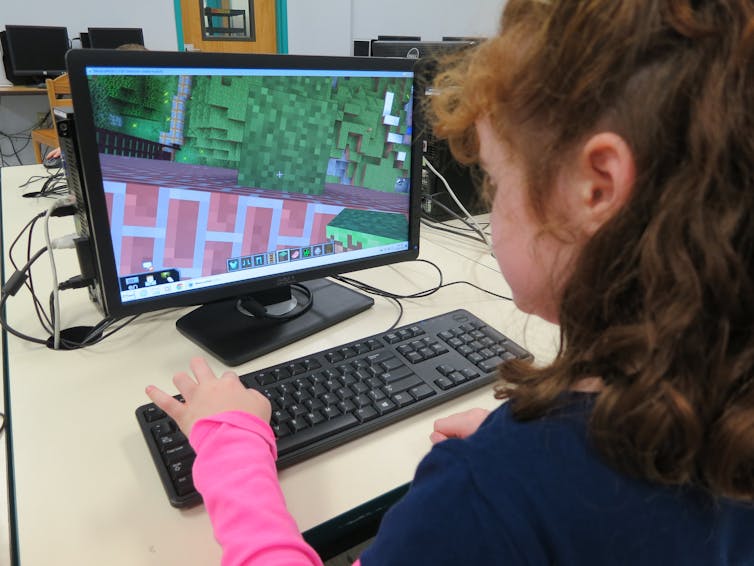
Arguments about “screen time” are likely to crop up in many households with children these holidays. As one of the best-selling digital games of all time, Minecraft will be a likely culprit.
Thankfully, more practical advice is on the way. We are starting to seeresearch that looks beyond the number of hours spent playing to more meaningful studies about what children are actually doing in their digital playtime.
Our research contributes to this by studying the characteristics of children’s Minecraft play in Australia, shedding light on how kids access the game, assessing the social nature of play, and providing a reality check on claims of gender-neutrality.
Understanding the Minecraft phenomenon
Minecraft is as much a digital playground as it is a digital game. The player controls a character within a virtual environment that can be manipulated in various ways, with varying degrees of difficulty. There is no definitive goal and players are free to create and direct their own playful interactions with the landscape and its inhabitants – either on their own or with other players.
The results show that 53% of children aged 6 to 8, and 68% of children aged 9 to 12, are actively playing Minecraft. More than half of those play more than once per week.
It is now clear that Minecraft is no passing fad, but rather a new addition to 21st-century play repertoires. It is crucial that we form a detailed understanding of how children use the game and how this fits in with their overall “play worlds”.
Minecraft is a social activity
Reflecting the rise of the tablet computer in children’s digital play, more than 70% of children aged 3 to 8 primarily play Minecraft on a tablet. This falls to 50% in children aged 9 to 12, with a corresponding increase in PC-based play where more technologically challenging play is possible.
Despite the persistent myth that digital game play is a solitary activity, 80% of children in our sample at times played Minecraft with someone else – including siblings, friends, parents, other relatives or other players online. And nearly half most often played with someone else.
Although there is evidence that co-play between parents and children is one of the more effective ways to maximise the benefits of digital play, only 11% of parents reported ever playing Minecraft with their children.
Minecraft is not gender-neutral
The game’s creator claims gender ‘doesn’t exist’ in Minecraft, but our results show significant differences in rates of Minecraft play in boys and girls.kjarrett/flickr
But our study shows that this does not appear to be reflected in actual player demographics.
We found that girls aged 3 to 12 are much less likely to play Minecraft than boys, with 54% of boys playing and only 32% of girls. This difference was greatest in younger children: 68% of boys aged six to eight in our study played Minecraft, but only 29% of girls.
What’s more, the players who most often play in the game’s more competitive “survival” mode are more likely to be boys. Girls are more likely to play in the game’s “creative” mode.
The research that supports campaigns like Let Toys Be Toys would suggest that this may be due to the broader marketing of digital games as “for boys”, even if Minecraft is for everyone.
The most striking gender difference was in relation to YouTube videos. While 32% of six to eight-year-old boys had watched Minecraft YouTube videos in the week prior to their parent taking the survey, only 9% of girls had. So not only is Minecraft play gendered, but so too is early immersion in the surrounding gamer culture.
Digital gaming can pave the way to careers in STEM
Children are increasingly required to bring iPads to school. The government (highlighting the benefits of STEM fields to the economy) casts the tech-savvy child a in central role in visions of “Australia’s future prosperity and competitiveness on the international stage”.
There is mountingevidence that Minecraft can be used to foster interest and skill in the kinds of areas that are relevant to STEM industry careers. And involvement with gamer culture is a likely inroad to interest in gaming and technological pursuits later on in life.
This is why the dominance of tablet play and the significant gender differences are so important. We need to look at why these differences exist and understand them in more detail.
It is only through this kind of information that we will be able to ask meaningful research questions and form advice for parents that maximises benefits of Minecraft play, while reducing any possible harms.
This work will ultimately mean that future advice is based more on the realities of children’s everyday practices and less on policing the clock.
In the meantime, we recommend checking out the “Parenting for a digital future” blog for practical tips on how to strike the right balance when it comes to managing screen time – including Minecraft play.
Since Minecraft was first released in 2009, players have been building their own virtual worlds, erecting countless, giant statues of Pikachu and posting semi-obnoxious Let’s Play videos on YouTube. You’d think that by now, we would have seen everything Minecraft has to offer, but some of the game’s most personal, heartfelt, and tragic stories remain buried on dead servers.
Minecraft player Matt B., whose Reddit username is “worldseed,” is data-mining old servers in search of players’ darkest secrets. (He spoke to us anonymously, saying that he preferred to keep his online and offline identities separate.) Matt wrote two programs in Java: BookReader.jar and SignReader.jar. These applications scan a Minecraft map for every book and sign left behind by players. They then dump all these messages into a text file that Matt can search for terms like “treasure.” Each log entry contains the exact in-game coordinates of the written document.
A few days ago, he founded the MinecraftDataMining subreddit and, so far, has enlisted around 30 volunteers in his efforts to dig up love letters, diaries, and bad high school poetry.
“A lot of the material is just cute little slice of life things,” Matt told Motherboard over Discord. “But it can be kind of depressing.”
Minecraft players can write anything they want on in-game books and signs. As expected, many of these notes are related to things players do in the game. There are recipes for healing potions and written notices that one player has intruded upon another player’s property. But occasionally Matt stumbles across something remarkable.
Discoveries range from the utterly bizarre, like the diary written from the perspective of a chicken found buried underground, to discarded documents of loneliness and grief. In one instance, Matt found what appears to be a player’s suicidal thoughts in a cave hidden below a house on a server that has been closed for five years.
“If I kill myself tonight: the stars will still disappear,” one of the signs read. “The sun will still come up, the Earth would still rotate, the seasons would change…”
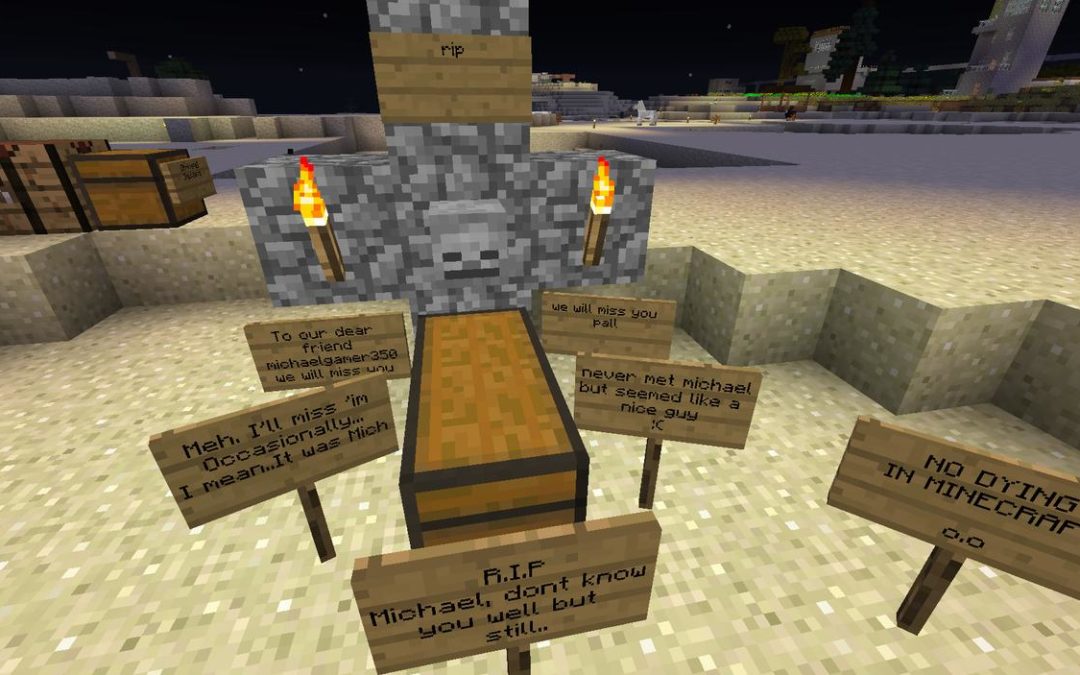
Another data mined sign led to what appears to be a memorial of a friend of a player who passed away. Matt was able to use the information from the monument to locate the person’s obituary. “RIP Charlie,” the signs read. “Student, Gamer, Friend…No one here knew him, but I will never forget.”
Not all the signs are so somber. One series tells the story of a missed connection. A player has stopped playing the game, only to return to find their online friend now away.
“I don’t think you guys are ever coming back… ~kat 11/10/15,” the sign reads.
“Hey, it’s Zmoney. Yeah. we’ve all stopped playing Minecraft :/,” another sign replies.
Matt’s data-mining efforts were inspired by an unsolved mystery from his days treasure-hunting in Minecraft. Around 2011, a player reportedly hid a treasure chest containing 64 diamonds somewhere on the Aperture Games Minecraft Server. But the chest never turned up, and the lore of unclaimed loot lingered in the back of his mind for the next seven years.
In hopes of finding the missing jewels, Matt wrote the two programs in Java.
When he went to the chest, someone had already raided it. Though half of the diamonds were gone, he had found something more valuable: all the written communication that remained on the server.
Minecraft is enormous, with each game map covering a surface area of four billion square kilometers. Because of the map’s sheer size, the majority of these correspondences might never have come to light otherwise. Matt said the excavation of a server can net anywhere from 20,000 to 450,000 written documents in the form of books and signs.
To pinpoint unconventional signage, Matt uses keyword searches for provocative terms such as “If you are reading this,” “Hate myself,” and “RIP.” If something catches his eye, he opens the server map and has a look around.
“I don’t mean to gawk or anything,” said Matt. “But if I hadn’t found this stuff, nobody would’ve ever seen it again.”
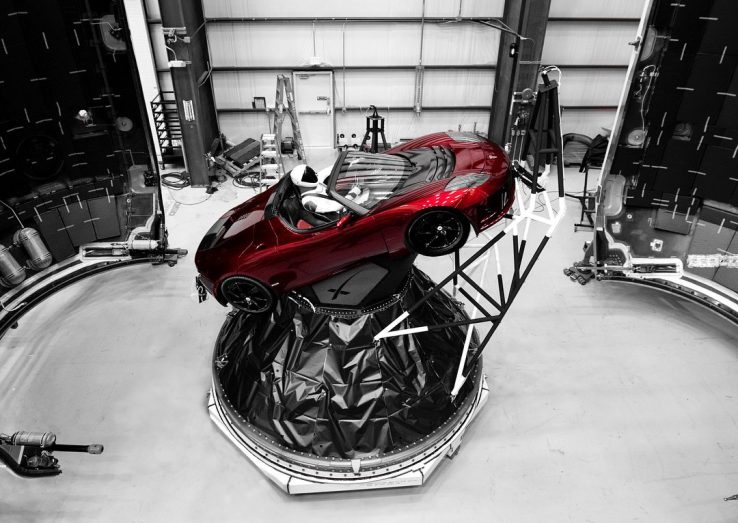
Elon Musk is in Florida getting ready for the launch of SpaceX’s Falcon Heavy rocket, the first-ever flight of the big new space freight beast. He’s making some final inspections of the cargo, it seems, including a new addition to the cherry red Tesla Roadster that’s going to be on board in the cargo area atop the rocket.
Said new addition is a dummy wearing one of SpaceX’s swanky new astronaut uniforms. Musk’s so-called “Starman” evokes the David Bowie tune that’s going to be playing on the Roadster when it’s launched, hopefully all the way up to space, during Falcon Heavy’s initial test mission on Tuesday at 1:30 PM ET.
SpaceX’s cargo for this one is easily among the most fun things ever put into space, and it’s both symbolic of how this helps Musk achieve his larger mission of reducing human ecological footprint on earth, while simultaneously making sure we can spread our wings and become a truly interplanetary species when the time comes, too.
We’re actually also in Cape Canaveral to witness and report on the historic launch, so stay tuned this week for updates as we near the momentous first journey of this gigantic orbital rocket.
Every consumer product goes through three stages of life. It’s invented; it’s improved and adjusted; and, finally, it becomes a commodity. There’s not a lot of innovation anymore in microwave ovens, ceiling fans, or toilets — they’ve pretty much stopped morphing. They’ve reached the third stage, their ultimate incarnations.
Drones, love ‘em or hate ‘em, are still in the second stage: They’re rapidly changing direction, gaining features, finding out what they want to be. It’s an exciting period in this category’s life, because new models come out fast, each better and more interesting than the last.
For proof, just look at the Chinese company DJI, the 800-pound gorilla of drones. It releases a new drone or two every single year.
They’ve just introduced a drone called the Mavic Air ($800). It’s so small and smart, it makes you wonder why anyone would buy the 2016 Mavic Pro, which costs $200 more — but it’s not what you’d call perfect.
View photos
The new Mavic Pro is incredibly tiny, stable, and lightweight.
Meet the Air
The 15-ounce Mavic Air is small — and that’s huge. It folds up for travel: its four arms collapse against the body to make the whole thing small enough to fit into a coat pocket, about 6.5 inches by 3.5 inches by 2 inches. (The top two arms swing horizontally, as you’d expect. The bottom two, though, are hinged in two dimensions: They fold downward and inward, and you have to remember to do those before you do the upper arms. You’ll figure it out.)
View photos
The Mavic Air’s arms fold up.
Of course, there are plenty of small drones — but not in this league. The Mavic Air, for example, can capture gorgeous 4K video. And its camera is on a three-axis gimbal for stabilization; the video looks like it was shot from a tripod even when the drone was being buffeted by 20 mph winds, as you can see in the video above.
The box includes the drone, a remote control (it uses your smartphone as its screen), a battery, a charger, a set of propeller guards for indoor flying, and a spare set of propellers (in crashes, they’re the first to go).
View photos
The Mavic Air comes with four propeller guards for indoor flight, 1 battery, a case, spare propellers and a charger.
The Mavic Air is also smarter than any sub-$1,000 drone DJI has ever made. It has depth-sensing cameras on three sides — forward, down, and backward (that’s new) — so that it can avoid collisions automatically in those directions.
Like most drones, this one has an automatic Return to Home feature that kicks in whenever the battery is getting low or if it loses the signal with the remote control. (You can also call it home with one button press whenever you’re just feeling anxious.) Thanks to the cameras underneath, this thing lands exactly where it took off — within a few inches.
The competitive landscape
The Mavic Air’s primary competition comes from two other DJI drones. Here’s the rundown:
Mavic Pro (2016 model, $1,000). Twice the size of the Air. Folding arms. 4K video. “27 minutes” of flight per charge (in the real world, 22 minutes). Front and bottom collision avoidance. Remote control included with built-in screen (no phone necessary). Very few palm control gestures (see below).
Mavic Air (2018 model, $800 — the new one). Folds up. 4K video. “21 minutes” per charge (more like 18). Front, bottom, and back collision avoidance. Remote control folds up tiny — even the joysticks unscrew and store inside the body, for even smaller packing. Has the most palm gestures of the three drones — and the most reliable palm gestures. 8 GB of internal storage for video and stills, so you can still record if you don’t have a micro SD card on you. Another $200 buys you a “Fly More” kit that includes two extra batteries, an ingenious folding four-battery charger, and even more spare props.
Spark (2017 model, $400). The smallest body of all, but its arms don’t fold, so it winds up being bigger for travel. 1080p video. “18 minutes” per charge (more like 11). Front and bottom collision avoidance. Remote control is an extra purchase ($120); uses your phone as a screen. Responds to hand gestures, but not reliably.
View photos
The Spark may look smaller than the Mavic Air, but remember that it doesn’t fold up.
True, the Mavic Pro gets a little more flight per battery. And there’s an even more expensive model, the $1,100 Mavic Pro Platinum, that gets “30” minutes per charge.
(Do those seem like incredibly short flights? Yup. But that’s drones for you. As it is, a modern drone is basically a flying frame designed to haul its own battery around.)
But in my book, the Air’s tiny size is far more important than the marginally greater battery life. As the old saying doesn’t go, “The best drone is the drone you have with you.”
View photos
Only the front “arms” have landing gear (the white thing), which fold up for travel.
In-flight entertainment
You can fly the Mavic Air in three ways.
First, you can use the included remote control. If you insert your smartphone into its grippers and connect the little cord, you get a number of perks — like actual joysticks, which make the drone much easier to fly than using the phone alone. The remote also has a dial at the outer corner for adjusting the camera’s tilt in flight, as well as a switch for Sport mode, which unlocks the drone’s top speed of 42 mph (by turning off the obstacle-avoidance features).
The remote also gives the drone a much greater range. It uses a Wi-Fi connection to the drone, instead of the proprietary radio connection of the Mavic Pro. DJI says that still gives you 2.4 miles of range, but I say baloney; even in the middle of the Texas desert, you’ll be lucky to get half that distance. It doesn’t really matter, though, since Federal Aviation Administration rules say you can’t fly a drone out of sight. (Speaking of the FAA: You don’t need a license to fly the Mavic Air as a hobby, but you do need to register the drone itself. And if you intend to fly it professionally — this means you, wedding videographers, filmmakers, construction firms, realtors, police, and farmers — you have to get permission from the FAA.)
The second way to fly the drone is using your smartphone. It works, but you get a much shorter range (about 250 feet), and it’s harder; DJI’s app has become one super-crowded, complex piece of software.
The third way: using hand gestures. The drone must be facing you at all times, and it has to remain pretty close to you, so this trick is primarily useful for positioning it for “dronies” (selfies from the air). Keep in mind that you also need the phone app with you, though, to turn on the palm-control mode.
You stand with your arm out, palm forward, in a “Stop! In the name of love!” pose. Now, you can “drag” your hand up, down, or around you; the drone follows as though connected to your palm by a magnet. It’s the next best thing to The Force.
New, two-handed gestures let you push the drone farther away or pull it closer to you. And you can now make the drone land by pointing your palm toward the ground and waiting.
In the previous model, the Spark, those palm gestures were super iffy; sometimes they worked, sometimes not. The Mavic Air makes them far more reliable, although I never got the new “take off from the ground” gesture working.
As in other DJI drones, the Mavic Air can follow you as you ski, bike, drive, or run (it tracks you optically — you don’t have to have the remote control on you). Unlike earlier ones, this one doesn’t just hover when it encounters an obstacle; it actually attempts to fly aroundthe obstacle and keep going.
How’s it look?
“4K” may be a buzzword, but it doesn’t automatically mean “great picture”; it could refer to 4,000 pixels’ worth of ugly blotch.
The Mavic Air contains the same tiny camera sensor as the Spark and the Mavic Pro. The footage and stills generally look terrific — anything shot from the air is automatically kind of stunning, and the Air uses more data (100 Mbps) to record data than the Pro does.
Unfortunately, this sensor is still fairly disastrous when it comes to dynamic range. That is, it tends to “blow out” bright areas and “muddy up” dark areas. Alas, those are things you get a lot of when you’re shooting from the sky.
View photos
The Mavic Air’s footage is often marred by blown-out highlights (sun, left) and goopy, murky shadows (people, right).
The Air can also do half-speed slow motion (in 1080p, not 4K), and take high-dynamic range photos (not videos).
All of these drones offer preprogrammed flight patterns, called QuickShots, that make great 10-second videos, incorporating flight maneuvers and camera operations that would be incredibly difficult to do yourself.
For example, the one called Circle makes the drone fly around you, keeping the camera pointed toward you the whole time; Helix makes the drone spiral out and away from you; and so on. There are two new ones: Boomerang flies a grand oval around you, up/out and back. Asteroid combines a flight up and away, with a spherical panorama. On playback, the video is reversed, so that it seems to start with a whole planet earth viewed from space, as the camera rushes down toward you. Here, have a look.
But it’s small
Like all drones in this price range, the Mavic Air is complicated and sometimes frustrating. It does a lot of beeping at you, it’s still full of options that are “not available now” for one reason or another, and it still doesn’t come with a printed instruction manual.
And yeah, someday, we’ll look back and laugh at an $800 drone that flies for only 18 minutes.
But you can’t buy a dream drone that doesn’t exist. And among the ones that do, the Mavic Air is ingeniously designed, impressively rugged, and incredibly small. Its features beat the cheaper DJI Spark in every category — and even the more expensive Mavic Pro in almost every category.
In other words, if you’re the kind of person considering a drone, the Mavic Air strikes a new sweet spot on the great spectrum of drones, somewhere between beginner and pro, between tiny and luggage-sized, between cheap and pricey. Invest as much time learning it as you’ve invested in buying it, and you’ll be flying high.
Virtual tourism is a little heavy in 2018. Sure, you’ve seen the Minecraft Eiffel Tower and beamed aboard the Minecraft USS Enterprise, but have you considered where you might wait out the end of days? Well, not you exactly, but people more important than you.
To draw attention to the escalating threat of global nuclear annihilation, the Nuclear Threat Initiative (NTI), which works to “prevent catastrophic attacks with weapons of mass destruction and disruption—nuclear, biological, radiological, chemical and cyber,” has partnered with the James Martin Center for Nonproliferation Studies to craft a virtual tour of the nuclear fallout facilities that Russian and/or American leadership will be whisked into in the event of nuclear war.
The team has really outdone itself with the Fallout-esque teaser video.
As NTI explains:
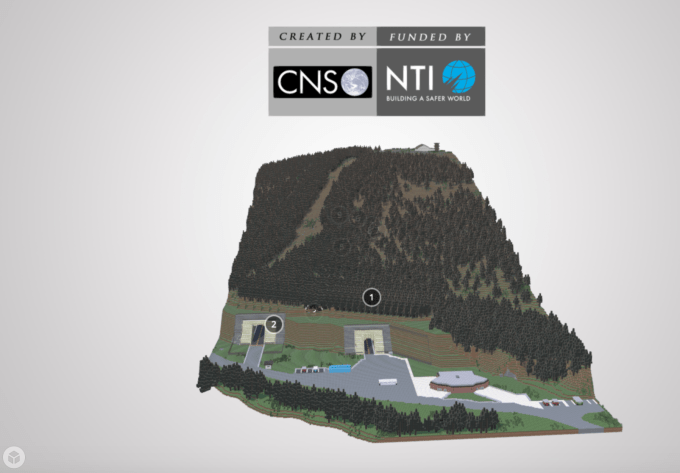
Nothing better illustrates the continuing absurdity of plans to fight a nuclear war than the massive complex of underground bunkers that the United States and Russia have built to survive and fight on even after both societies have collapsed. To help explain the scale of these facilities, we have reconstructed two, Site R in rural Pennsylvania (also known as Raven Rock) and the Kosvinsky underground command facility in Russia, roughly to scale using the popular immersive gaming platform Minecraft.
For anyone with the game, you can fire up a multiplayer instance of Minecraft, select “direct connect” and put in server address 185.38.151.31:25566 to visit Raven Rock, the underground makeshift Pentagon located near Camp David, or 185.38.151.2:25566 to tool around Kosvinsky, “a survivable command post” that serves as Russia’s equivalent. NTI cautions that it only lets zombies out on the weekends.
For anyone without Minecraft, you can take an in-browser virtual tour on NTI’s post about the project, which is also chock full of interesting nuclear bunker facts that put the existence of such underground facilities in an appropriately dark context. The tour is much clunkier outside the game, but the Minecraft experience actually looks pretty cool in that eerie we-definitely-won’t-survive-but-these-people-probably-will way.